Day 127 of 300 · Week 17
Eighteen weeks: sleep at 4 to 5 months
Last reviewed · 3 min read · 12 sources · Plain-text version
Eighteen weeks: how much sleep babies this age need, why 'sleeping through' varies so much from baby to baby, and the short bedtime routine with the best evidence behind it.
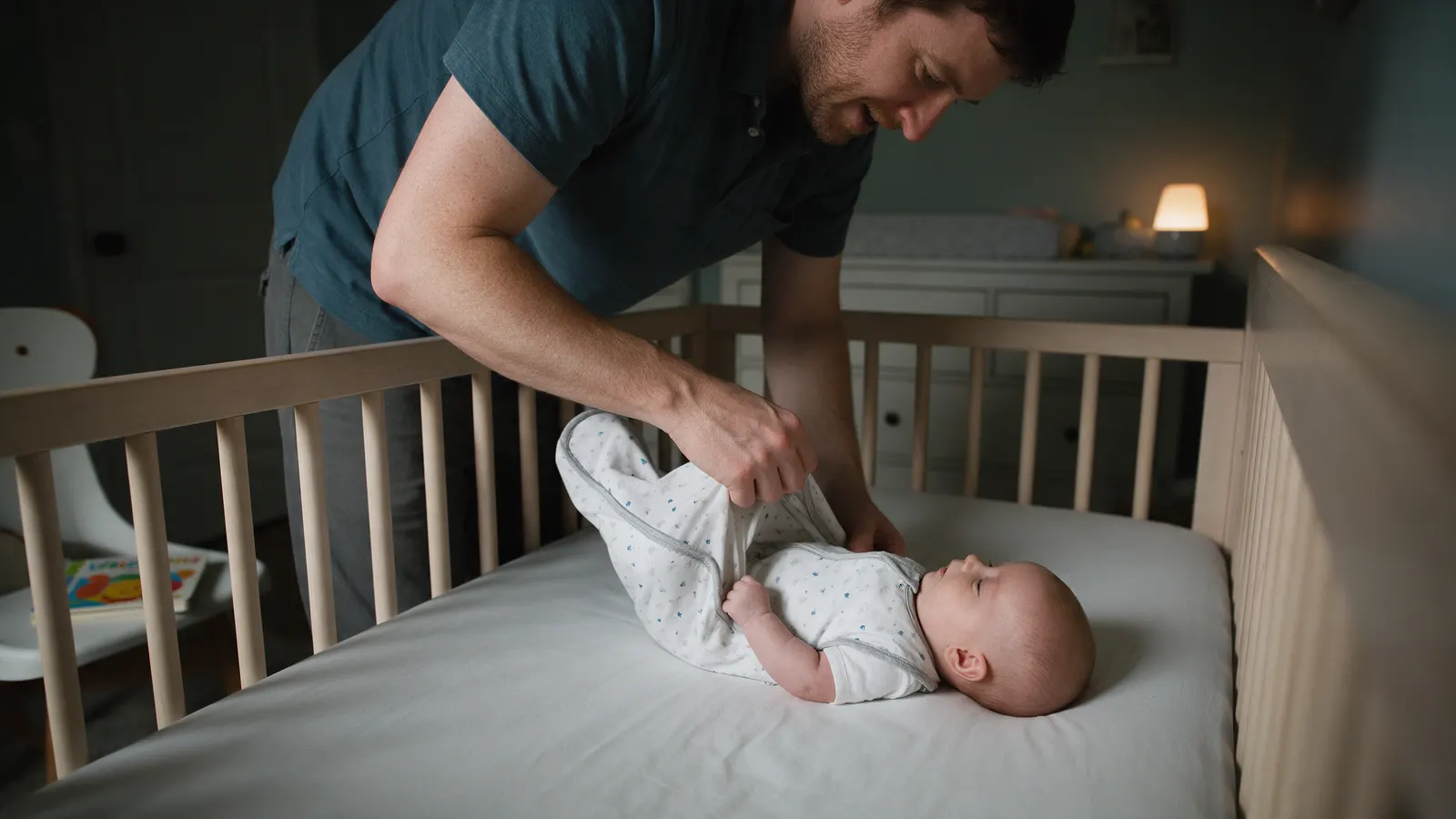
Eighteen weeks. Sleep is the question everyone asks you about now, so here is what's known.
Heart
Babies 4 to 12 months need 12 to 16 hours of sleep in 24 hours, naps included (Paruthi et al., 2016); the AAP supports that guidance and notes that some babies need a bit more or less (AAP). Regular sleep cycles arrive at about 4 months (AAP). What "sleeping through the night" means is the part that varies.
Head
It varies a lot. In a study of 75 New Zealand babies, 21 still weren't sleeping from 10 p.m. to 6 a.m. at 12 months (Henderson et al., 2010). In a Canadian study of 388 babies, 27.9% to 57.0% of 6- and 12-month-olds didn't sleep 6 to 8 hours straight, and that wasn't linked to their development (Pennestri et al., 2018). Night waking at this age is common and normal, whether or not anyone calls it a "4-month sleep regression."
Body
The routine is what the evidence likes. A survey of more than 10,000 mothers linked consistent bedtime routines with better sleep, though it can't prove cause (Mindell et al., 2015), and in a trial of 405 families of babies and toddlers, a consistent bedtime routine improved sleep and mothers' mood within weeks (Mindell et al., 2009). Keep it short and the same each night, and don't put your baby to bed with a bottle (AAP). A regular wake time and active days help too (AAP).
Try today
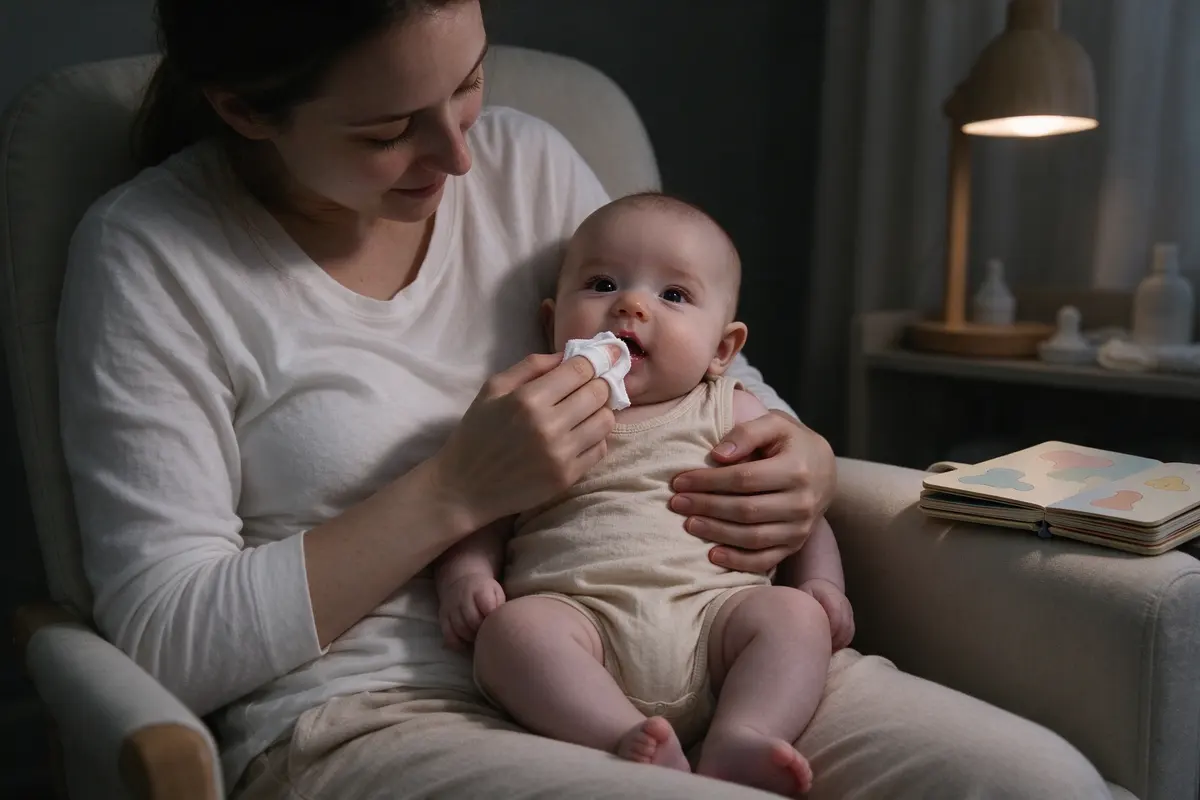
Brush, book, bed
Time: 10 to 15 minutes at the same time each night · Brush, book, bed in the guide
Wipe your baby's gums with a soft, damp cloth (or brush a first tooth with a rice-grain smear of fluoride toothpaste).
Read one short book in dim light.
Lay your baby on their back in their own sleep space at a regular time (AAP).
Make it work:The order is the routine. Same three steps, same lamp, same song if you have one, every night, including the bad ones.
Watch for
Normal
waking at night; in one study, 27.9% to 57.0% of 6- and 12-month-olds didn't sleep 6 to 8 hours straight (Pennestri et al., 2018).
Call your pediatrician within 24 hours
about any fever at 3 to 6 months, and sooner if your baby seems very sick (AAP).
Normal
falling asleep on the breast or bottle. Never put a baby to bed with a bottle (AAP).
Go to the ER now
if your baby is hard to wake or isn't alert when awake (AAP).
Normal
a baby at the edges of the 12-to-16-hour range; some need a bit more or less (AAP).
Call 911
if your baby is struggling for each breath or has bluish lips or face (AAP).
For you
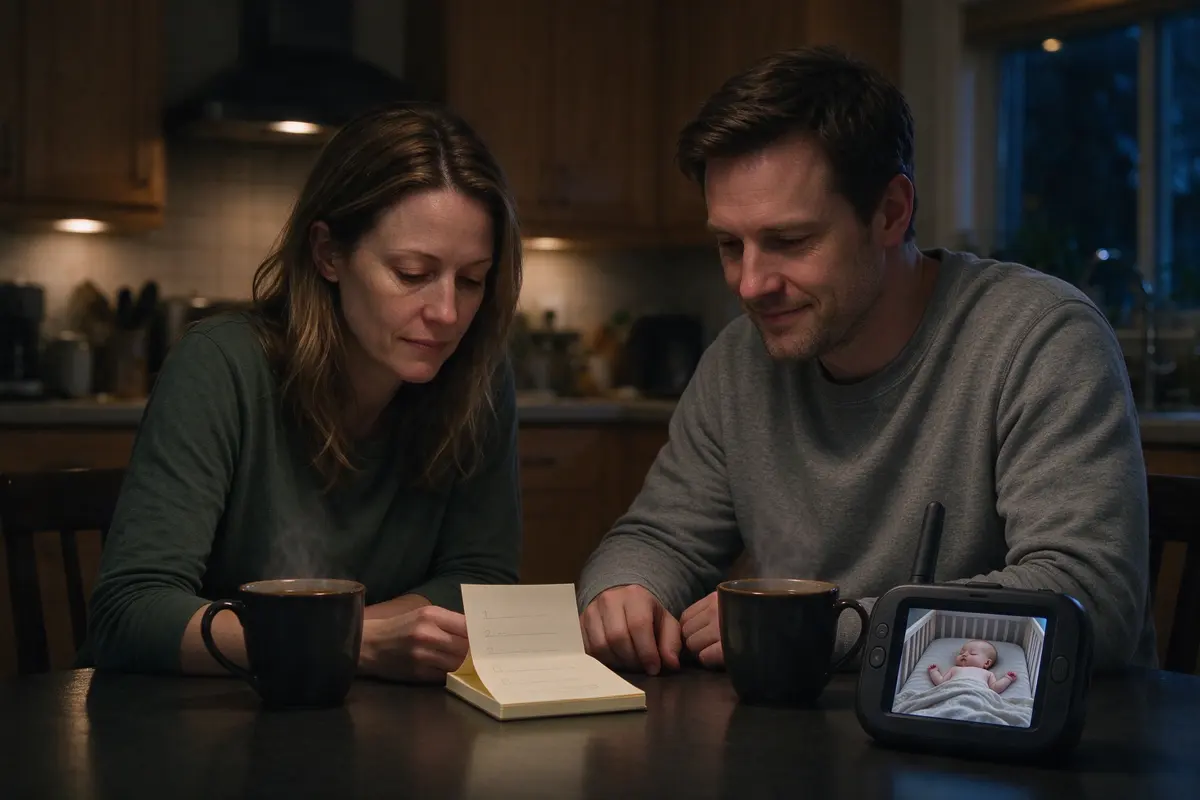
Sleep training is optional. Nobody has to do it, and tomorrow's note is only for those thinking about it. If that's you, here are the questions to bring to the pediatrician: which approach, gradual or checking without soothing; when, since pediatricians generally give the okay at 3 or 4 months (Lurie Children's); what happens to night feeds; and how every safe sleep rule stays in place, back to sleep, a bare crib, and room-sharing for at least the first 6 months (Moon, AAP). Write the four questions on one page tonight.
If you're the partner: this is a two-adult decision. The one who does the 2 a.m. feed doesn't get to decide alone, and neither does the one who doesn't.
Sources
- Paruthi S, Brooks LJ, D'Ambrosio C, et al. "Recommended Amount of Sleep for Pediatric Populations: A Consensus Statement of the American Academy of Sleep Medicine." Journal of Clinical Sleep Medicine, 2016. https://pubmed.ncbi.nlm.nih.gov/27250809/
- American Academy of Pediatrics. "Healthy Sleep Habits: How Many Hours Does Your Child Need?" HealthyChildren.org, 2026. https://www.healthychildren.org/English/healthy-living/sleep/Pages/healthy-sleep-habits-how-many-hours-does-your-child-need.aspx
- American Academy of Pediatrics. "Getting Your Baby to Sleep." HealthyChildren.org, 2024. https://www.healthychildren.org/English/ages-stages/baby/sleep/Pages/getting-your-baby-to-sleep.aspx
- Henderson JM, France KG, Owens JL, Blampied NM. "Sleeping through the night: the consolidation of self-regulated sleep across the first year of life." Pediatrics, 2010. https://pubmed.ncbi.nlm.nih.gov/20974775/
- Pennestri MH, Laganière C, Bouvette-Turcot AA, et al. "Uninterrupted Infant Sleep, Development, and Maternal Mood." Pediatrics, 2018. https://pubmed.ncbi.nlm.nih.gov/30420470/
- Mindell JA, Li AM, Sadeh A, Kwon R, Goh DY. "Bedtime routines for young children: a dose-dependent association with sleep outcomes." Sleep, 2015. https://pubmed.ncbi.nlm.nih.gov/25325483/
- Mindell JA, Telofski LS, Wiegand B, Kurtz ES. "A nightly bedtime routine: impact on sleep in young children and maternal mood." Sleep, 2009. https://pubmed.ncbi.nlm.nih.gov/19480226/
- American Academy of Pediatrics. "Brush, Book, Bed: How to Structure Your Child's Nighttime Routine." HealthyChildren.org, 2024. https://www.healthychildren.org/English/healthy-living/oral-health/Pages/Brush-Book-Bed.aspx
- American Academy of Pediatrics. "Fever" (symptom checker). HealthyChildren.org, 2026. https://www.healthychildren.org/English/tips-tools/symptom-checker/Pages/symptomviewer.aspx?symptom=Fever
- American Academy of Pediatrics. "Breathing Trouble" (symptom checker). HealthyChildren.org, 2026. https://www.healthychildren.org/English/tips-tools/symptom-checker/Pages/symptomviewer.aspx?symptom=Breathing+Trouble
- Freeman I. "How to Sleep Train Your Baby." Lurie Children's Hospital of Chicago, 2022. https://www.luriechildrens.org/en/blog/sleep-training-for-babies/
- Moon RY. "How to Keep Your Sleeping Baby Safe: AAP Policy Explained." HealthyChildren.org, 2026. https://www.healthychildren.org/English/ages-stages/baby/sleep/Pages/a-parents-guide-to-safe-sleep.aspx
This guide is general education that summarizes published research and guidance from groups like the American Academy of Pediatrics, the CDC, and the WHO. It isn’t medical advice, and every child develops on their own timeline. Your pediatrician knows your child; if something feels wrong, call them. In an emergency, call 911.
Get each day’s note the morning it applies
Add your baby to a free Chorevia household with their date of birth, and every morning for 300 days the day’s note arrives in the app and by email: what’s developing, one thing to try, what to watch for, and a word for you.
Create your household