Day 140 of 300 · Week 19
Twenty weeks: safe sleep for a roller
Last reviewed · 4 min read · 9 sources · Plain-text version
Rolling changes the rules: the swaddle ends at the first attempt, the back is still where every sleep starts, and a baby who rolls both ways can be left. Walk the crib tonight.
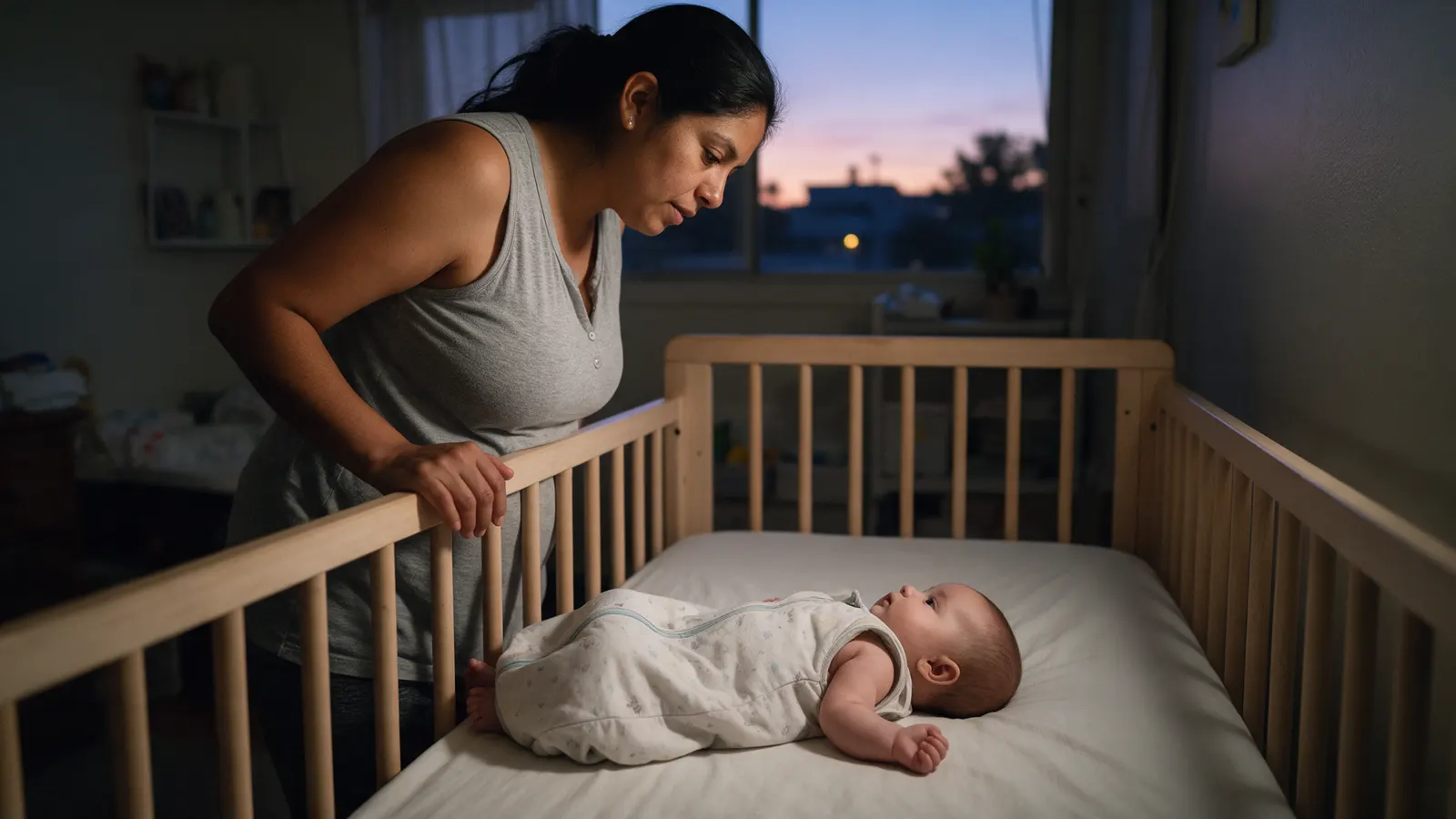
Twenty weeks. The rocking on the tummy, the swimming arms, the sideways lurch in the crib: rolling is close or here, and it changes a few sleep rules without changing the big one.
Heart
Rocking on the tummy, kicking, and "swimming" with the arms usually appear at about 5 months and lead to rolling. Most babies roll tummy to back first, and many roll both ways by 7 months (AAP); the AAP's safe sleep guidance notes that rolling often begins around 3 to 4 months and can start earlier (Moon, AAP). The first rule to change is the swaddle: stop at the first signs of rolling, and a sleep sack that lets your baby move freely is fine (AAP). If any swaddle is still in the rotation, tonight is its last night.
Head
Every newborn rule still applies: on the back for every sleep, a firm, flat surface with only a fitted sheet, and room-sharing without bed-sharing for at least the first 6 months (Moon, AAP). What's new is what you do when you find them on their tummy. Once your baby rolls both ways on their own, you don't need to keep turning them onto their back, as long as the crib is bare (Moon, AAP). Both ways is the test: a baby who gets onto their tummy but not back off it gets turned over, every time.
Body
Try today
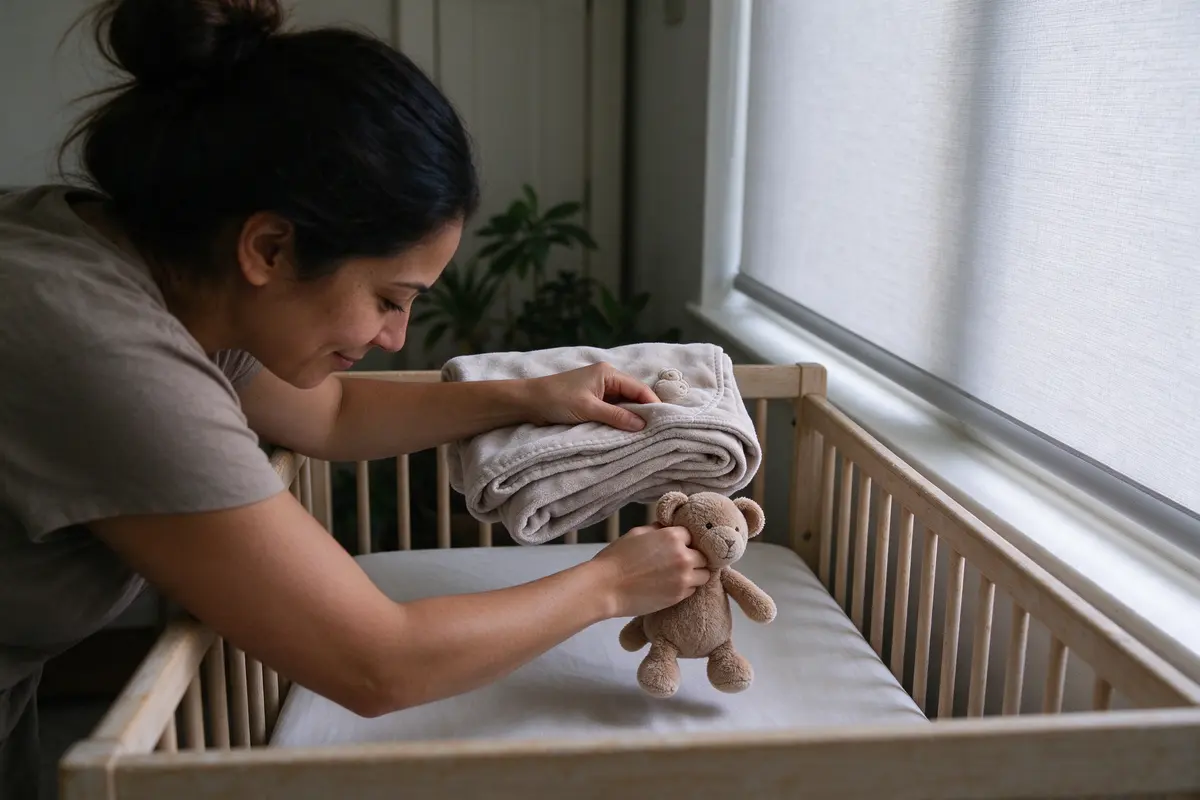
The bare-crib audit
Time: 10 minutes, in daylight
Strip the crib to the mattress and put back only the fitted sheet; no bumper, pillow, blanket, toy, or positioner goes back in (Moon, AAP).
Retire any swaddle to the donation bag, and lay out a sleep sack that leaves the arms and hips free (AAP).
Stand where your baby's hands will reach from the rail: move cords, monitors, and anything hanging out of reach (AAP).
Check the crib is in your room, not your bed, with a clear path for a 3 a.m. walk (Moon, AAP).
Say the rule out loud to whoever else puts the baby down: "Back to start, both ways to stay, nothing else in."
Make it work:Anywhere else the baby sleeps this week, a grandparent's house or a travel crib, gets the same ten minutes.
Watch for
Normal
finding your baby on their side or tummy after you laid them on their back.
Turn them back
every time until they roll both ways on their own; after that, a bare crib means you can leave them (Moon, AAP).
Normal
an arm worked free of a swaddle during the night.
Stop swaddling
at the first signs of rolling (AAP).
Normal
no roll in either direction yet.
Talk with your pediatrician
if your baby doesn't roll either way by 5 months (AAP).
Normal
knowing this baby better than anyone alive.
Call anyway
if your baby just doesn't seem right to you. Trust your instincts; twenty weeks have made them sharp (Lurie Children's).
For you

Room-sharing, not bed-sharing, for at least the first 6 months (Moon, AAP). Twenty weeks in, the pull to move the crib down the hall, or the baby in beside you, gets stronger. Neither is this month's move. Plan for the drowsy feeds instead: skip the couch and armchair, clear the bedding, set an alarm, and if you nod off, move your baby to their own sleep space as soon as you wake (Moon, AAP).
Bank sleep where you can: nap when your baby naps, and go to bed right after the last feed (Moon, AAP). A rolling baby in a bare crib an arm's length away is what lets you actually sleep.
If you're the partner: the audit is yours tomorrow morning, in daylight, and you say the rule back to her so she hears it from you.
Sources
- American Academy of Pediatrics. "Movement Milestones: Babies 4 to 7 Months." HealthyChildren.org, updated 2021. https://www.healthychildren.org/English/ages-stages/baby/Pages/Movement-4-to-7-Months.aspx
- Moon RY. "How to Keep Your Sleeping Baby Safe: AAP Policy Explained." HealthyChildren.org, updated 2026. https://www.healthychildren.org/English/ages-stages/baby/sleep/Pages/a-parents-guide-to-safe-sleep.aspx
- Moon RY, Glassy D. "Swaddling: Is it Safe for Your Baby?" HealthyChildren.org, updated 2022. https://www.healthychildren.org/English/ages-stages/baby/diapers-clothing/Pages/Swaddling-Is-it-Safe.aspx
- American Academy of Pediatrics. "Home Safety: Tips for Families With Young Children." HealthyChildren.org, updated 2022. https://www.healthychildren.org/English/safety-prevention/at-home/Pages/home-safety-heres-how.aspx
- American Academy of Pediatrics. "Changing Table Safety." HealthyChildren.org, updated 2009. https://www.healthychildren.org/English/safety-prevention/at-home/Pages/Changing-Table-Safety.aspx
- American Academy of Pediatrics. "Checkup Checklist: 2 Months Old." HealthyChildren.org, updated 2021. https://www.healthychildren.org/English/ages-stages/Your-Childs-Checkups/Pages/Your-Checkup-Checklist-2-Months-Old.aspx
- American Academy of Pediatrics. "Developmental Milestones: 7 Months." HealthyChildren.org, updated 2009. https://www.healthychildren.org/English/ages-stages/baby/Pages/Developmental-Milestones-7-Months.aspx
- Latimer T. "When to Call the Pediatrician for Your Newborn." Lurie Children's Hospital of Chicago, 2022. https://www.luriechildrens.org/en/blog/when-to-call-the-pediatrician-for-your-newborn/
- Moon RY. "Safe Sleep Tips for Sleep-Deprived New Parents." HealthyChildren.org, updated 2026. https://www.healthychildren.org/English/ages-stages/baby/sleep/Pages/safe-sleep-tips-for-sleep-deprived-parents.aspx
This guide is general education that summarizes published research and guidance from groups like the American Academy of Pediatrics, the CDC, and the WHO. It isn’t medical advice, and every child develops on their own timeline. Your pediatrician knows your child; if something feels wrong, call them. In an emergency, call 911.
Get each day’s note the morning it applies
Add your baby to a free Chorevia household with their date of birth, and every morning for 300 days the day’s note arrives in the app and by email: what’s developing, one thing to try, what to watch for, and a word for you.
Create your household