Day 138 of 300 · Week 19
Lap bounce songs
Last reviewed · 3 min read · 11 sources · Plain-text version
Feet on your thighs, hands under the arms, and a rhyme with a pause before the big finish: leg strength, rhythm, and laughter in one song. Plus a word about your pelvic floor.
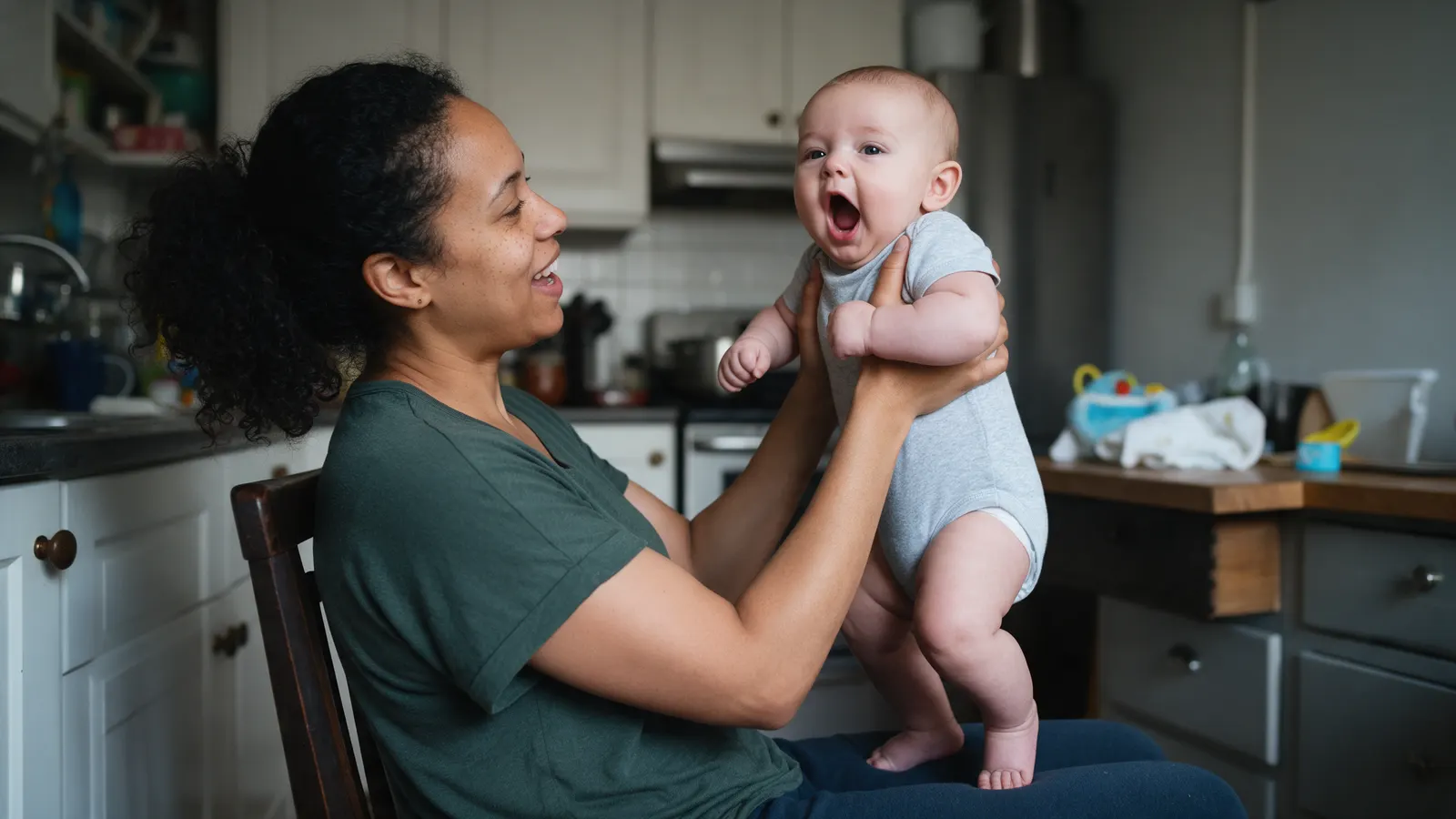
This is the game your grandmother played with you, and it still works. A song, a lap, and a pause before the ending.
Heart
CDC suggests holding your baby under the arms with their feet on your lap and letting them bounce (CDC). Add a rhyme and you have leg strength, rhythm, and laughter in one. Chuckling when you try to make them laugh is a 4-month milestone, and a full laugh is on the 6-month list (CDC; CDC). Lap bounce songs are the most reliable way I know to find out which one your baby has today.
Head
The pause is the clever part. When you stop before the last line, your baby's body tells you they know what's coming, and that's memory at work: in a classic experiment, a brief reminder let 3-month-olds hold on to a learned game for 2 to 4 weeks (Rovee-Collier et al., 1980). The song is also a conversation. Babies whose adult partner answered in a back-and-forth rhythm made more speech-like sounds than babies whose partner responded at random (Bloom et al., 1987), so when a squeal fills your pause, answer it, then finish the verse.
Body
Your hands do the holding. Keep it gentle and always support the head and trunk (CDC). By 4 months, most babies hold their head steady when you hold them (CDC); the legs push and the head wobbles a little, and your grip under the arms takes the rest. This is a lap, not a walker: the AAP says wheeled walkers aren't safe and don't help babies learn to walk (AAP). The bouncing your baby does on you is the real practice.
Try today
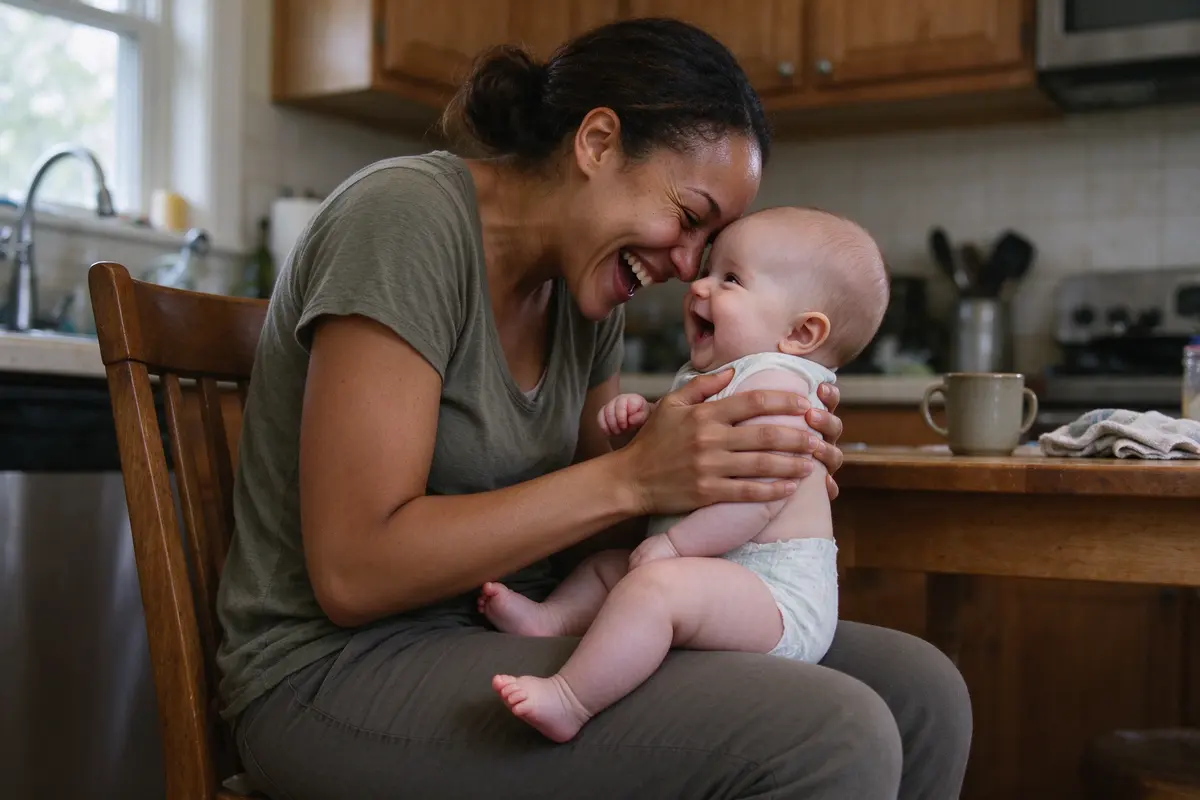
Lap bounce songs
Time: A song or two · Lap bounce songs in the guide
Sit with your baby facing you, their feet flat on your thighs.
Hold them securely under the arms, thumbs on their chest, and let them push and bounce (CDC).
Sing a rhyme you know by heart, bouncing on the beat, and stop before the last line.
Wait for the kick, the squeal, or the stare, then deliver the big finish: a dip, a lift, a kiss.
Once more, then down to the floor for tummy time while the legs are warm.
Make it work:Always support the head and trunk; the dip and lift are small, and the baby's feet never leave your lap for a toss.
Watch for
Normal
legs that fold one bounce and push the next, and a head that bobs then steadies.
Bring it up with your pediatrician
if your baby's head still flops back when pulled up to sitting between 4 and 7 months, or if they seem very stiff or very floppy (AAP).
Normal
a cough or hiccup in the middle of a laugh.
Go to the ER now
for any trouble breathing, or ribs pulling in with each breath (AAP).
Normal
a baby who wants the song six more times.
Call your pediatrician right away
if your baby has a fever of 104°F (40°C) or higher, or cries when touched or moved (AAP).
For you
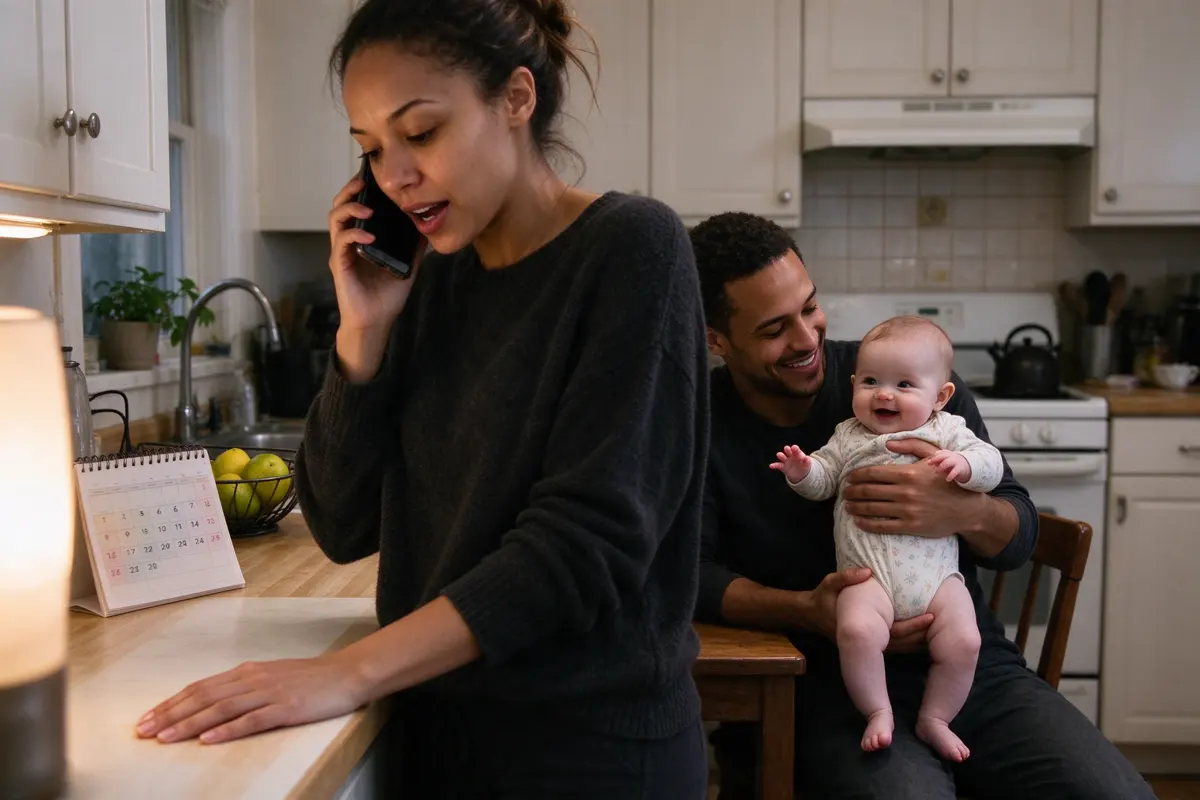
Your pelvic floor on the bounce. If you leak when you laugh, bounce, cough, or sneeze, or feel heaviness low down, that's a question for your provider in those exact words, not something to live with. The postpartum visit is about six weeks after birth (OWH), and ACOG wants a full visit, covering recovery, no later than 12 weeks (ACOG, 2018). At nineteen weeks, if it hasn't happened, it's overdue; book it this week. If it happened and nobody asked, call and ask.
After a C-section, don't lift anything heavier than your baby for the first 6 to 8 weeks (MedlinePlus); that window has closed for most, but a lap bounce still asks nothing of your core that you can't give.
If you're the partner: the bounce is a two-person song. You do the bouncing tonight; she lies on the floor with her feet up and sings the words.
Sources
- Centers for Disease Control and Prevention. "Milestones by 4 Months." Learn the Signs. Act Early., updated 2026. https://www.cdc.gov/act-early/milestones/4-months.html
- Centers for Disease Control and Prevention. "Milestones by 6 Months." Learn the Signs. Act Early., updated 2026. https://www.cdc.gov/act-early/milestones/6-months.html
- Rovee-Collier CK, Sullivan MW, Enright M, Lucas D, Fagen JW. "Reactivation of infant memory." Science, 1980. https://pubmed.ncbi.nlm.nih.gov/7375924/
- Bloom K, Russell A, Wassenberg K. "Turn taking affects the quality of infant vocalizations." Journal of Child Language, 1987. https://doi.org/10.1017/s0305000900012897
- American Academy of Pediatrics. "Baby Walkers: A Dangerous Choice." HealthyChildren.org, updated 2022. https://www.healthychildren.org/English/safety-prevention/at-home/Pages/Baby-Walkers-A-Dangerous-Choice.aspx
- American Academy of Pediatrics. "Developmental Milestones: 7 Months." HealthyChildren.org, updated 2009. https://www.healthychildren.org/English/ages-stages/baby/Pages/Developmental-Milestones-7-Months.aspx
- American Academy of Pediatrics. "Breathing Trouble" (symptom checker). HealthyChildren.org, accessed 2026. https://www.healthychildren.org/English/tips-tools/symptom-checker/Pages/symptomviewer.aspx?symptom=Breathing+Trouble
- American Academy of Pediatrics. "Fever" (symptom checker). HealthyChildren.org, accessed 2026. https://www.healthychildren.org/English/tips-tools/symptom-checker/Pages/symptomviewer.aspx?symptom=Fever
- Office on Women's Health. "Recovering from birth." US Department of Health and Human Services. https://womenshealth.gov/pregnancy/childbirth-and-beyond/recovering-birth
- American College of Obstetricians and Gynecologists. "ACOG Committee Opinion No. 736: Optimizing Postpartum Care." Obstetrics & Gynecology, 2018. https://pubmed.ncbi.nlm.nih.gov/29683911/
- MedlinePlus. "Going home after a C-section." National Library of Medicine. https://medlineplus.gov/ency/patientinstructions/000624.htm
This guide is general education that summarizes published research and guidance from groups like the American Academy of Pediatrics, the CDC, and the WHO. It isn’t medical advice, and every child develops on their own timeline. Your pediatrician knows your child; if something feels wrong, call them. In an emergency, call 911.
Get each day’s note the morning it applies
Add your baby to a free Chorevia household with their date of birth, and every morning for 300 days the day’s note arrives in the app and by email: what’s developing, one thing to try, what to watch for, and a word for you.
Create your household