Day 121 of 300 · Week 17
Month five
Last reviewed · 4 min read · 15 sources · Plain-text version
A new month begins: what's coming by 6 months (laughs, raspberries, rolling), corrected age if your baby came early, and the warning signs that are still about you.

Four months done. Here is the road for the next one, and the first thing to try.
Heart
Your baby starts the month with most of the 4-month list behind them: chuckling when you try to make them laugh, cooing back, turning toward your voice, holding a toy you put in their hand, and pushing up onto their forearms (CDC). CDC's checklists describe what at least 75% of babies do by each age, so anything still missing is a reason to ask, not to wait and see (Zubler et al., 2022).
Coming by 6 months: laughing, taking turns making sounds, blowing raspberries, reaching for a toy they want, rolling from tummy to back, and pushing up on straight arms (CDC). That gap between the two lists is month five. If your baby was born early, count by corrected age, their age in weeks minus the weeks born early, until age 2 (AAP).
Head
The big one is rolling. Rocking on the tummy, kicking, and "swimming" with the arms usually appear at about 5 months and lead to it; most babies roll tummy to back first, and many roll both ways by 7 months (AAP). Rolling often begins around 3 to 4 months and can start earlier (Moon, AAP), so the floor, not the bed, is where your baby lives from now on.
Body
Everything they grab goes in the mouth, and that is learning, not a habit to break (CDC). It changes what the house needs; the 4-month guide's safety section covers small objects, batteries, cords, and burns. The floor gets busier too: WHO advises floor play several times a day, at least 30 minutes of tummy time spread through the day, and no more than 1 hour at a time strapped into a stroller, high chair, or carrier (WHO).
Try today

Toy circle tummy time
Time: 5 to 10 minutes, several times a day · Toy circle tummy time in the guide
Lay your baby tummy-down on a firm mat on the floor.
Place 3 or 4 toys in a circle around them, some just out of reach; reaching builds the muscles for rolling and crawling (AAP).
Get down at eye level and cheer each reach and pivot.
Stop when they fuss or arch, and count a stretch on your chest as tummy time too.
Make it work:A review of 16 mostly observational studies linked tummy time to better gross motor development and to rolling and crawling (Hewitt et al., 2020). Short sessions add up.
Watch for
Normal
a baby who hasn't rolled; rolling tummy to back is a 6-month milestone (CDC).
Normal
a drooly, tooth-free mouth; teething typically starts between 4 and 7 months (AAP).
Call your pediatrician within 24 hours
about any fever, a rectal temperature of 100.4°F (38°C) or higher, at 3 to 6 months, and sooner for 104°F (40°C) or a baby who seems very sick (AAP).
Normal
eyes that track together now.
Ask
if an eye still crosses or wanders; that should be going away by 2 to 3 months (AAP).
For you
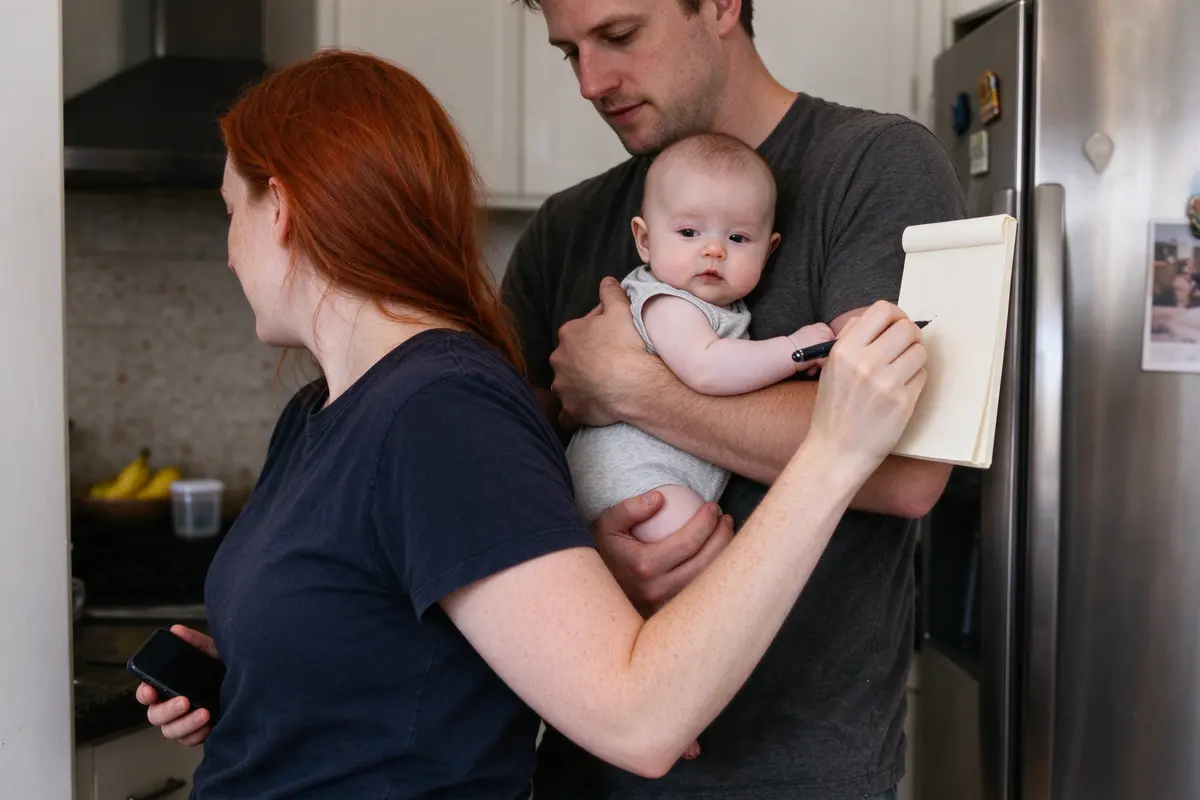
A new month, the same list for you. Seek care immediately for a headache that won't go away or gets worse, changes in vision, chest pain or a fast-beating heart, trouble breathing, a fever of 100.4°F or higher, heavy bleeding, severe belly pain that doesn't go away, extreme swelling of your hands or face, or thoughts about harming yourself or your baby, and tell any provider you were pregnant within the last year (CDC). Their rule for anything that just doesn't feel right is the same as ours: ask.
Low, numb, or frightened still counts, four months in. Call or text 1-833-TLC-MAMA (1-833-852-6262) or 988 (CDC).
If you're the partner: the list above is yours to know too. Four months on, she may not say it first.
Sources
- Centers for Disease Control and Prevention. "Milestones by 4 Months." Learn the Signs. Act Early., 2026. https://www.cdc.gov/act-early/milestones/4-months.html
- Zubler JM, Wiggins LD, Macias MM, et al. "Evidence-Informed Milestones for Developmental Surveillance Tools." Pediatrics, 2022. https://pubmed.ncbi.nlm.nih.gov/35132439/
- Centers for Disease Control and Prevention. "Milestones by 6 Months." Learn the Signs. Act Early., 2026. https://www.cdc.gov/act-early/milestones/6-months.html
- American Academy of Pediatrics. "Corrected Age For Preemies." HealthyChildren.org, 2018. https://www.healthychildren.org/English/ages-stages/baby/preemie/Pages/Corrected-Age-For-Preemies.aspx
- American Academy of Pediatrics. "Movement Milestones: Babies 4 to 7 Months." HealthyChildren.org, 2021. https://www.healthychildren.org/English/ages-stages/baby/Pages/Movement-4-to-7-Months.aspx
- Moon RY. "How to Keep Your Sleeping Baby Safe: AAP Policy Explained." HealthyChildren.org, 2026. https://www.healthychildren.org/English/ages-stages/baby/sleep/Pages/a-parents-guide-to-safe-sleep.aspx
- World Health Organization. "To grow up healthy, children need to sit less and play more." 2019. https://www.who.int/news/item/24-04-2019-to-grow-up-healthy-children-need-to-sit-less-and-play-more
- American Academy of Pediatrics. "Back to Sleep, Tummy to Play: Give Your Baby a Safe, Strong Start." HealthyChildren.org, 2026. https://www.healthychildren.org/English/ages-stages/baby/sleep/Pages/back-to-sleep-tummy-to-play.aspx
- Hewitt L, Kerr E, Stanley RM, Okely AD. "Tummy Time and Infant Health Outcomes: A Systematic Review." Pediatrics, 2020. https://pubmed.ncbi.nlm.nih.gov/32371428/
- Centers for Disease Control and Prevention. "Concerned About Your Child's Development?" 2026. https://www.cdc.gov/act-early/families/concerned.html
- American Academy of Pediatrics. "When Does Teething Start?" HealthyChildren.org, 2024. https://www.healthychildren.org/English/ages-stages/baby/teething-tooth-care/Pages/Teething-4-to-7-Months.aspx
- American Academy of Pediatrics. "Fever" (symptom checker). HealthyChildren.org, 2026. https://www.healthychildren.org/English/tips-tools/symptom-checker/Pages/symptomviewer.aspx?symptom=Fever
- American Academy of Pediatrics. "Infant Vision Development: What Can Babies See?" HealthyChildren.org, 2024. https://www.healthychildren.org/English/ages-stages/baby/Pages/Babys-Vision-Development.aspx
- Centers for Disease Control and Prevention. "Urgent Maternal Warning Signs and Symptoms." HEAR HER, 2024. https://www.cdc.gov/hearher/maternal-warning-signs/index.html
- Centers for Disease Control and Prevention. "Symptoms of Depression Among Women." 2024. https://www.cdc.gov/reproductive-health/depression/index.html
This guide is general education that summarizes published research and guidance from groups like the American Academy of Pediatrics, the CDC, and the WHO. It isn’t medical advice, and every child develops on their own timeline. Your pediatrician knows your child; if something feels wrong, call them. In an emergency, call 911.
Get each day’s note the morning it applies
Add your baby to a free Chorevia household with their date of birth, and every morning for 300 days the day’s note arrives in the app and by email: what’s developing, one thing to try, what to watch for, and a word for you.
Create your household