Day 120 of 120 · Four months
Four months
Last reviewed · 4 min read · 14 sources · Plain-text version
The 4-month list as a celebration, not a score: chuckles, a steady head, hands that grab, a voice that answers. A third of a year done, and the next guide.

Four months. A third of a year. Today's list is for celebrating, and nobody is keeping score.
Heart
By about now, many babies smile on their own to get your attention, chuckle when you try to make them laugh, look at you or move or make sounds to keep your attention, coo, make sounds back, turn toward your voice, open their mouth at the sight of the breast or bottle, look at their hands, hold their head steady when held, hold a toy you put in their hand, swing at toys, bring hands to mouth, and push up on forearms on their tummy (CDC). Those are the skills at least 75% of babies show by 4 months (Zubler et al., 2022); a missing one is a question for your pediatrician, not a grade. Born early? Corrected age, for the first 2 years (AAP).
Head
The first laugh, if it hasn't come, is close. Laughter first appears at about 4 months on average (Mireault et al., 2015); chuckles are the 4-month milestone and full laughs the 6-month one, so the window is wide (CDC; CDC). Your own laughter helps your baby figure out what's funny (Mireault et al., 2015), which is why the first one is almost always at something you did.
Body
A third of a year of feeding, holding, floor time, and nights. Longer night stretches are common now, not universal: in a London video study of 101 babies, 45% slept at least 5 hours straight by 3 months (St James-Roberts et al., 2015). Rolling, for the babies who've started, usually begins around 3 to 4 months (Moon, AAP). Whatever your baby's numbers are, they got there with you.
Try today

The laugh collection
Time: 5 minutes tonight, then whenever a new one turns up · Raspberry laugh game in the guide
Write down, or record, three things that got a chuckle this month: a raspberry on the belly, a sound, a face, a song.
Try each one now, and laugh along; your reaction is part of the game (Mireault et al., 2015).
Mark which worked and which got a stare, and stop while it's still fun.
Keep the list on the fridge where a sitter or grandparent can find it.
Make it work:In the second half of the first year, babies start laughing at silly surprises, like a parent putting a book on their head (Mireault et al., 2015). Leave room on the list.
Watch for
Normal
a chuckle, not a laugh, and some days neither.
Raise it with your pediatrician
if your baby doesn't smile on their own by 5 months (AAP).
Normal
a stuffy nose from the fourth-month cold.
Go to the ER now
for any trouble breathing, including ribs pulling in with each breath or wheezing, and call 911 if your baby is struggling to breathe or has bluish lips or face (AAP).
Normal
at 3 to 6 months, a fever is a call within 24 hours;
Normal
not being sure whether something is wrong.
Call anyway
if your baby just doesn't seem right to you. Trust your instincts (Lurie Children's).
For you
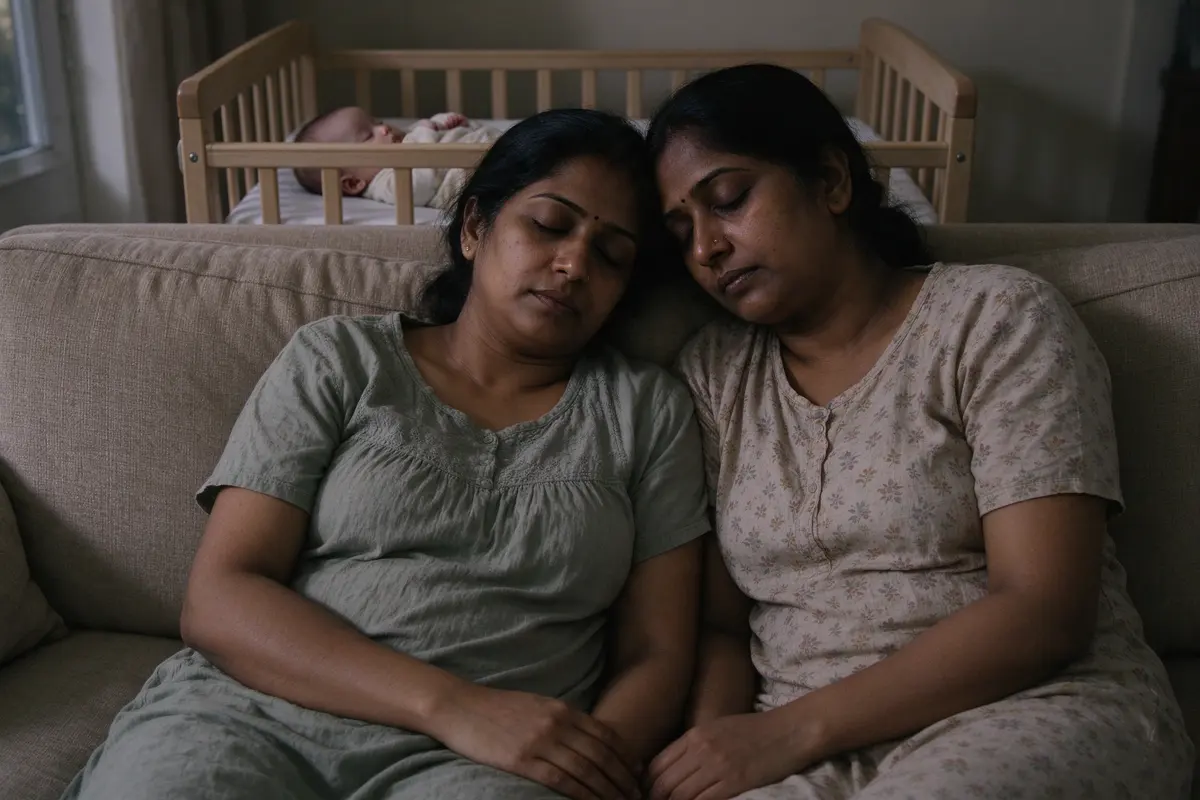
You did a third of a year. Nobody will give you the certificate, so here it is: one hundred and twenty days of answering, every one of them. If the mood underneath is heavier than tired, low mood, anxiety, or emptiness that is severe or lasts more than 2 weeks may be postpartum depression, and it responds to treatment (NIMH). Four months in is still early to ask for help, not late.
Once more, lightly: the National Maternal Mental Health Hotline is 1-833-TLC-MAMA (1-833-852-6262), call or text, and 988 is for anyone (CDC).
If you're the partner: you did it too, and the hotlines are yours as well. Tonight, say one thing she did this month that you noticed. Then go read what's next, together: the 4-month guide.
Sources
- Centers for Disease Control and Prevention. "Milestones by 4 Months." Learn the Signs. Act Early., 2026. https://www.cdc.gov/act-early/milestones/4-months.html
- Zubler JM, Wiggins LD, Macias MM, et al. "Evidence-Informed Milestones for Developmental Surveillance Tools." Pediatrics, 2022. https://pubmed.ncbi.nlm.nih.gov/35132439/
- American Academy of Pediatrics. "Corrected Age For Preemies." HealthyChildren.org, 2018. https://www.healthychildren.org/English/ages-stages/baby/preemie/Pages/Corrected-Age-For-Preemies.aspx
- Mireault GC, Crockenberg SC, Sparrow JE, et al. "Laughing matters: Infant humor in the context of parental affect." Journal of Experimental Child Psychology, 2015. https://pubmed.ncbi.nlm.nih.gov/25897958/
- Centers for Disease Control and Prevention. "Milestones by 6 Months." Learn the Signs. Act Early., 2026. https://www.cdc.gov/act-early/milestones/6-months.html
- St James-Roberts I, Roberts M, Hovish K, Owen C. "Video Evidence That London Infants Can Resettle Themselves Back to Sleep After Waking in the Night, as well as Sleep for Long Periods, by 3 Months of Age." Journal of Developmental and Behavioral Pediatrics, 2015. https://pubmed.ncbi.nlm.nih.gov/26035139/
- Moon RY. "How to Keep Your Sleeping Baby Safe: AAP Policy Explained." HealthyChildren.org, 2026. https://www.healthychildren.org/English/ages-stages/baby/sleep/Pages/a-parents-guide-to-safe-sleep.aspx
- American Academy of Pediatrics. "Developmental Milestones: 7 Months." HealthyChildren.org, 2009. https://www.healthychildren.org/English/ages-stages/baby/Pages/Developmental-Milestones-7-Months.aspx
- American Academy of Pediatrics. "Breathing Trouble" (symptom checker). HealthyChildren.org, 2026. https://www.healthychildren.org/English/tips-tools/symptom-checker/Pages/symptomviewer.aspx?symptom=Breathing+Trouble
- American Academy of Pediatrics. "Fever and Your Baby." HealthyChildren.org, 2025. https://www.healthychildren.org/English/health-issues/conditions/fever/Pages/Fever-and-Your-Baby.aspx
- American Academy of Pediatrics. "Fever" (symptom checker). HealthyChildren.org, 2026. https://www.healthychildren.org/English/tips-tools/symptom-checker/Pages/symptomviewer.aspx?symptom=Fever
- Latimer T. "When to Call the Pediatrician for Your Newborn." Lurie Children's Hospital of Chicago, 2022. https://www.luriechildrens.org/en/blog/when-to-call-the-pediatrician-for-your-newborn/
- National Institute of Mental Health. "Perinatal Depression." 2026. https://www.nimh.nih.gov/health/publications/perinatal-depression
- Centers for Disease Control and Prevention. "Symptoms of Depression Among Women." 2024. https://www.cdc.gov/reproductive-health/depression/index.html
This guide is general education that summarizes published research and guidance from groups like the American Academy of Pediatrics, the CDC, and the WHO. It isn’t medical advice, and every child develops on their own timeline. Your pediatrician knows your child; if something feels wrong, call them. In an emergency, call 911.
Get each day’s note the morning it applies
Add your baby to a free Chorevia household with their date of birth, and every morning for 120 days the day’s note arrives in the app and by email: what’s developing, one thing to try, what to watch for, and a word for you.
Create your household