Day 112 of 120 · Week 16
The 4-month checkup
Last reviewed · 4 min read · 16 sources · Plain-text version
What today's visit covers, the second round of shots, how to make them easier (feed or suck, no medicine beforehand), what's normal after, and the screen that's about you.

Checkup day. Here is what happens, how to make the shots easier, and what to expect tonight.
Heart
Expect measurements, an exam, and questions about sleep, feeding, and safety (AAP). Under the AAP schedule, babies may get second doses of rotavirus, DTaP, Hib, pneumococcal, and polio vaccines at this visit (AAP). The AAP's 2026 schedule differs from CDC's (AAP), and in March 2026 a federal judge paused the CDC's January 2026 changes while the court fight continues (KFF, 2026). Ask which schedule the practice follows, and bring the question page.
Head
Comfort works; medicine beforehand doesn't. A Cochrane review of 10 trials (1,066 babies) found breastfeeding during vaccination cut crying by about 38 seconds compared with water or nothing (Harrison et al., 2016), and a 2026 guideline strongly recommends oral comfort such as feeding or sucking for babies, and advises against video distraction for infants (Taddio et al., 2026). In two trials with 459 babies, preventive acetaminophen at vaccination cut fevers but also lowered antibody responses to several vaccines (Prymula et al., 2009). The AAP says no acetaminophen under 2 without a doctor's guidance (AAP) and no ibuprofen before 6 months unless your doctor says to (AAP).
Body
Tonight and tomorrow: soreness, redness, and swelling at the spot usually start within a day and last 3 to 5 days (up to 7 with DTaP); fussiness, restless sleep, extra sleep, and eating a little less usually pass within 24 to 48 hours. A warm, wet washcloth on the spot for 10 minutes and gentle massage can help, and under 6 months the only fluids are breast milk or formula (AAP).
Try today
Shot-day comfort, round two
Time: The minutes before, during, and right after each shot · After the 2-month shots in the guide
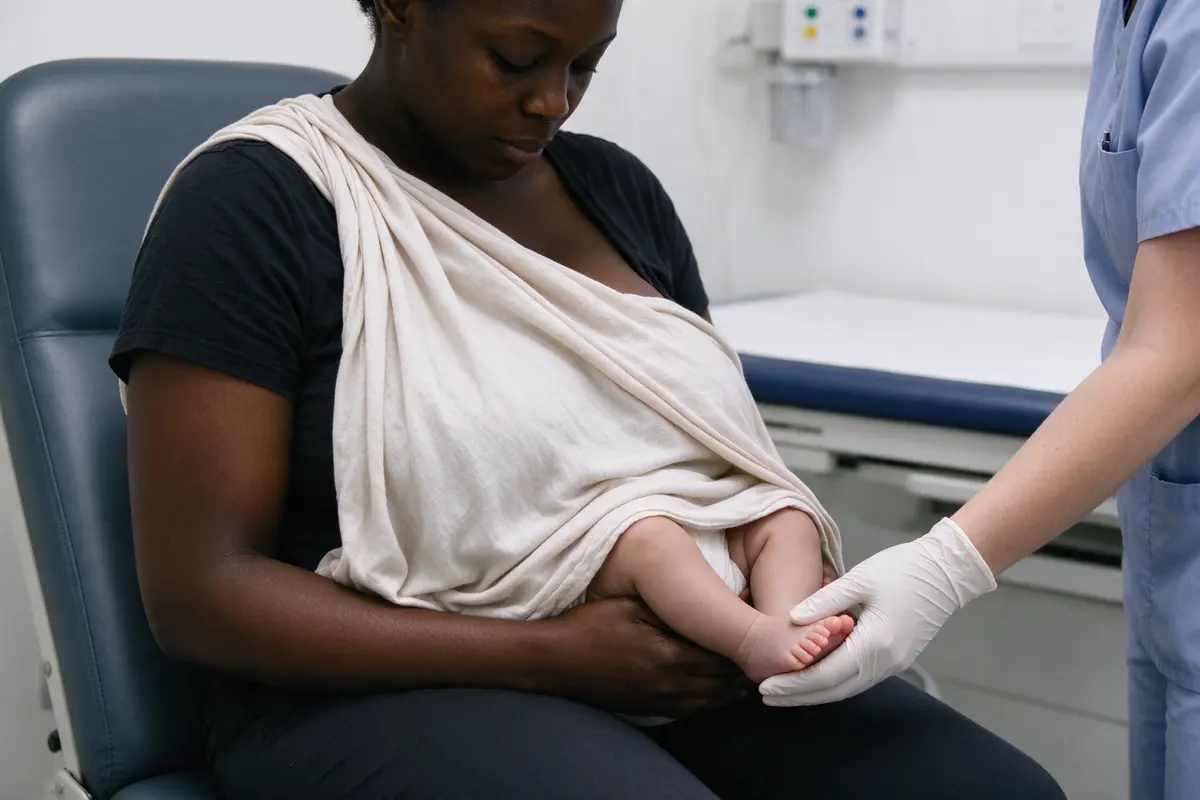
Hold your baby on your lap the way the nurse asks, with your face in view.
Start a breastfeed, bottle, or pacifier just before the first needle and keep it going during and right after (Harrison et al., 2016; Taddio et al., 2026).
Keep the phone in your pocket; video distraction isn't advised for infants (Taddio et al., 2026).
Afterward, stay seated and hold until the crying settles, then feed again if they want it.
At home, if the leg looks sore, a warm wet washcloth for 10 minutes (AAP).
Make it work:No medicine beforehand (Prymula et al., 2009); if you think your baby needs something afterward, that's a call to the office, not the cabinet (AAP).
Watch for
- Normal: a fussy evening and a sore leg. Call your pediatrician now for nonstop crying that lasts more than 3 hours after any shot (AAP).
- Normal: in babies past 12 weeks, a low fever on day 1 or 2 after shots (AAP). At 3 to 6 months, call within 24 hours about any fever, and call right away for a rectal temperature of 101°F (38.3°C) or higher (AAP; AAP).
- Normal: a little less appetite tonight. Call your pediatrician now for vomiting or severe crying in the week after the rotavirus vaccine; about 1 in 20,000 to 1 in 100,000 US babies who get it develop intussusception, a bowel blockage (CDC; AAP).
- Go to the ER now for any trouble breathing, or a fever with a bulging soft spot or a baby who isn't alert when awake (AAP; AAP).
For you

Answer the screen honestly. The pediatrician will ask how you're doing (AAP), and perinatal depression can be treated effectively (Earls et al., 2019). About 1 in 8 women report symptoms of postpartum depression after a birth (CDC). If a sentence helps: "I'm not sleeping even when the baby sleeps, and I feel numb. Is that normal?" Four months in is not too late to say it.
If you're the partner: come if you can; one adult holds, the other asks. About 8% to 10% of fathers have depression during pregnancy or the year after birth (Cameron et al., 2016), so when they ask how the family is doing, answer for yourself too.
Sources
- American Academy of Pediatrics. "Checkup Checklist: 4 Months Old." HealthyChildren.org, 2023. https://www.healthychildren.org/English/ages-stages/Your-Childs-Checkups/Pages/Your-Checkup-Checklist-4-Months-Old.aspx
- American Academy of Pediatrics. "AAP Releases Recommended Childhood and Adolescent Immunization Schedule for 2026." HealthyChildren.org, 2026. https://www.healthychildren.org/English/news/Pages/AAPs-recommended-childhood-and-adolescent-immunization-schedule-for-2026.aspx
- Kates J. "The Court's Opening Shot on Federal Vaccine Policy Changes." KFF, 2026. https://www.kff.org/quick-insights/the-courts-opening-shot-on-federal-vaccine-policy-changes/
- Harrison D, Reszel J, Bueno M, et al. "Breastfeeding for procedural pain in infants beyond the neonatal period." Cochrane Database of Systematic Reviews, 2016. https://pubmed.ncbi.nlm.nih.gov/27792244/
- Taddio A, Shah V, McMurtry CM, et al. "Reducing distress during vaccine injections: 2026 clinical practice guideline update." CMAJ, 2026. https://pubmed.ncbi.nlm.nih.gov/42767684/
- Prymula R, Siegrist CA, Chlibek R, et al. "Effect of prophylactic paracetamol administration at time of vaccination on febrile reactions and antibody responses in children." The Lancet, 2009. https://pubmed.ncbi.nlm.nih.gov/19837254/
- American Academy of Pediatrics. "Acetaminophen Dosing Tables for Fever and Pain in Children." HealthyChildren.org, 2025. https://www.healthychildren.org/English/safety-prevention/at-home/medication-safety/Pages/Acetaminophen-for-Fever-and-Pain.aspx
- American Academy of Pediatrics. "Ibuprofen Dosing Table for Fever and Pain." HealthyChildren.org, 2025. https://www.healthychildren.org/English/safety-prevention/at-home/medication-safety/Pages/Ibuprofen-for-Fever-and-Pain.aspx
- American Academy of Pediatrics. "Immunization Reactions" (symptom checker). HealthyChildren.org, 2026. https://www.healthychildren.org/English/tips-tools/symptom-checker/Pages/symptomviewer.aspx?symptom=Immunization+Reactions
- American Academy of Pediatrics. "Fever" (symptom checker). HealthyChildren.org, 2026. https://www.healthychildren.org/English/tips-tools/symptom-checker/Pages/symptomviewer.aspx?symptom=Fever
- American Academy of Pediatrics. "Fever and Your Baby." HealthyChildren.org, 2025. https://www.healthychildren.org/English/health-issues/conditions/fever/Pages/Fever-and-Your-Baby.aspx
- Centers for Disease Control and Prevention. "Rotavirus Vaccine Safety." 2024. https://www.cdc.gov/vaccine-safety/vaccines/rotavirus.html
- American Academy of Pediatrics. "Breathing Trouble" (symptom checker). HealthyChildren.org, 2026. https://www.healthychildren.org/English/tips-tools/symptom-checker/Pages/symptomviewer.aspx?symptom=Breathing+Trouble
- Earls MF, Yogman MW, Mattson G, Rafferty J. "Incorporating Recognition and Management of Perinatal Depression Into Pediatric Practice." Pediatrics, 2019. https://pubmed.ncbi.nlm.nih.gov/30559120/
- Centers for Disease Control and Prevention. "Symptoms of Depression Among Women." 2024. https://www.cdc.gov/reproductive-health/depression/index.html
- Cameron EE, Sedov ID, Tomfohr-Madsen LM. "Prevalence of paternal depression in pregnancy and the postpartum: An updated meta-analysis." Journal of Affective Disorders, 2016. https://pubmed.ncbi.nlm.nih.gov/27475890/
This guide is general education that summarizes published research and guidance from groups like the American Academy of Pediatrics, the CDC, and the WHO. It isn’t medical advice, and every child develops on their own timeline. Your pediatrician knows your child; if something feels wrong, call them. In an emergency, call 911.
Get each day’s note the morning it applies
Add your baby to a free Chorevia household with their date of birth, and every morning for 120 days the day’s note arrives in the app and by email: what’s developing, one thing to try, what to watch for, and a word for you.
Create your household