Day 108 of 120 · Week 15
Falls: no safe second
Last reviewed · 4 min read · 9 sources · Plain-text version
Rolling can start without warning, and babies this age don't fear edges. Why the changing-table strap isn't enough, what to do if your baby fell, and the floor-change habit.

A baby who could only lie where you put them is becoming a baby who can leave. Today is about the second you turn to reach for the wipes.
Heart
Rolling can start without warning, and babies this age don't fear edges (Dahl et al., 2013). Babies can see depth within a few months (Held et al., 1980), but babies with little or no crawling experience show no wariness of heights; that comes from moving around on their own (Dahl et al., 2013). Your baby can see the edge of the bed and has no idea it matters. You're the only thing between them and the floor, and you can't be that from the next room.
Head
Changing tables: never step away, even for a moment, even with the strap buckled (AAP). Beds and couches: don't leave your baby on adult furniture; among young children hospitalized for furniture falls in one study, a third fell from beds (Pomerantz et al., 2012). Car seats: keep them on the floor. From 2003 to 2007, an estimated 43,562 babies were treated in US ERs for car seat injuries outside the car, mostly from falls (Parikh & Wilson, 2010). The NHS version: not for a second, on a bed, sofa, or changing table (NHS).
Body
If it already happened, from the AAP's symptom guide: call your pediatrician now for any head injury in a baby under 1 year, even if your baby seems fine. Call 911 if your baby has a seizure, was knocked out for more than a minute, is hard to wake, or has bleeding you can't stop. Go to the ER now if your baby vomits 2 or more times, cries nonstop, or seems "out of it" (AAP). Falls from furniture are a common cause of injury hospitalizations in young children, and beds top the list (Pomerantz et al., 2012).
Try today
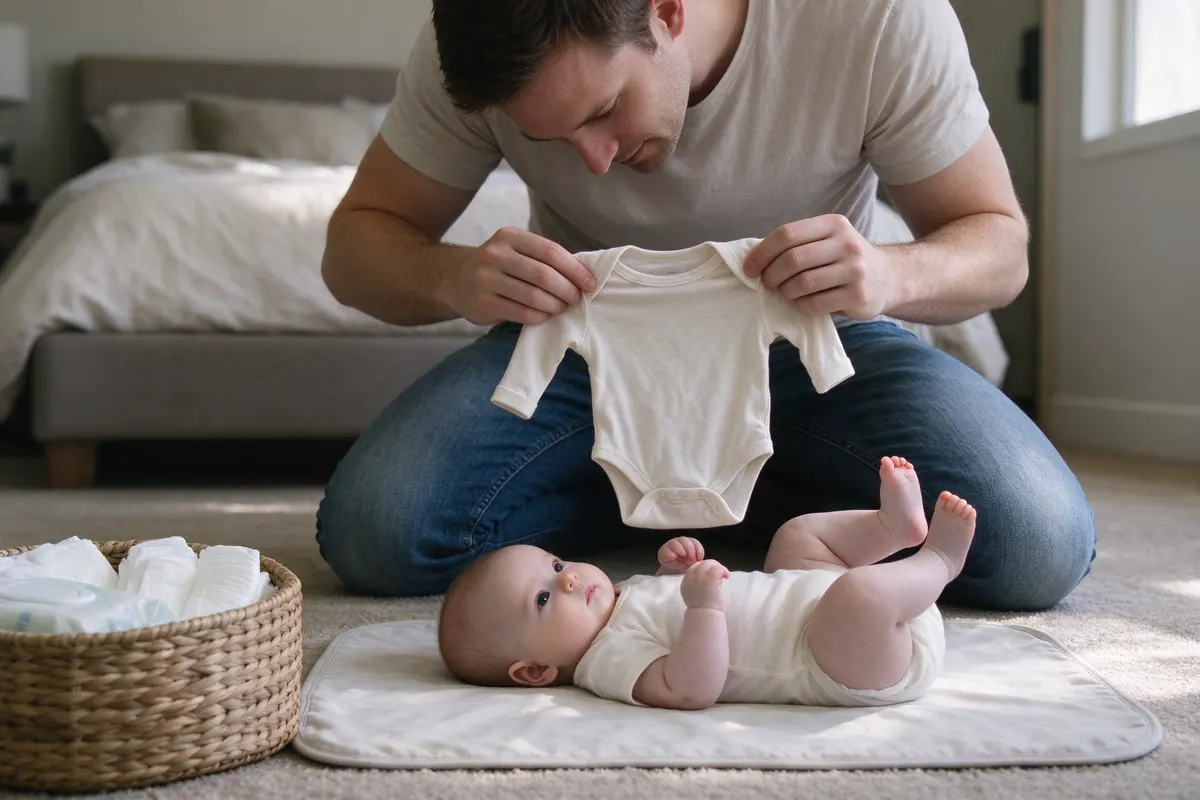
The floor-change habit
Time: Every diaper change from today · Roll-over helper in the guide
Put a changing mat on the floor in the room you change most, with diapers, wipes, and a spare onesie in a basket beside it.
Kneel on one side of the mat and keep one hand on your baby whenever the other is busy.
Change, then let them kick for a minute on the mat; it's a safe place for a roll to happen (AAP).
If you keep the changing table, use it only when everything is laid out first, and never step away (AAP).
Make it work:The floor can't be fallen from. A mat on the rug costs nothing and ends the question.
Watch for
Normal
a half-roll onto the side during a change, or none yet; most babies roll tummy to back first, and rolling both ways often follows by about 7 months (AAP).
Call your pediatrician now
for any head injury under 1 year, even if your baby seems fine (AAP).
Normal
a fussy evening after a scare that turned out fine.
Go to the ER now
if, after a fall, your baby vomits 2 or more times, cries nonstop, or seems "out of it" (AAP).
Normal
a baby who sleeps hard after a big day.
Call 911
after a fall if your baby has a seizure, was knocked out for more than a minute, is hard to wake, or has bleeding you can't stop (AAP).
For you
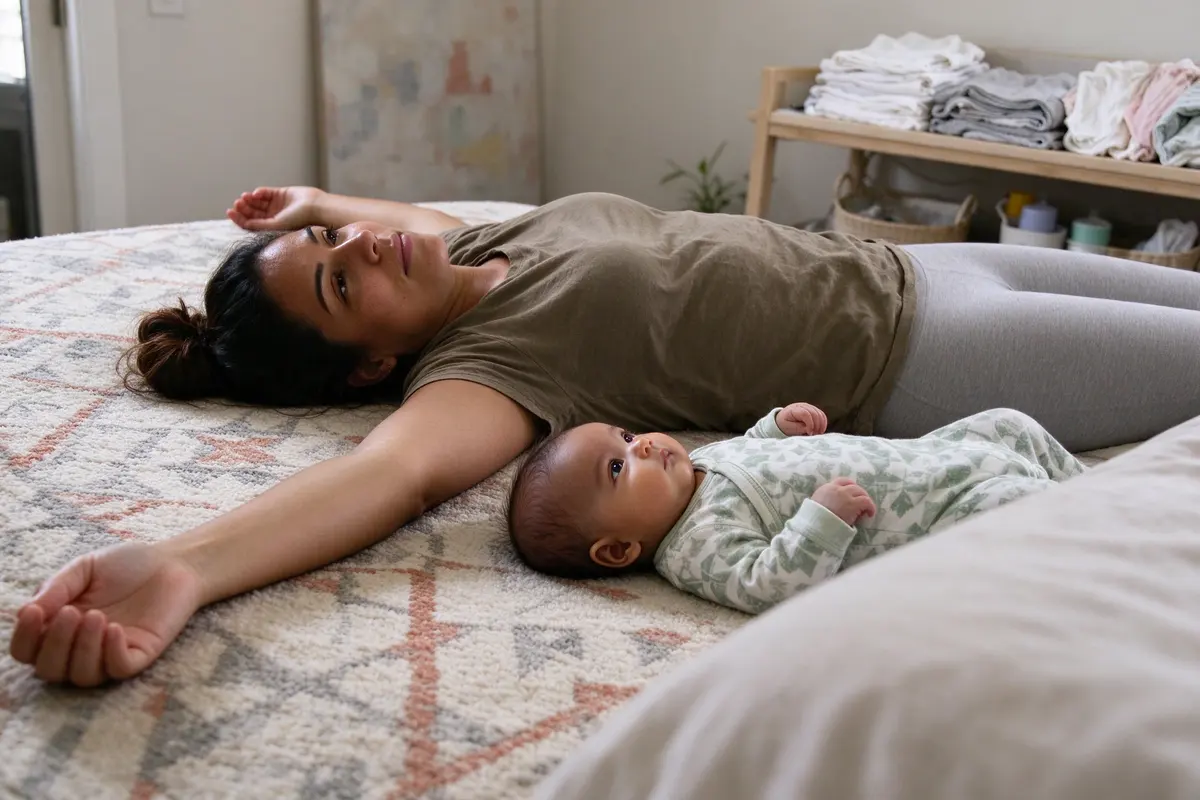
The floor is the safest furniture you own, for you too. Lying flat on the rug beside your baby for five minutes is rest with nothing to hold. After a C-section, most regular activities are back within 4 to 8 weeks (MedlinePlus), so kneeling to change a diaper is yours to do; roll to your side and push up with your arms if the middle of you still complains.
If the fall already happened and you made the call, that was the right thing, and the guilt is the price of caring about the next second. It doesn't need to be paid twice.
If you're the partner: set up the floor station today, basket and all, before she has to ask.
Sources
- Dahl A, Campos JJ, Anderson DI, et al. "The epigenesis of wariness of heights." Psychological Science, 2013. https://pubmed.ncbi.nlm.nih.gov/23722981/
- Held R, Birch E, Gwiazda J. "Stereoacuity of human infants." Proceedings of the National Academy of Sciences, 1980. https://pubmed.ncbi.nlm.nih.gov/6933571/
- American Academy of Pediatrics. "Changing Table Safety." HealthyChildren.org, 2009. https://www.healthychildren.org/English/safety-prevention/at-home/Pages/Changing-Table-Safety.aspx
- Pomerantz WJ, Gittelman MA, Hornung R, Husseinzadeh H. "Falls in children birth to 5 years: different mechanisms lead to different injuries." Journal of Trauma and Acute Care Surgery, 2012. https://pubmed.ncbi.nlm.nih.gov/23026963/
- Parikh SN, Wilson L. "Hazardous use of car seats outside the car in the United States, 2003-2007." Pediatrics, 2010. https://pubmed.ncbi.nlm.nih.gov/20603257/
- National Health Service (UK). "Baby and toddler safety." 2026. https://www.nhs.uk/baby/first-aid-and-safety/safety/baby-and-toddler-safety/
- American Academy of Pediatrics. "Head Injury" (symptom checker). HealthyChildren.org, 2026. https://www.healthychildren.org/English/tips-tools/symptom-checker/Pages/symptomviewer.aspx?symptom=Head+Injury
- American Academy of Pediatrics. "Movement Milestones: Babies 4 to 7 Months." HealthyChildren.org, 2021. https://www.healthychildren.org/English/ages-stages/baby/Pages/Movement-4-to-7-Months.aspx
- MedlinePlus. "Going home after a C-section." National Library of Medicine. https://medlineplus.gov/ency/patientinstructions/000624.htm
This guide is general education that summarizes published research and guidance from groups like the American Academy of Pediatrics, the CDC, and the WHO. It isn’t medical advice, and every child develops on their own timeline. Your pediatrician knows your child; if something feels wrong, call them. In an emergency, call 911.
Get each day’s note the morning it applies
Add your baby to a free Chorevia household with their date of birth, and every morning for 120 days the day’s note arrives in the app and by email: what’s developing, one thing to try, what to watch for, and a word for you.
Create your household