Day 115 of 120 · Week 16
Talk all day
Last reviewed · 4 min read · 16 sources · Plain-text version
Reading from birth, the parentese voice, and copying sounds back with a word added. Why talk aimed at your baby is what counts, and the one screen that's allowed.
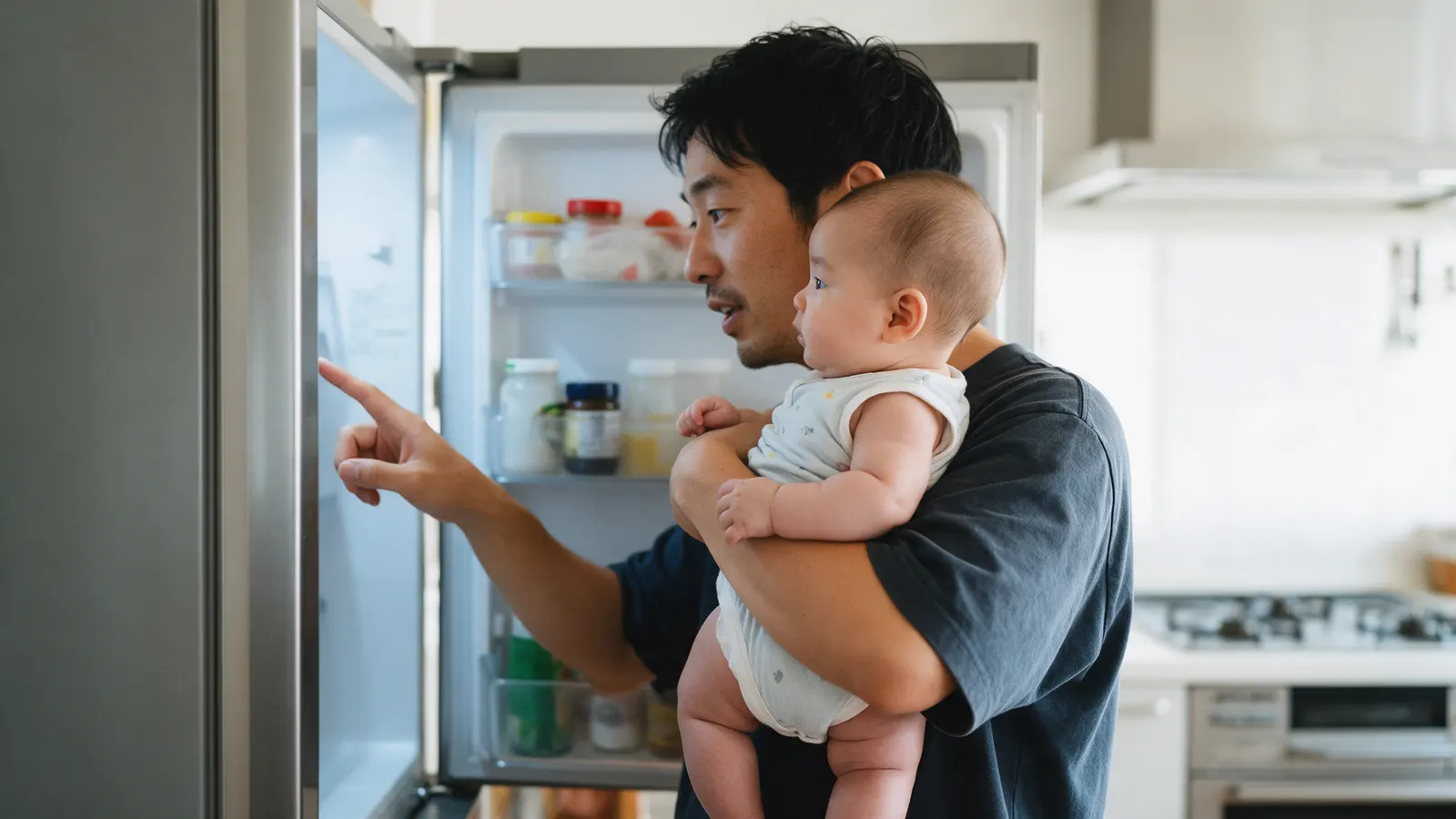
You don't need a lesson plan. You need to keep talking, and today is about how.
Heart
The AAP recommends shared reading from birth (Klass et al., 2024), and in a randomized trial at a New York public hospital clinic, coaching parents to read and play with children from birth to age 3 led to fewer behavior problems at age 4½ (Mendelsohn et al., 2018). The book is the easy part. The rest of the day is the harder, bigger part: the diaper change, the laundry, the kitchen. All of it is language time when you say what you're doing.
Head
Use the voice you already use. Parentese is the higher-pitched, slower, more melodic way adults talk to babies (Ferjan Ramírez et al., 2020), and even 2-day-olds preferred it to adult-style speech in a small lab study (Cooper & Aslin, 1990). The famous "30 million word gap" is contested: a meta-analysis of 19 studies found a difference in child-directed speech, but much smaller than 30 million words, and none when all speech was counted (Dailey & Bergelson, 2022), while other researchers argue that speech aimed at children, not overheard talk, is what drives learning (Golinkoff et al., 2019). Don't count. Talk to your baby, not near them.
Body
By 4 months, most babies make sounds back when you talk and turn their head toward your voice (CDC), and many amuse themselves with strange new sounds and grow more sensitive to your tone (AAP). Copy the sound, then add a simple word with that sound in it (AAP). Screens stay off, with one exception: CDC advises keeping screens to video calls with loved ones (CDC); babies under 18 months learn best from real-world interactions (Munzer, AAP).
Try today
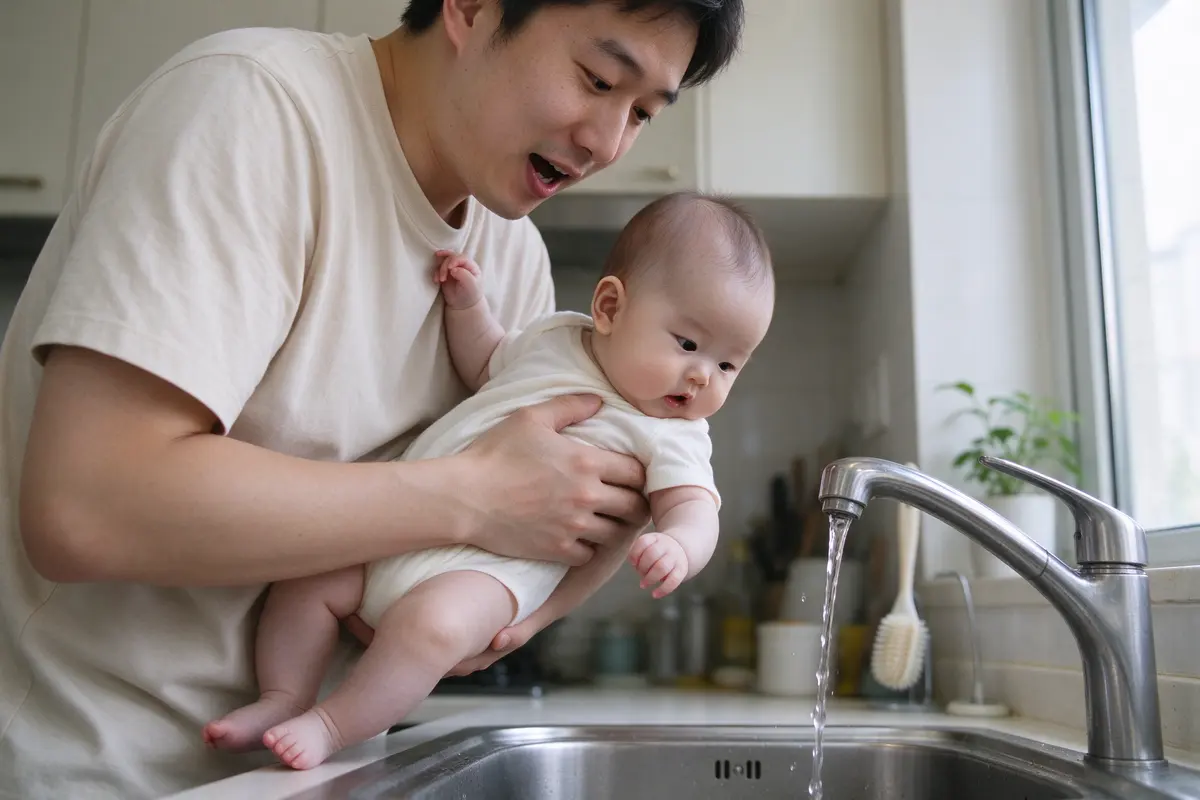
The narrated kitchen tour
Time: 5 minutes, with your baby alert and your hands free · Sound copycat in the guide
Carry your baby on your hip, head steady and facing out, and walk the kitchen naming what you touch: "Cold. That's the fridge." "Spoon. Shiny spoon."
Pause after each name. If your baby answers with a sound, copy it, then say a word with that sound: "Bah. Bah, bowl" (AAP).
Stay away from the stove, and never hold your baby while you're holding something hot (Seattle Children's).
End at the window: "Light. Look at the light," and wait for the last reply.
Make it work:Reaching hands will go for everything now, so the counter is cleared of anything small or sharp before the tour (AAP).
Watch for
Normal
a quiet day after a chatty one.
Raise it with your pediatrician
if your baby doesn't make sounds back when you talk or turn toward your voice (CDC).
Normal
a hoarse squeal at the end of a long play session.
Call 911
for new grunting, wheezing, or whistling sounds with breathing, or a baby struggling for each breath (AAP).
Normal
a baby who seems to hear you from the next room. If your baby didn't pass the newborn hearing screen and hasn't been retested,
book it now
; follow-up testing should happen by 3 months (Hecht, AAP).
For you
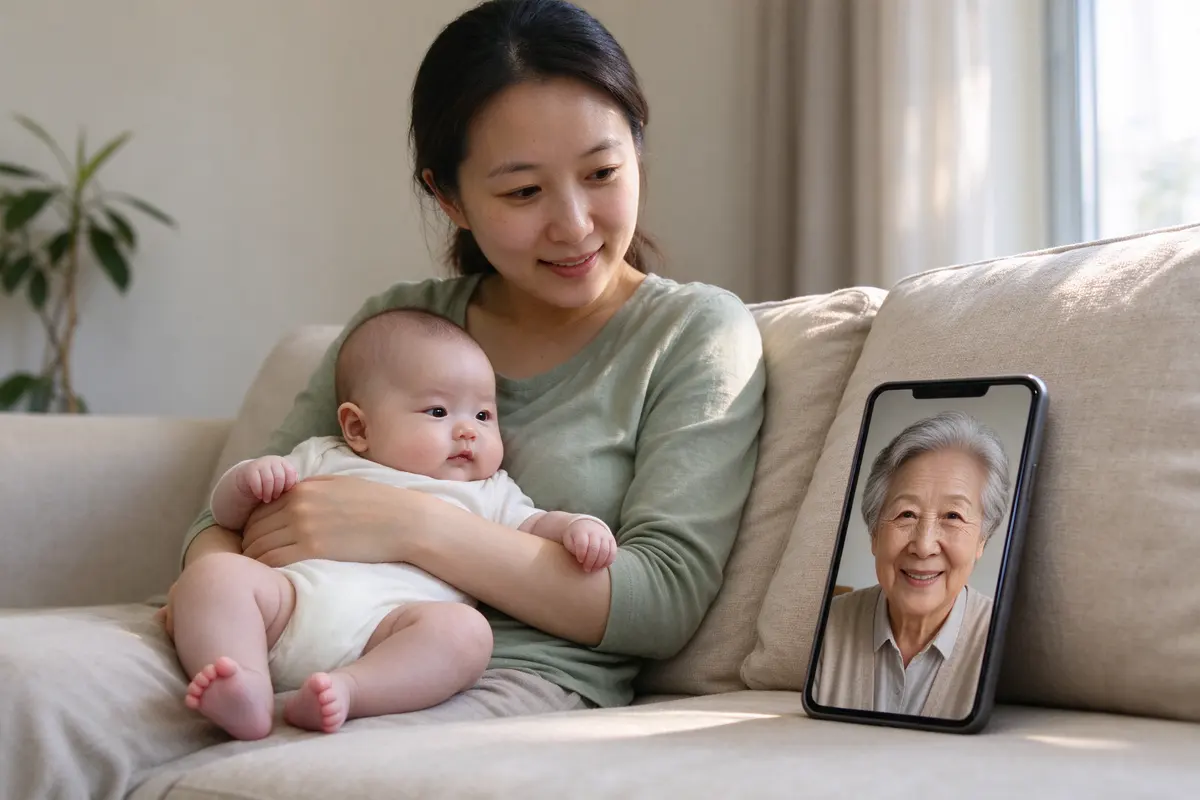
The phone is for calls with loved ones, and that's allowed. Video calls are the one screen CDC keeps on the list (CDC), and the AAP makes video chat the exception to avoiding screens before 18 months (Hill, AAP). Which means the call to your mother, your sister, the friend who moved away, is not screen time to feel guilty about. It's a face your baby gets to know, and a voice you get to hear.
Make one today, with the baby on your lap. If talking all day to someone who can't answer yet is wearing on you, say that on the call. And if the thing you need to say is bigger than a loved one can hold, call or text the National Maternal Mental Health Hotline at 1-833-TLC-MAMA (1-833-852-6262), or call or text 988 (CDC).
If you're the partner: narrate your own jobs tonight, in your own voice. The baby is learning two voices, not one.
Sources
- Klass P, Miller-Fitzwater A, High PC; AAP Council on Early Childhood. "Literacy Promotion: An Essential Component of Primary Care Pediatric Practice: Policy Statement." Pediatrics, 2024. https://pubmed.ncbi.nlm.nih.gov/39342414/
- Mendelsohn AL, Cates CB, Weisleder A, et al. "Reading Aloud, Play, and Social-Emotional Development." Pediatrics, 2018. https://pubmed.ncbi.nlm.nih.gov/29632254/
- Ferjan Ramírez N, Lytle SR, Kuhl PK. "Parent coaching increases conversational turns and advances infant language development." PNAS, 2020. https://pubmed.ncbi.nlm.nih.gov/32015127/
- Cooper RP, Aslin RN. "Preference for infant-directed speech in the first month after birth." Child Development, 1990. https://pubmed.ncbi.nlm.nih.gov/2245748/
- Dailey S, Bergelson E. "Language input to infants of different socioeconomic statuses: A quantitative meta-analysis." Developmental Science, 2022. https://pubmed.ncbi.nlm.nih.gov/34806256/
- Golinkoff RM, Hoff E, Rowe ML, Tamis-LeMonda CS, Hirsh-Pasek K. "Language Matters: Denying the Existence of the 30-Million-Word Gap Has Serious Consequences." Child Development, 2019. https://pubmed.ncbi.nlm.nih.gov/30102419/
- Centers for Disease Control and Prevention. "Milestones by 4 Months." Learn the Signs. Act Early., 2026. https://www.cdc.gov/act-early/milestones/4-months.html
- American Academy of Pediatrics. "Hearing & Making Sounds: Your Baby's Milestones." HealthyChildren.org, 2021. https://www.healthychildren.org/English/ages-stages/baby/Pages/Hearing-and-Making-Sounds.aspx
- American Academy of Pediatrics. "Language Development: 4 to 7 Months." HealthyChildren.org, 2009. https://www.healthychildren.org/English/ages-stages/baby/Pages/Language-Development-4-to-7-Months.aspx
- Munzer T. "Helping Kids Thrive in a Digital World: AAP Policy Explained." HealthyChildren.org, 2026. https://www.healthychildren.org/English/family-life/Media/Pages/helping-kids-thrive-in-a-digital-world-AAP-policy-explained.aspx
- Seattle Children's Hospital. "Preventing Scald Burns." 2026. https://www.seattlechildrens.org/health-safety/injury-prevention/preventing-scald-burns/
- American Academy of Pediatrics. "Movement Milestones: Babies 4 to 7 Months." HealthyChildren.org, 2021. https://www.healthychildren.org/English/ages-stages/baby/Pages/Movement-4-to-7-Months.aspx
- American Academy of Pediatrics. "Breathing Trouble" (symptom checker). HealthyChildren.org, 2026. https://www.healthychildren.org/English/tips-tools/symptom-checker/Pages/symptomviewer.aspx?symptom=Breathing+Trouble
- Hecht JL. "Hearing Screening for Newborns, Children & Adolescents: AAP Policy Explained." HealthyChildren.org, 2023. https://www.healthychildren.org/English/ages-stages/baby/Pages/Purpose-of-Newborn-Hearing-Screening.aspx
- Hill DL. "Why to Avoid TV for Infants & Toddlers." HealthyChildren.org, 2016. https://www.healthychildren.org/English/family-life/Media/Pages/Why-to-Avoid-TV-Before-Age-2.aspx
- Centers for Disease Control and Prevention. "Symptoms of Depression Among Women." 2024. https://www.cdc.gov/reproductive-health/depression/index.html
This guide is general education that summarizes published research and guidance from groups like the American Academy of Pediatrics, the CDC, and the WHO. It isn’t medical advice, and every child develops on their own timeline. Your pediatrician knows your child; if something feels wrong, call them. In an emergency, call 911.
Get each day’s note the morning it applies
Add your baby to a free Chorevia household with their date of birth, and every morning for 120 days the day’s note arrives in the app and by email: what’s developing, one thing to try, what to watch for, and a word for you.
Create your household