Day 119 of 120 · Four months
What's next
Last reviewed · 3 min read · 17 sources · Plain-text version
What changed in 120 days, from two hours of crying to a chuckle, and what the 6-month list and the 4-month guide say is coming: laughs, raspberries, grabbing on purpose, rolling.

Tomorrow is four months. Today, look back once, then forward.
Heart
What changed. Across 28 diary studies of 8,690 babies, fussing and crying averaged about 2 hours a day for the first 6 weeks, then dropped to about 68 minutes by 10 to 12 weeks (Wolke et al., 2017). The baby who cried through those first weeks now smiles on their own to get your attention and chuckles when you try to make them laugh (CDC), and reaches for and grasps what they see (AAP). None of that happened on a schedule. All of it happened.
Head
What's coming is on the 6-month list: laughing, squeals and raspberries, grabbing a toy they want on purpose, and rolling tummy to back (CDC). Sometime after 4 months, babies start to grasp that things exist out of sight (AAP). Sleep keeps maturing: regular sleep cycles arrive at about 4 months (AAP), and the sleep-training question, which a 2013 review found no proof for before 6 months (Douglas & Hill, 2013), is next month's decision. The 4-month guide covers the checkup you just had, readiness for solids, and that question in detail.
Body
By the numbers you'll hear at visits: from 1 to 4 months, babies typically gain 1.5 to 2 pounds a month (AAP), and slower growth from 3 months on is normal in breastfed babies on the charts CDC recommends (Grummer-Strawn et al., 2010). If your baby was born early, every list and chart ahead uses corrected age for the first 2 years (AAP).
Try today
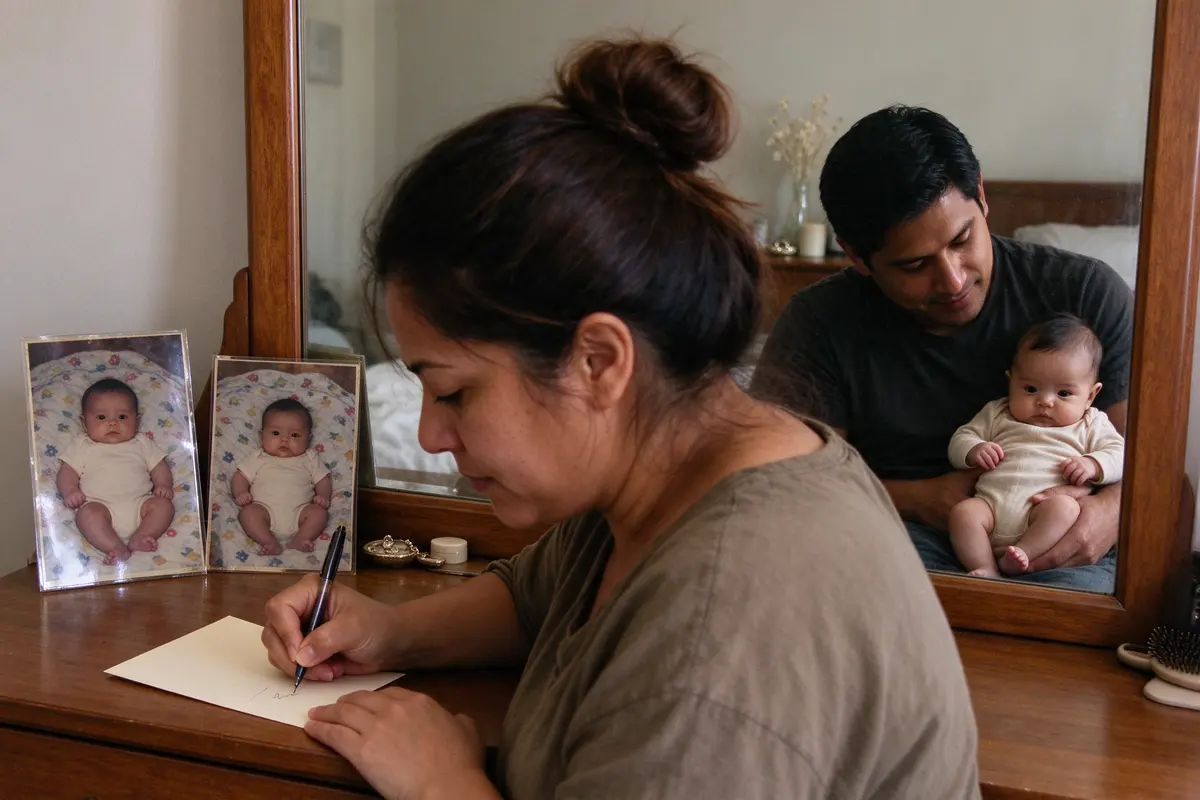
Four-month photo and letter
Time: 10 minutes, with the baby fed and awake
Lay your baby on their back in the day-one spot, on the floor blanket or in the bare crib, never on a bed or changing table unattended (AAP).
Take the photo from the same angle as the first one; put your hand in the frame for scale.
Write five lines to your baby: what made them chuckle this month, what they grabbed, the thing you worried about and how it went.
Date it and tuck it with the day-one and three-month photos.
Make it work:If they roll mid-shot, that's the photo. This is a keepsake; it proves nothing except that you were there.
Watch for
Normal
a 6-month list with nothing checked yet; it describes 6 months (CDC).
Don't wait
if you're concerned: ask about developmental screening, or call your state's early intervention program for a free evaluation (CDC).
Normal
a first roll onto the tummy in the crib. Always lay your baby down on their back, and once they roll both ways you don't need to keep turning them over; keep the crib bare, and stop swaddling at the first sign of rolling (Moon, AAP).
Turn them back and ask your pediatrician
what to do next if your baby rolls one way but can't roll back yet (Moon, AAP).
Normal
a warm forehead after a nap. Use a digital thermometer and skip ear thermometers before 6 months (AAP); at 3 to 6 months,
call within 24 hours
about any fever (AAP).
For you
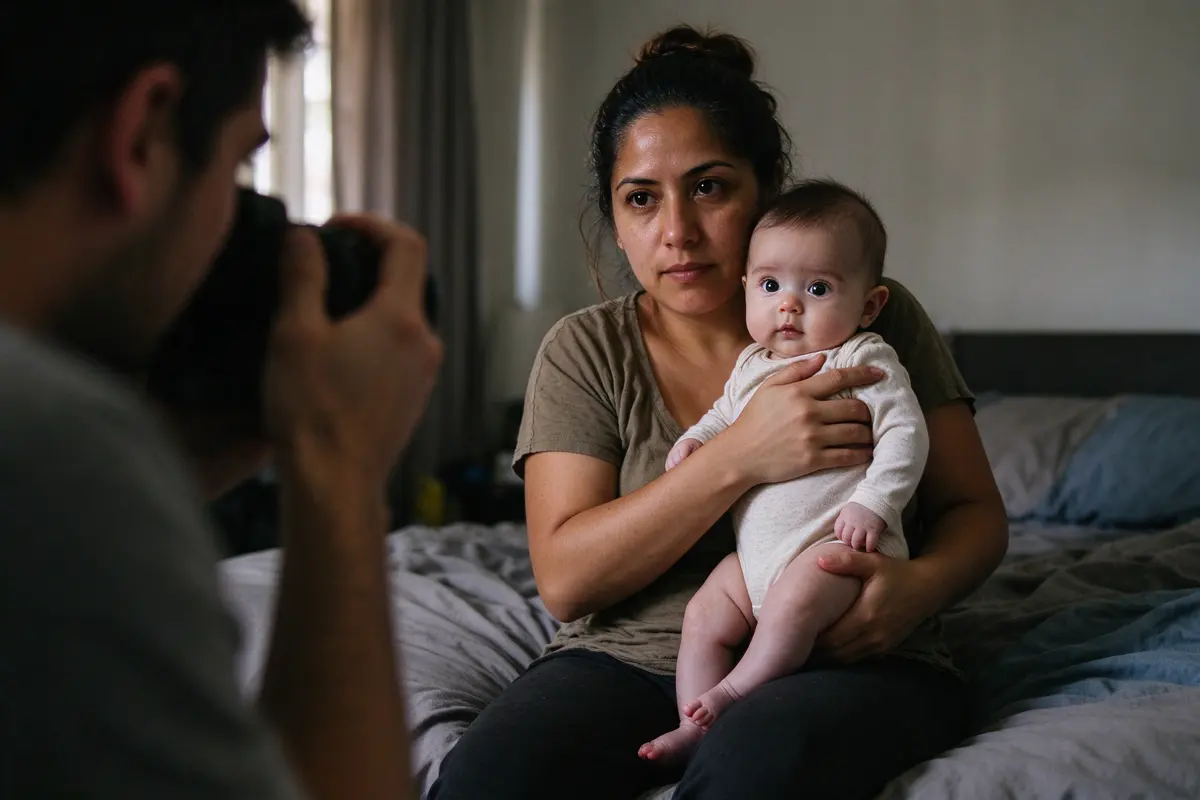
The photo of you at four months. In a German study of 2,541 mothers and 2,118 fathers, sleep hit its low point in the first 3 months after birth (Richter et al., 2019), and new mothers' sleep gets less fragmented over the first 4 months (Montgomery-Downs et al., 2010). You are standing at the far edge of the hardest stretch the research can measure. Have someone take the picture today, as you are. Not for anyone else. For the version of you who, a year from now, won't believe she did this.
If you're the partner: take it, and then hand her the phone and stand where she was.
Sources
- Wolke D, Bilgin A, Samara M. "Systematic Review and Meta-Analysis: Fussing and Crying Durations and Prevalence of Colic in Infants." Journal of Pediatrics, 2017. https://pubmed.ncbi.nlm.nih.gov/28385295/
- Centers for Disease Control and Prevention. "Milestones by 4 Months." Learn the Signs. Act Early., 2026. https://www.cdc.gov/act-early/milestones/4-months.html
- American Academy of Pediatrics. "Infant Vision Development: What Can Babies See?" HealthyChildren.org, 2024. https://www.healthychildren.org/English/ages-stages/baby/Pages/Babys-Vision-Development.aspx
- Centers for Disease Control and Prevention. "Milestones by 6 Months." Learn the Signs. Act Early., 2026. https://www.cdc.gov/act-early/milestones/6-months.html
- American Academy of Pediatrics. "Cognitive Development in Infants: 4 to 7 Months." HealthyChildren.org, 2023. https://www.healthychildren.org/English/ages-stages/baby/Pages/Cognitive-Development-4-to-7-Months.aspx
- American Academy of Pediatrics. "Getting Your Baby to Sleep." HealthyChildren.org, 2024. https://www.healthychildren.org/English/ages-stages/baby/sleep/Pages/getting-your-baby-to-sleep.aspx
- Douglas PS, Hill PS. "Behavioral sleep interventions in the first six months of life do not improve outcomes for mothers or infants: a systematic review." Journal of Developmental and Behavioral Pediatrics, 2013. https://pubmed.ncbi.nlm.nih.gov/24042081/
- American Academy of Pediatrics. "Your Baby's Growth & Physical Development: 1 to 4 Months Old." HealthyChildren.org, 2026. https://www.healthychildren.org/English/ages-stages/baby/Pages/Physical-Appearance-and-Growth-1-To-3-Months.aspx
- Grummer-Strawn LM, Reinold C, Krebs NF; CDC. "Use of World Health Organization and CDC growth charts for children aged 0-59 months in the United States." MMWR Recommendations and Reports, 2010. https://pubmed.ncbi.nlm.nih.gov/20829749/
- American Academy of Pediatrics. "Corrected Age For Preemies." HealthyChildren.org, 2018. https://www.healthychildren.org/English/ages-stages/baby/preemie/Pages/Corrected-Age-For-Preemies.aspx
- American Academy of Pediatrics. "Changing Table Safety." HealthyChildren.org, 2009. https://www.healthychildren.org/English/safety-prevention/at-home/Pages/Changing-Table-Safety.aspx
- Centers for Disease Control and Prevention. "Concerned About Your Child's Development?" 2026. https://www.cdc.gov/act-early/families/concerned.html
- Moon RY. "How to Keep Your Sleeping Baby Safe: AAP Policy Explained." HealthyChildren.org, 2026. https://www.healthychildren.org/English/ages-stages/baby/sleep/Pages/a-parents-guide-to-safe-sleep.aspx
- American Academy of Pediatrics. "Fever and Your Baby." HealthyChildren.org, 2025. https://www.healthychildren.org/English/health-issues/conditions/fever/Pages/Fever-and-Your-Baby.aspx
- American Academy of Pediatrics. "Fever" (symptom checker). HealthyChildren.org, 2026. https://www.healthychildren.org/English/tips-tools/symptom-checker/Pages/symptomviewer.aspx?symptom=Fever
- Richter D, Krämer MD, Tang NKY, Montgomery-Downs HE, Lemola S. "Long-term effects of pregnancy and childbirth on sleep satisfaction and duration of first-time and experienced mothers and fathers." Sleep, 2019. https://pubmed.ncbi.nlm.nih.gov/30649536/
- Montgomery-Downs HE, Insana SP, Clegg-Kraynok MM, Mancini LM. "Normative longitudinal maternal sleep: the first 4 postpartum months." American Journal of Obstetrics and Gynecology, 2010. https://pubmed.ncbi.nlm.nih.gov/20719289/
This guide is general education that summarizes published research and guidance from groups like the American Academy of Pediatrics, the CDC, and the WHO. It isn’t medical advice, and every child develops on their own timeline. Your pediatrician knows your child; if something feels wrong, call them. In an emergency, call 911.
Get each day’s note the morning it applies
Add your baby to a free Chorevia household with their date of birth, and every morning for 120 days the day’s note arrives in the app and by email: what’s developing, one thing to try, what to watch for, and a word for you.
Create your household