Day 98 of 120 · Week 14
Sleep is reorganizing
Last reviewed · 4 min read · 16 sources · Plain-text version
What's actually changing in sleep around 4 months, why the '4-month sleep regression' isn't a research term, what longer stretches look like, and a three-step bedtime to start tonight.
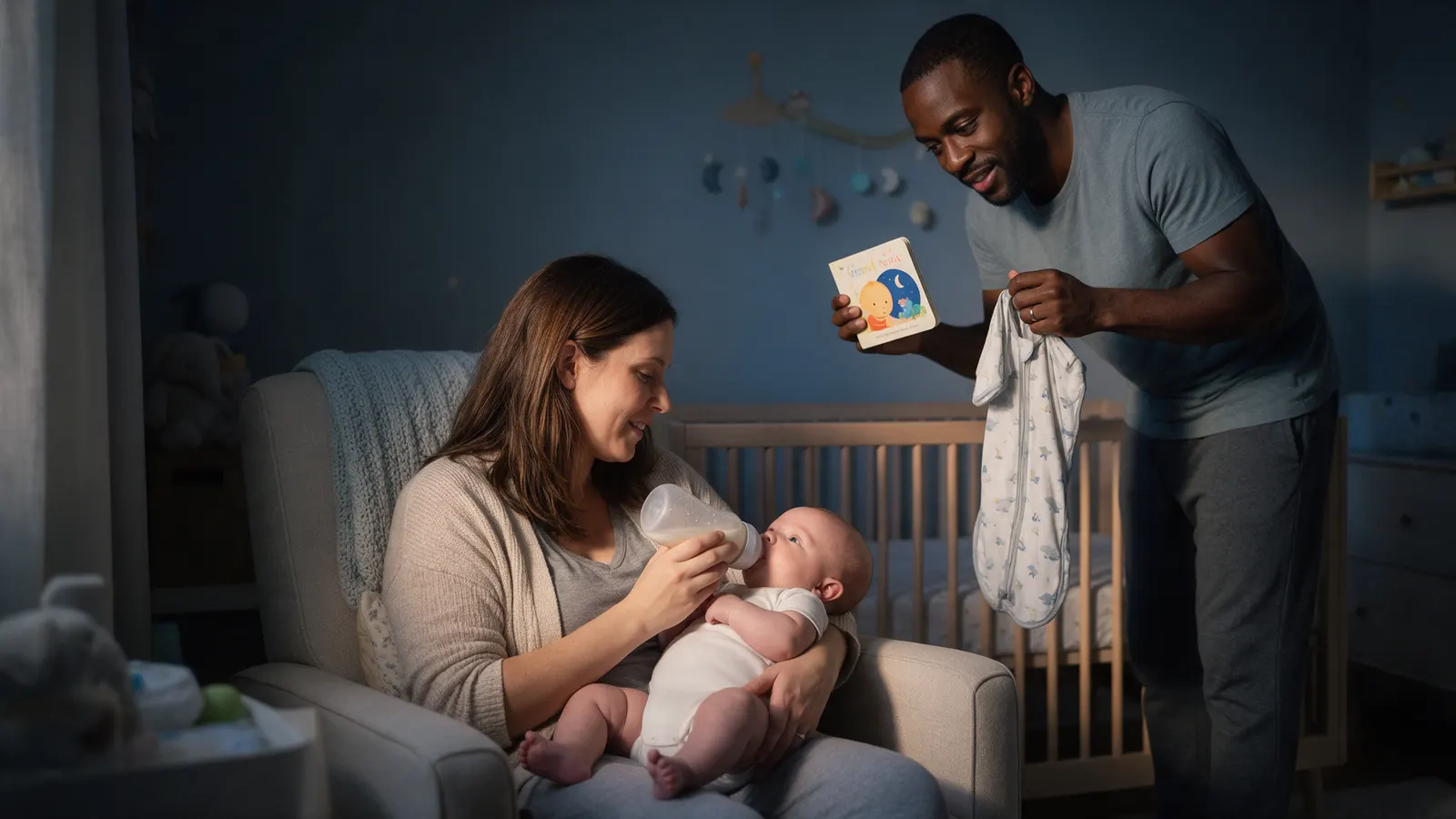
You've probably heard about the four-month sleep regression by now. Here is what the research actually documents, and what it doesn't.
Heart
Sleep is maturing, and that is real. Newborns often fall asleep straight into active, REM-like sleep, a pattern that fades by 2 to 3 months (Grigg-Damberger, 2016). Daily sleep and hormone rhythms develop after 2 months (Rivkees, 2003), regular sleep cycles arrive at about 4 months (AAP), and light and deep non-REM stages become distinct after 4 to 6 months (Ednick et al., 2009). A baby whose sleep looks different than it did a month ago is a baby whose sleep is growing up.
Head
The "4-month sleep regression" isn't a medical diagnosis or a research term, and we couldn't find studies that test it directly. What is documented is variation: in two Finnish birth cohorts (1,427 babies at 3 months, 2,002 at 6 months), sleep varied widely, night sleep began to consolidate during the second year, and parents often reported sleep problems throughout (Paavonen et al., 2020). Longer stretches are becoming common, not universal: in a London video study of 101 babies, 45% slept at least 5 hours straight by 3 months (St James-Roberts et al., 2015). WHO recommends 14 to 17 hours a day, including naps, up to 3 months, and 12 to 16 hours from 4 months (WHO). A rough patch is common, and it doesn't mean you did something wrong.
Body
What helps is boring and cheap. In a randomized trial of 405 mothers, a nightly bath, massage, and quiet time cut night wakings in 7- to 18-month-olds from 1.6 to 1.0 a night, and mothers' moods improved; a baby-products company funded it (Mindell et al., 2009). A survey of mothers of 10,085 children up to age 5 linked more consistent routines with better sleep, which can't prove cause (Mindell et al., 2015), and in an industry-funded survey of 135 families with babies 1 to 15 weeks old, babies with a routine slept longer stretches (Mindell et al., 2025). A simple routine costs nothing and may help.
Try today
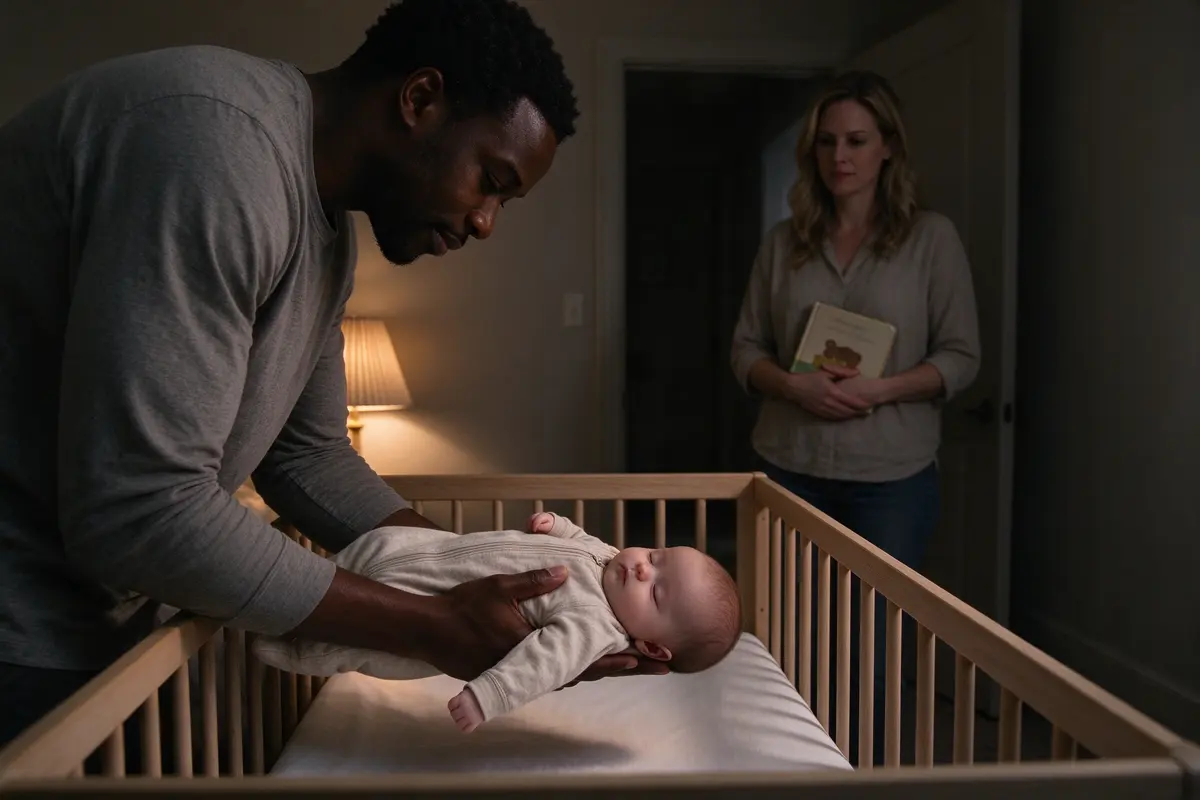
Three-step bedtime
Time: 15 to 30 minutes before the first long sleep of the night · Three-step bedtime in the guide
Pick three steps, like a feed, pajamas, and a song or a book.
Do them in the same order, with lights low and voices soft.
Lay your baby on their back in their crib or bassinet, drowsy if possible, and say the same goodnight line every night.
Make it work:Use the same steps, in the same order, for naps (Moon, AAP). Any calm steps work; what research links to better sleep is doing them consistently (Mindell et al., 2015).
Watch for
Normal
waking at night and needing help back down; a good sleeper at this age is one who wakes but can get back to sleep (AAP).
Call 911
if your baby can't be woken up (AAP).
Normal
a week of shorter naps that doesn't match anything in a book.
Call your pediatrician right away
if your baby has a fever and has had no urine in more than 8 hours, or looks very sick (AAP).
Normal
a nap that starts in the stroller; move your baby to a firm, flat surface on their back as soon as you can (Moon, AAP).
Go to the ER now
for any trouble breathing, including ribs pulling in with each breath (AAP).
For you
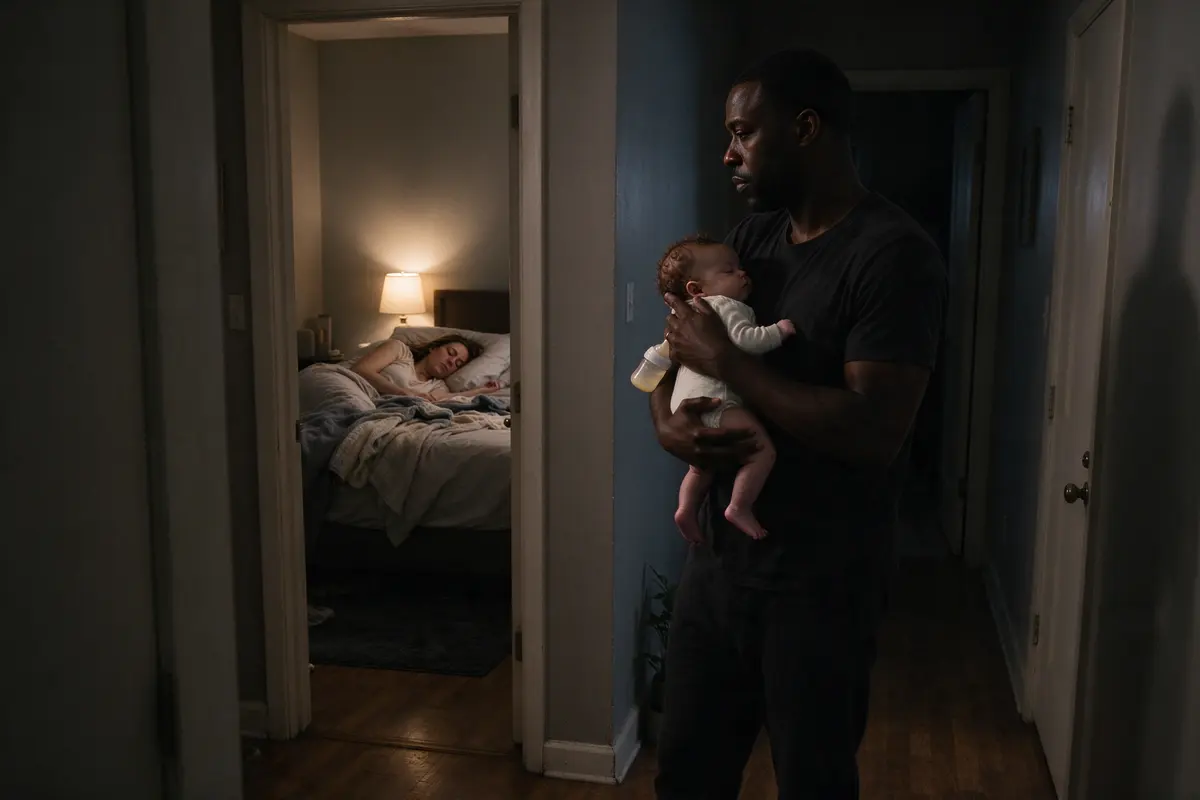
A routine both adults can do. The AAP's advice is to pick steps you and your partner can both do, the same few things in the same order, at naptime and bedtime (Moon, AAP). That's a sleep rule for the baby and a freedom rule for you: a bedtime only you can run is a bedtime you can never miss.
Then bank the sleep it buys. Nap when your baby naps, and go to bed right after the last feed (Moon, AAP); the dishes have no bedtime.
If you're the partner: run the whole routine tonight, all three steps, with her out of the room. If the baby fusses, that's practice, not failure.
Sources
- Grigg-Damberger MM. "The Visual Scoring of Sleep in Infants 0 to 2 Months of Age." Journal of Clinical Sleep Medicine, 2016. https://pubmed.ncbi.nlm.nih.gov/26951412/
- Rivkees SA. "Developing circadian rhythmicity in infants." Pediatrics, 2003. https://pubmed.ncbi.nlm.nih.gov/12897290/
- American Academy of Pediatrics. "Getting Your Baby to Sleep." HealthyChildren.org, 2024. https://www.healthychildren.org/English/ages-stages/baby/sleep/Pages/getting-your-baby-to-sleep.aspx
- Ednick M, Cohen AP, McPhail GL, et al. "A review of the effects of sleep during the first year of life on cognitive, psychomotor, and temperament development." Sleep, 2009. https://pubmed.ncbi.nlm.nih.gov/19928384/
- Paavonen EJ, Saarenpää-Heikkilä O, Morales-Munoz I, et al. "Normal sleep development in infants: findings from two large birth cohorts." Sleep Medicine, 2020. https://pubmed.ncbi.nlm.nih.gov/32087408/
- St James-Roberts I, Roberts M, Hovish K, Owen C. "Video Evidence That London Infants Can Resettle Themselves Back to Sleep After Waking in the Night, as well as Sleep for Long Periods, by 3 Months of Age." Journal of Developmental and Behavioral Pediatrics, 2015. https://pubmed.ncbi.nlm.nih.gov/26035139/
- World Health Organization. "To grow up healthy, children need to sit less and play more." 2019. https://www.who.int/news/item/24-04-2019-to-grow-up-healthy-children-need-to-sit-less-and-play-more
- Mindell JA, Telofski LS, Wiegand B, Kurtz ES. "A nightly bedtime routine: impact on sleep in young children and maternal mood." Sleep, 2009. https://pubmed.ncbi.nlm.nih.gov/19480226/
- Mindell JA, Li AM, Sadeh A, Kwon R, Goh DY. "Bedtime routines for young children: a dose-dependent association with sleep outcomes." Sleep, 2015. https://pubmed.ncbi.nlm.nih.gov/25325483/
- Mindell JA, Leichman ES, Carson M, Mack MC. "Bedtime and naptime routines for young infants: Associations with family sleep outcomes." Sleep Health, 2025. https://pubmed.ncbi.nlm.nih.gov/40461397/
- Moon RY. "Safe Sleep Tips for Sleep-Deprived New Parents." HealthyChildren.org, 2026. https://www.healthychildren.org/English/ages-stages/baby/sleep/Pages/safe-sleep-tips-for-sleep-deprived-parents.aspx
- American Academy of Pediatrics. "Sleeping Through the Night." HealthyChildren.org, 2013. https://www.healthychildren.org/English/ages-stages/baby/sleep/Pages/Sleeping-Through-the-Night.aspx
- American Academy of Pediatrics. "Vomiting Without Diarrhea" (symptom checker). HealthyChildren.org, 2026. https://www.healthychildren.org/English/tips-tools/symptom-checker/Pages/symptomviewer.aspx?symptom=Vomiting+Without+Diarrhea
- American Academy of Pediatrics. "Fever" (symptom checker). HealthyChildren.org, 2026. https://www.healthychildren.org/English/tips-tools/symptom-checker/Pages/symptomviewer.aspx?symptom=Fever
- Moon RY. "How to Keep Your Sleeping Baby Safe: AAP Policy Explained." HealthyChildren.org, 2026. https://www.healthychildren.org/English/ages-stages/baby/sleep/Pages/a-parents-guide-to-safe-sleep.aspx
- American Academy of Pediatrics. "Breathing Trouble" (symptom checker). HealthyChildren.org, 2026. https://www.healthychildren.org/English/tips-tools/symptom-checker/Pages/symptomviewer.aspx?symptom=Breathing+Trouble
This guide is general education that summarizes published research and guidance from groups like the American Academy of Pediatrics, the CDC, and the WHO. It isn’t medical advice, and every child develops on their own timeline. Your pediatrician knows your child; if something feels wrong, call them. In an emergency, call 911.
Get each day’s note the morning it applies
Add your baby to a free Chorevia household with their date of birth, and every morning for 120 days the day’s note arrives in the app and by email: what’s developing, one thing to try, what to watch for, and a word for you.
Create your household