Day 99 of 120 · Week 14
Drowsy but awake, and the pause
Last reviewed · 4 min read · 11 sources · Plain-text version
From 4 months the AAP suggests laying babies down drowsy, not asleep, and stepping up slowly before you pick up a fussing baby. What that is, what it isn't, and the step-up to try.
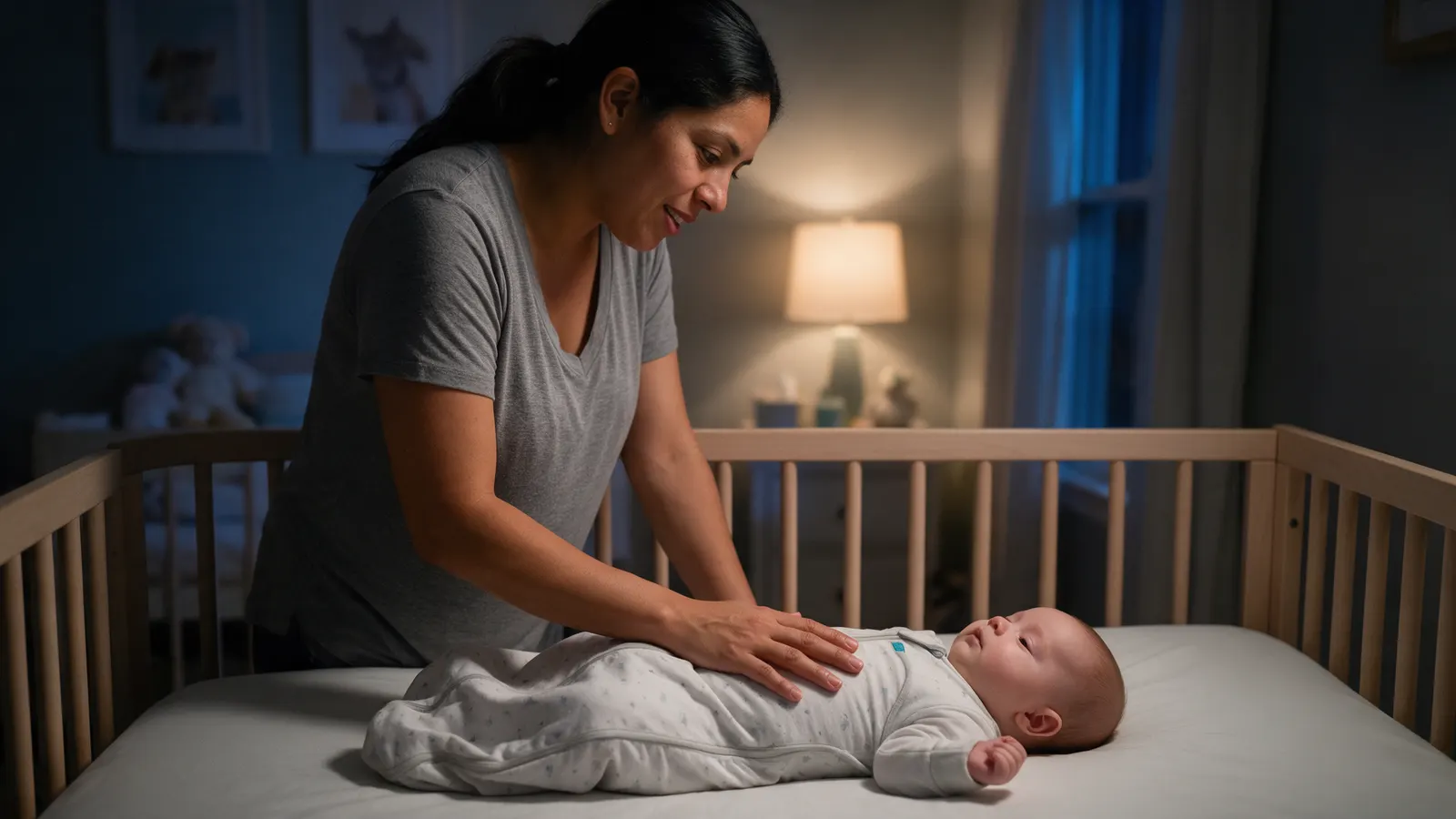
Two ideas arrive around now, and both get misheard. Drowsy but awake isn't a test you can fail. The pause isn't crying it out.
Heart
From 4 months, the AAP suggests putting babies to bed drowsy rather than asleep, because babies rocked to sleep may struggle to resettle at night (AAP). Practicing now is fine, and so is not managing it: if your baby cries, pick them up, soothe them, and try again another night (AAP). In a study of 80 babies, those whose parents responded a bit more slowly to night wakings at 3 months were more likely to soothe themselves at 12 months, though that link doesn't prove cause (Burnham et al., 2002).
Head
Self-soothing doesn't mean crying it out. For a fussy baby who is fed, changed, and rested, the AAP suggests stepping up slowly: look, talk softly, rest a hand on their belly, and only then pick up, rock, or feed (Ideran & Fishbein, AAP). A brief pause may help too: about a quarter of 3-month-olds in one video study resettled on their own after waking (St James-Roberts et al., 2015). The pause is a moment of watching, not a timer; it ends when the fussing builds.
Body
What this isn't is sleep training. A meta-analysis of 9 randomized trials (1,656 families) found sleep programs for new parents slightly increased reported night sleep but didn't reduce how often babies woke (Kempler et al., 2016), and a 2013 review found no proof that behavioral sleep interventions before 6 months reduce crying, prevent later sleep problems, or protect against postnatal depression, and flagged risks like early weaning (Douglas & Hill, 2013). Gentle habits are fine now; formal sleep training is a later decision, in the 4-month guide.
Try today
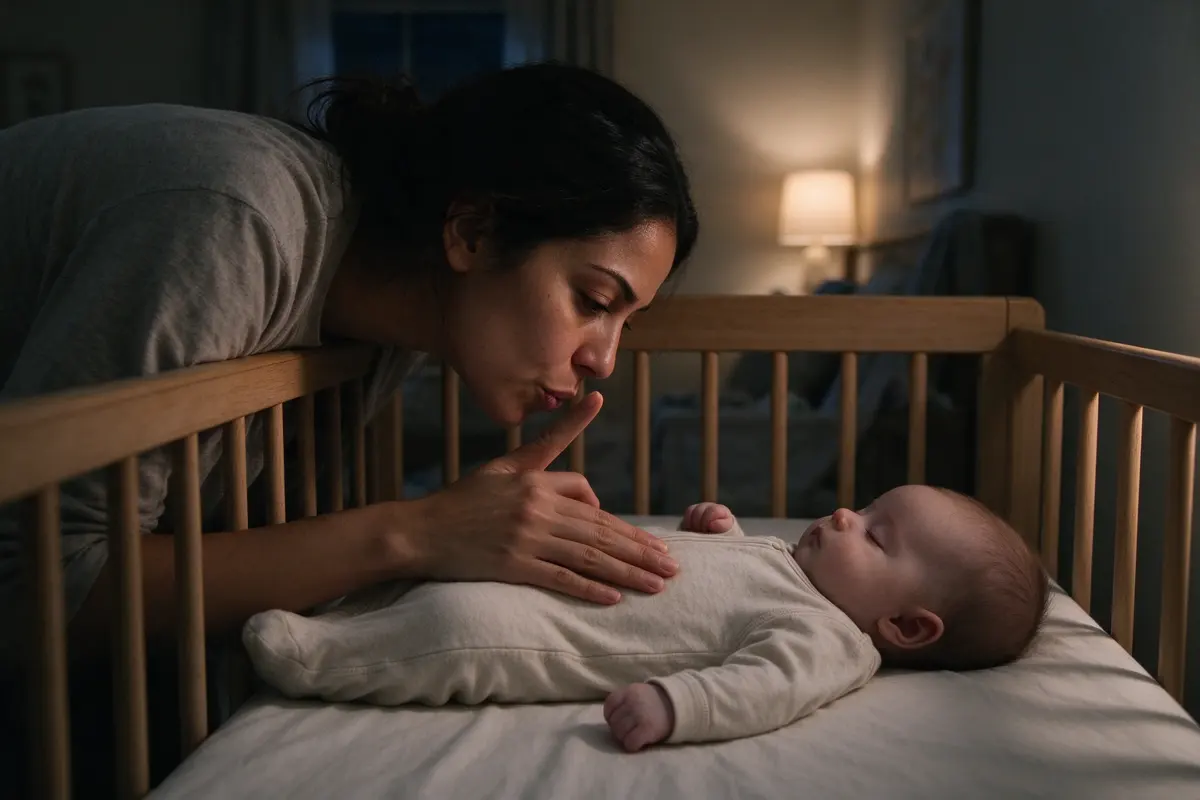
The step-up
Time: A minute or two, at bedtime or after a night waking · Drowsy but awake, and a pause before you go in in the guide
Your baby stirs and fusses. Run the basics in your head (fed, changed, not sick), then watch for a moment.
If it builds, let them see your face and talk softly: "I'm here. Shh, shh."
Rest a hand on their belly and keep talking low.
Only then pick up, rock, or feed (Ideran & Fishbein, AAP).
Lay them back down on their back in the bare crib, drowsy if you can manage it, awake or not if you can't.
Make it work:Each step is a rung, not a rule; skip straight to the pick-up any time the crying is real. The ladder hasn't been tested as a routine on its own.
Watch for
Normal
fussing that fades before you reach the crib; about a quarter of 3-month-olds resettled on their own in one study (St James-Roberts et al., 2015).
Call your pediatrician right away
if your baby has a fever and cries nonstop, or cries when touched (AAP).
Normal
a baby who falls asleep at the breast or bottle anyway; never put them to bed with a bottle, since milk pooling in the mouth can lead to tooth decay and ear infections (AAP).
Go to the ER now
if your baby isn't alert when awake (AAP).
Normal
a night that undoes a week of progress.
Call your pediatrician
if your baby seems unwell, has fewer wet diapers, or isn't growing as expected (Jain & Bunik, AAP).
For you
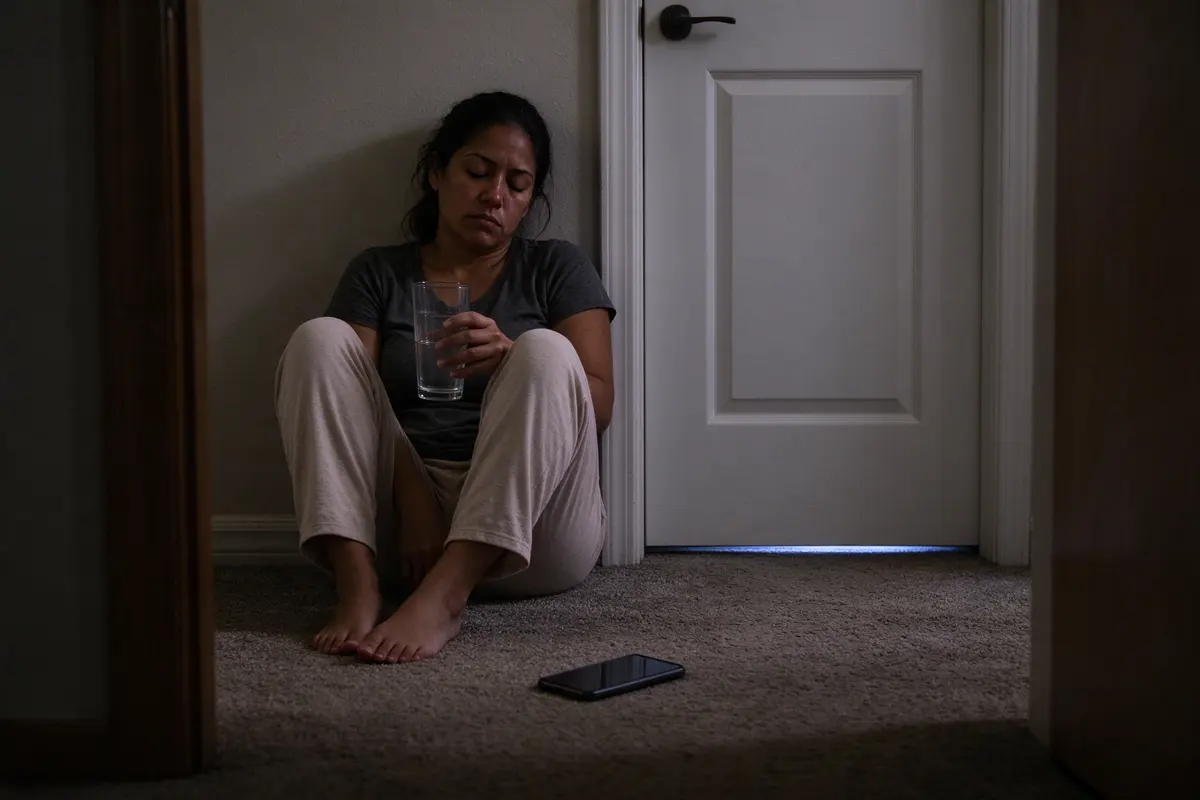
Your pause too. The baby's pause is a few seconds of watching. Yours is longer, and it's a safety tool: if you feel yourself losing control, put your baby on their back in the crib, leave the room for 10 to 15 minutes, and call someone (AAP). A baby crying in a bare crib is safe. A parent at the end of their rope needs the hallway.
Neither pause is neglect. You cannot spoil a young baby with attention, and babies whose calls for help are answered cry less overall (AAP). Answering a minute late, with your breath back, is still answering.
If you're the partner: agree on a hand-off word tonight. When she says it, the baby is yours, no questions.
Sources
- American Academy of Pediatrics. "Getting Your Baby to Sleep." HealthyChildren.org, 2024. https://www.healthychildren.org/English/ages-stages/baby/sleep/Pages/getting-your-baby-to-sleep.aspx
- Burnham MM, Goodlin-Jones BL, Gaylor EE, Anders TF. "Nighttime sleep-wake patterns and self-soothing from birth to one year of age: a longitudinal intervention study." Journal of Child Psychology and Psychiatry, 2002. https://pubmed.ncbi.nlm.nih.gov/12236607/
- Ideran P, Fishbein M. "Self-Soothing: Help Your Baby Learn This Life Skill." HealthyChildren.org, 2024. https://www.healthychildren.org/English/ages-stages/baby/crying-colic/Pages/Self-Soothing-Helping-Your-Baby-Learn-This-Life-Skill.aspx
- St James-Roberts I, Roberts M, Hovish K, Owen C. "Video Evidence That London Infants Can Resettle Themselves Back to Sleep After Waking in the Night, as well as Sleep for Long Periods, by 3 Months of Age." Journal of Developmental and Behavioral Pediatrics, 2015. https://pubmed.ncbi.nlm.nih.gov/26035139/
- Kempler L, Sharpe L, Miller CB, Bartlett DJ. "Do psychosocial sleep interventions improve infant sleep or maternal mood in the postnatal period? A systematic review and meta-analysis of randomised controlled trials." Sleep Medicine Reviews, 2016. https://pubmed.ncbi.nlm.nih.gov/26555938/
- Douglas PS, Hill PS. "Behavioral sleep interventions in the first six months of life do not improve outcomes for mothers or infants: a systematic review." Journal of Developmental and Behavioral Pediatrics, 2013. https://pubmed.ncbi.nlm.nih.gov/24042081/
- American Academy of Pediatrics. "Fever" (symptom checker). HealthyChildren.org, 2026. https://www.healthychildren.org/English/tips-tools/symptom-checker/Pages/symptomviewer.aspx?symptom=Fever
- American Academy of Pediatrics. "Sleeping Through the Night." HealthyChildren.org, 2013. https://www.healthychildren.org/English/ages-stages/baby/sleep/Pages/Sleeping-Through-the-Night.aspx
- Jain S, Bunik M. "How Often and How Much Should Your Baby Eat?" HealthyChildren.org, 2024. https://www.healthychildren.org/English/ages-stages/baby/feeding-nutrition/Pages/How-Often-and-How-Much-Should-Your-Baby-Eat.aspx
- American Academy of Pediatrics. "Shaken Baby Syndrome: Protect Your Infant from Abusive Head Trauma." HealthyChildren.org, 2025. https://www.healthychildren.org/English/safety-prevention/at-home/Pages/Abusive-Head-Trauma-Shaken-Baby-Syndrome.aspx
- American Academy of Pediatrics. "Responding to Your Baby's Cries." HealthyChildren.org, 2025. https://www.healthychildren.org/English/ages-stages/baby/crying-colic/Pages/Responding-to-Your-Babys-Cries.aspx
This guide is general education that summarizes published research and guidance from groups like the American Academy of Pediatrics, the CDC, and the WHO. It isn’t medical advice, and every child develops on their own timeline. Your pediatrician knows your child; if something feels wrong, call them. In an emergency, call 911.
Get each day’s note the morning it applies
Add your baby to a free Chorevia household with their date of birth, and every morning for 120 days the day’s note arrives in the app and by email: what’s developing, one thing to try, what to watch for, and a word for you.
Create your household