Day 96 of 120 · Week 13
Depth and color
Last reviewed · 3 min read · 11 sources · Plain-text version
By 4 months babies see colors and shades better and love circular patterns; depth vision shows up in the lab at about 16 weeks. Why seeing an edge isn't fearing one.

The world is filling in. Colors, shades, and the space between things are arriving this month, and one of them comes with a warning label.
Heart
By 4 months, babies see colors and shades better and often love circular patterns, like faces (AAP). A lab study found 4- to 6-month-olds sort colors into categories like red, yellow, green, blue, and purple (Skelton et al., 2017). So the long stare at your red mug, or the stripe on a sibling's shirt, is real looking, and the face that gets the most looks is still yours.
Head
Depth is coming online. Lab tests first detect depth vision at about 16 weeks on average (Held et al., 1980), and by around 5 months the eyes work together to see in depth (AOA). That teamwork is why reaching gets better: babies typically start reaching for things at around 3 months (AOA), and now the hand can start to aim. If an eye seems to turn in or out all the time, ask about an eye exam (AOA).
Body
Here's the warning label: seeing depth isn't the same as fearing heights. Babies can see depth within a few months (Held et al., 1980), but babies with little or no crawling experience show no wariness of heights; that comes from moving around on their own (Dahl et al., 2013). Your baby can see the edge of the bed. They can't protect themselves from it. You have to, and that means a hand on them on any raised surface, every time (AAP).
Try today

Color and pattern look
Time: 1 to 3 minutes · Color and pattern look in the guide
Show a brightly colored toy or book page about a foot from your baby's face.
Name the color and move it slowly side to side, then in a small circle.
Switch to a new color and watch whether your baby looks longer.
Finish with the best pattern you own: your face, close up.
Make it work:Looking games haven't been tested for benefits (AAP); this one is for noticing what your baby notices. Stop when they look away.
Watch for
Normal
a baby who looks longer at some colors than others (Skelton et al., 2017).
Tell your pediatrician
if your baby has an eye that consistently turns in or out (AAP).
Normal
no fear of edges at all (Dahl et al., 2013). After any fall,
call your pediatrician now
, and go to the ER if your baby vomits 2 or more times, cries nonstop, or seems "out of it" (AAP).
Normal
a long, serious stare at a stripe or a lamp.
Call your pediatrician right away
for a rectal temperature of 101°F (38.3°C) or higher between 3 and 6 months (AAP).
For you
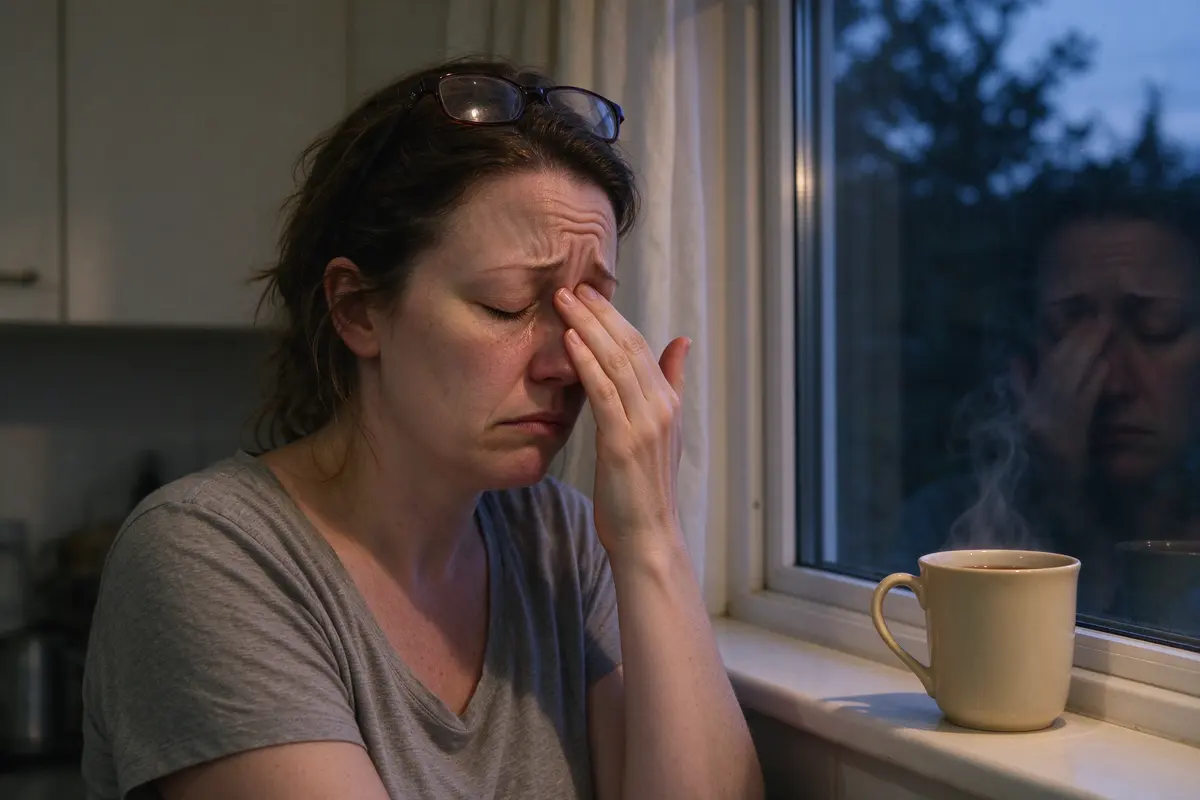
Your own eyes are still an urgent warning sign, fourteen weeks out. Changes in vision are on the CDC's list of urgent maternal warning signs, along with a headache that won't go away or gets worse and extreme swelling of your hands or face; seek care immediately, and tell the provider you were pregnant within the last year (CDC). The discharge instructions say the same: swelling, a headache that won't go away, or vision changes can mean postpartum preeclampsia (MedlinePlus).
Blurry from no sleep is different from flashing lights, spots, or a patch that's gone. The first one needs a nap. The second needs a call today.
If you're the partner: ask her, plainly, whether her vision has been odd. Then ask about the headache.
Sources
- American Academy of Pediatrics. "Infant Vision Development: What Can Babies See?" HealthyChildren.org, 2024. https://www.healthychildren.org/English/ages-stages/baby/Pages/Babys-Vision-Development.aspx
- Skelton AE, Catchpole G, Abbott JT, Bosten JM, Franklin A. "Biological origins of color categorization." Proceedings of the National Academy of Sciences, 2017. https://pubmed.ncbi.nlm.nih.gov/28484022/
- Held R, Birch E, Gwiazda J. "Stereoacuity of human infants." Proceedings of the National Academy of Sciences, 1980. https://pubmed.ncbi.nlm.nih.gov/6933571/
- American Optometric Association. "Infant Vision: Birth to 24 Months of Age." 2026. https://www.aoa.org/healthy-eyes/eye-health-for-life/infant-vision
- Dahl A, Campos JJ, Anderson DI, et al. "The epigenesis of wariness of heights." Psychological Science, 2013. https://pubmed.ncbi.nlm.nih.gov/23722981/
- American Academy of Pediatrics. "Changing Table Safety." HealthyChildren.org, 2009. https://www.healthychildren.org/English/safety-prevention/at-home/Pages/Changing-Table-Safety.aspx
- American Academy of Pediatrics. "Developmental Milestones: 7 Months." HealthyChildren.org, 2009. https://www.healthychildren.org/English/ages-stages/baby/Pages/Developmental-Milestones-7-Months.aspx
- American Academy of Pediatrics. "Head Injury" (symptom checker). HealthyChildren.org, 2026. https://www.healthychildren.org/English/tips-tools/symptom-checker/Pages/symptomviewer.aspx?symptom=Head+Injury
- American Academy of Pediatrics. "Fever and Your Baby." HealthyChildren.org, 2025. https://www.healthychildren.org/English/health-issues/conditions/fever/Pages/Fever-and-Your-Baby.aspx
- Centers for Disease Control and Prevention. "Urgent Maternal Warning Signs and Symptoms." HEAR HER. https://www.cdc.gov/hearher/maternal-warning-signs/index.html
- MedlinePlus. "Vaginal delivery - discharge." National Library of Medicine. https://medlineplus.gov/ency/patientinstructions/000628.htm
This guide is general education that summarizes published research and guidance from groups like the American Academy of Pediatrics, the CDC, and the WHO. It isn’t medical advice, and every child develops on their own timeline. Your pediatrician knows your child; if something feels wrong, call them. In an emergency, call 911.
Get each day’s note the morning it applies
Add your baby to a free Chorevia household with their date of birth, and every morning for 120 days the day’s note arrives in the app and by email: what’s developing, one thing to try, what to watch for, and a word for you.
Create your household