Day 109 of 120 · Week 15
Everything goes in the mouth
Last reviewed · 3 min read · 13 sources · Plain-text version
Grabbing on purpose means anything in reach ends up in the mouth. What's small enough to choke on, the cords and strings to clear, and a sweep of the play area at baby height.

Your baby's hands are catching things now, and every catch has the same destination. Today is a look at the room from the floor.
Heart
Mouthing is how a baby this age studies the world. Early grabs use a mitten-like grip, and most of what they catch goes straight to the mouth; the pincer grasp waits until about 9 months (AAP). Lips and tongue tell your baby more than fingers can yet. It isn't a habit to break; it's a lab, and your job is to stock it safely and clear out the rest.
Head
The AAP's rule is to remove anything your baby could choke on or get hurt by (AAP). The CDC's version: let them mouth safe things that aren't sharp, hot, or small enough to choke on (CDC). The quieter danger is strangling. Never tie a pacifier to the crib or around your baby's neck or hand (AAP), and skip amber or other teething necklaces and bracelets: the FDA warned against them in 2018 after reports of choking and a strangulation death (AAP). The AAP also says to skip liquid-filled teethers and numbing gels (AAP).
Body
Reach is growing faster than judgment. Babies typically start reaching for things at around 3 months (AOA), and by 4 months they often reach for and grasp nearby objects they see (AAP). Rolling usually starts around 3 to 4 months (Moon, AAP), so the circle your baby can reach is about to outgrow the blanket. Sweep for the baby you'll have next week.
Try today
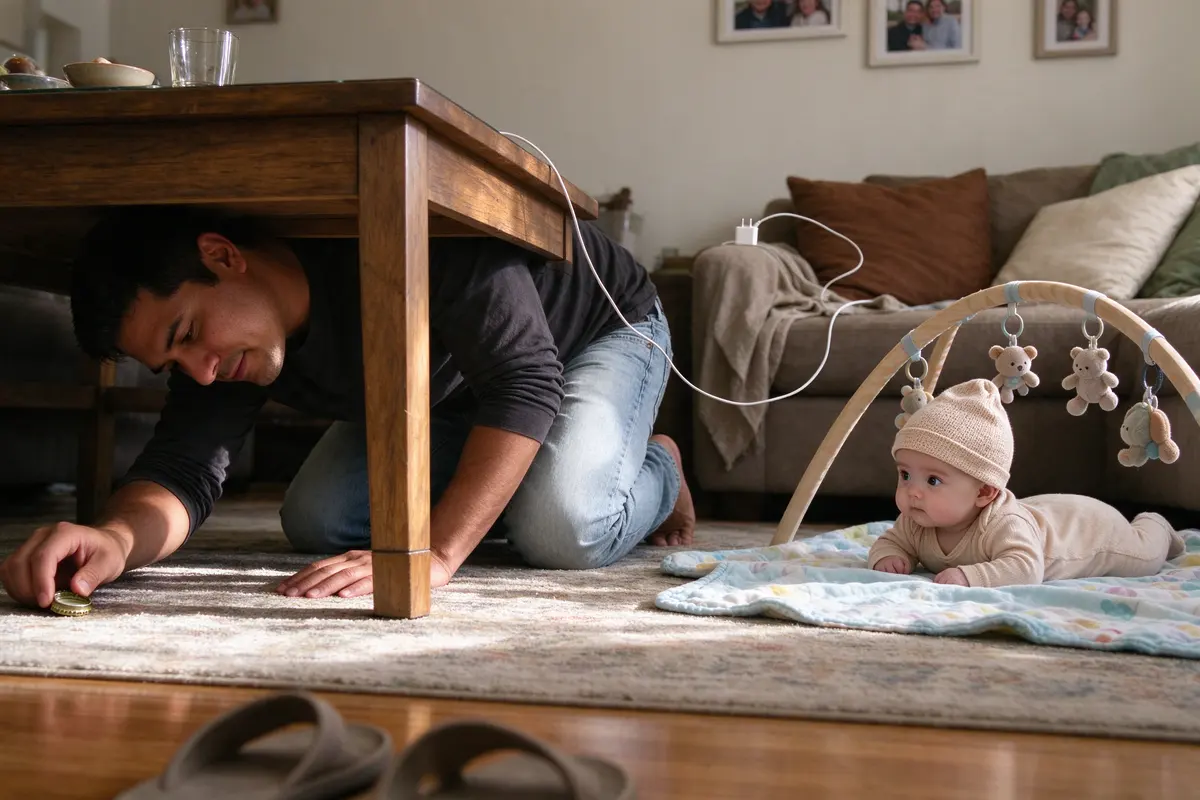
The choke-size sweep
Time: 10 minutes, with the baby in someone's arms or the crib · Reach-and-grab in the guide
Get down on hands and knees in the play area and look at it from your baby's height, under the sofa and the coffee table included.
Pick up anything small enough to choke on, sharp, or hot; coins, caps, pen lids, and an older child's toy parts are the usual finds (CDC).
Trace every cord and string within a rolling baby's reach: phone chargers, blind cords, bag straps, a pacifier clip. Move them up or out (AAP).
Put three safe things to grab back on the blanket, big ones that won't break, and do the sweep again next week from a little farther out.
Make it work:Whatever passes the sweep still gets watched; babies this age don't yet know an edge from a floor, and they won't know a cap from a teether (AAP).
Watch for
Normal
gagging on a fist shoved in too far, then carrying on; bringing hands to the mouth is a 4-month milestone (CDC).
Call 911
if your baby choked on a small object that could be stuck in the throat, or is struggling to breathe (AAP).
Normal
a soaked bib by mid-morning.
Normal
reaching with the hand nearest the toy.
Tell your pediatrician
if your baby struggles to get objects to their mouth, or reaches with only one hand (AAP).
For you

The partner's job tonight is the sweep, and yours is to lie down while it happens. Nap when your baby naps, and go to bed right after the last feed (Moon, AAP). The play area needs one adult with a clear view, not you specifically.
One line for you. Thoughts about harming yourself or your baby are on the CDC's list of urgent maternal warning signs; seek care immediately, and tell them you were pregnant within the last year (CDC).
If you're the partner: hands and knees, under the sofa, tonight. Then put three big safe toys back and tell her what you found.
Sources
- American Academy of Pediatrics. "Movement Milestones: Babies 4 to 7 Months." HealthyChildren.org, 2021. https://www.healthychildren.org/English/ages-stages/baby/Pages/Movement-4-to-7-Months.aspx
- Centers for Disease Control and Prevention. "Milestones by 4 Months." Learn the Signs. Act Early., 2026. https://www.cdc.gov/act-early/milestones/4-months.html
- American Academy of Pediatrics. "Pacifiers and Thumb Sucking." HealthyChildren.org, 2026. https://www.healthychildren.org/English/ages-stages/baby/crying-colic/Pages/Pacifiers-and-Thumb-Sucking.aspx
- American Academy of Pediatrics. "Teething Necklaces and Beads: A Caution for Parents." HealthyChildren.org, 2018. https://www.healthychildren.org/English/ages-stages/baby/teething-tooth-care/Pages/Amber-Teething-Necklaces.aspx
- American Academy of Pediatrics. "Teething Pain Relief: How to Soothe Your Baby's Discomfort." HealthyChildren.org, 2025. https://www.healthychildren.org/English/ages-stages/baby/teething-tooth-care/Pages/Teething-Pain.aspx
- American Optometric Association. "Infant Vision: Birth to 24 Months of Age." 2026. https://www.aoa.org/healthy-eyes/eye-health-for-life/infant-vision
- American Academy of Pediatrics. "Infant Vision Development: What Can Babies See?" HealthyChildren.org, 2024. https://www.healthychildren.org/English/ages-stages/baby/Pages/Babys-Vision-Development.aspx
- Moon RY. "How to Keep Your Sleeping Baby Safe: AAP Policy Explained." HealthyChildren.org, 2026. https://www.healthychildren.org/English/ages-stages/baby/sleep/Pages/a-parents-guide-to-safe-sleep.aspx
- American Academy of Pediatrics. "Breathing Trouble" (symptom checker). HealthyChildren.org, 2026. https://www.healthychildren.org/English/tips-tools/symptom-checker/Pages/symptomviewer.aspx?symptom=Breathing+Trouble
- Shu J. "Drooling Baby? Here's Why Spit Happens." HealthyChildren.org, 2026. https://www.healthychildren.org/English/ages-stages/baby/teething-tooth-care/Pages/Drooling-and-Your-Baby.aspx
- American Academy of Pediatrics. "Developmental Milestones: 7 Months." HealthyChildren.org, 2009. https://www.healthychildren.org/English/ages-stages/baby/Pages/Developmental-Milestones-7-Months.aspx
- Moon RY. "Safe Sleep Tips for Sleep-Deprived New Parents." HealthyChildren.org, 2026. https://www.healthychildren.org/English/ages-stages/baby/sleep/Pages/safe-sleep-tips-for-sleep-deprived-parents.aspx
- Centers for Disease Control and Prevention. "Urgent Maternal Warning Signs and Symptoms." HEAR HER, 2024. https://www.cdc.gov/hearher/maternal-warning-signs/index.html
This guide is general education that summarizes published research and guidance from groups like the American Academy of Pediatrics, the CDC, and the WHO. It isn’t medical advice, and every child develops on their own timeline. Your pediatrician knows your child; if something feels wrong, call them. In an emergency, call 911.
Get each day’s note the morning it applies
Add your baby to a free Chorevia household with their date of birth, and every morning for 120 days the day’s note arrives in the app and by email: what’s developing, one thing to try, what to watch for, and a word for you.
Create your household