Day 104 of 120 · Week 14
Fifteen weeks: books
Last reviewed · 3 min read · 11 sources · Plain-text version
The AAP recommends shared reading from birth, and one trial found fewer behavior problems years later. A board book on your lap, and why the same three books forever is fine.

Fifteen weeks. Your baby can't follow a story and will try to eat the book. Read anyway. Today is why.
Heart
Reading to a baby this age isn't about the words on the page. It's a lap, a voice, a picture, and a pause for a coo. The AAP recommends shared reading from birth (Klass et al., 2024), and says any book works; it's the time together that counts (AAP). Your baby gets your attention, your face, and a rhythm that repeats. You get five minutes of sitting down.
Head
The research here is better than for most things on a baby's shelf. In a randomized trial at a New York public hospital clinic, coaching parents to read and play with their children from birth to age 3 led to fewer behavior problems at age 4½ (Mendelsohn et al., 2018). That's a long way from a 15-week-old chewing a cloth book, and the trial tested coaching, not a book count. What it supports is the habit: reading and playing together, started early and kept up. Pair it with the other half of the AAP's advice for this stretch: copy your baby's sounds, then add simple words with that sound (AAP). A picture book gives you the words.
Body
Your baby will grab the book, and that's the body part of reading. By 4 months most babies hold a toy you put in their hand and swing an arm at things they see (CDC), and early grabs use a mitten-like grip with everything headed for the mouth (AAP). Board, cloth, and vinyl books are built for that. Let them touch, grab, and mouth the page; it's reading too.
Try today

Board-book time
Time: About 5 minutes, once or twice a day · Board-book time in the guide
Sit your baby on your lap facing out, back against your chest, with a board, cloth, or vinyl book held a foot from their face.
Point to one picture and name it, then pause for a coo or a kick before you turn the page.
When a hand lands on the page, name that too: "You found the dog."
Let them grab and mouth the book, and close it when they look away or fuss.
Make it work:Pick books with thick pages and no small parts that could come off; anything in reach ends up in the mouth, and it has to be too big to choke on (CDC).
Watch for
Normal
a book that gets chewed more than looked at; most of what babies catch goes straight to the mouth (AAP).
Call 911
if your baby choked on a small object that could be stuck in the throat (AAP).
Normal
swiping at the page with one hand today and the other tomorrow.
Tell your pediatrician
if your baby reaches with only one hand, or struggles to get objects to their mouth (AAP).
Normal
a long stare at one bright page; by 4 months babies see colors and shades better (AAP).
Ask about an eye exam
if an eye seems to turn in or out all the time (AOA).
For you
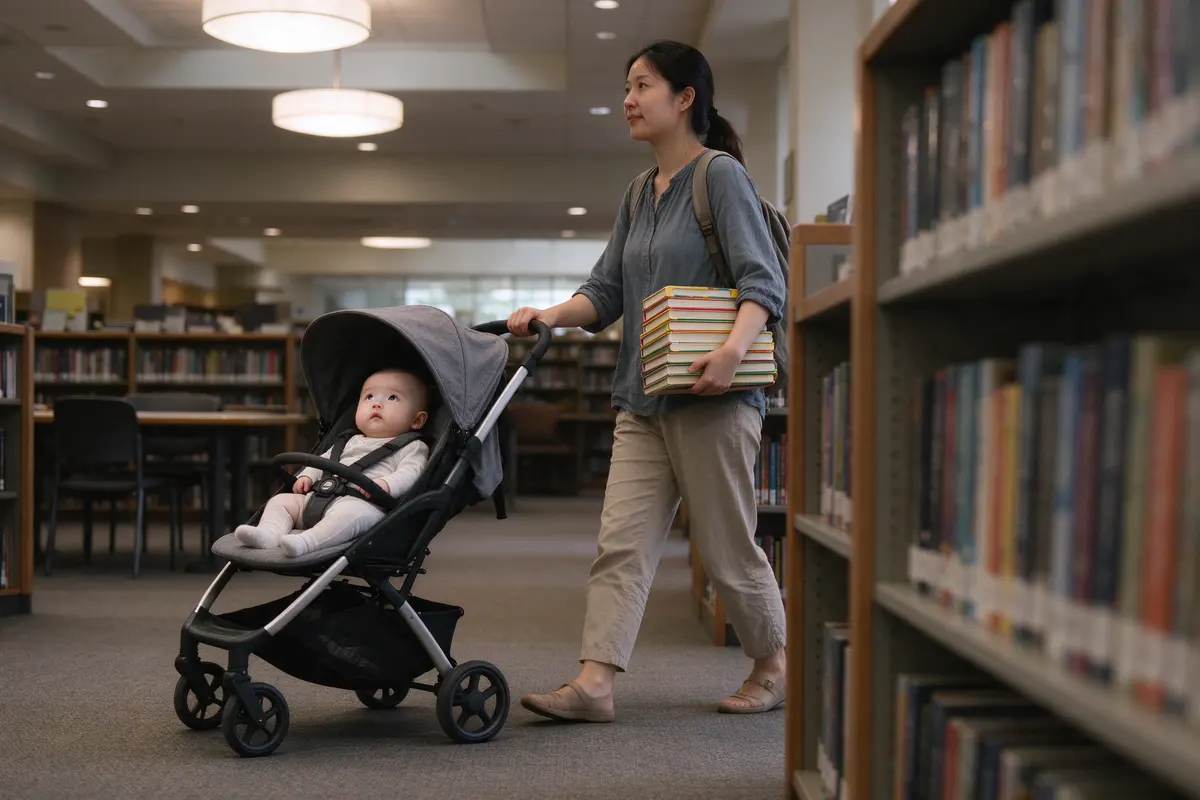
The library, or the same three books forever. Both are fine. Your baby doesn't need variety yet; they need the lap and the voice, and the AAP's own line is that any book works (AAP). If the same board book is in your hand every night for a month, you haven't failed at reading. You've built a routine.
If you do want out of the house, a library is warm, free, and used to babies. Go at a quiet hour, borrow a stack of board books, and read one on the floor there. Walking helps healing after a C-section and helps prevent clots (MedlinePlus); a walk with a destination is easier to start.
If you're the partner: one of the three books is yours. Same book, your voice, every night this week.
Sources
- Klass P, Miller-Fitzwater A, High PC; AAP Council on Early Childhood. "Literacy Promotion: An Essential Component of Primary Care Pediatric Practice: Policy Statement." Pediatrics, 2024. https://pubmed.ncbi.nlm.nih.gov/39342414/
- American Academy of Pediatrics. "Checkup Checklist: 4 Months Old." HealthyChildren.org, 2023. https://www.healthychildren.org/English/ages-stages/Your-Childs-Checkups/Pages/Your-Checkup-Checklist-4-Months-Old.aspx
- Mendelsohn AL, Cates CB, Weisleder A, et al. "Reading Aloud, Play, and Social-Emotional Development." Pediatrics, 2018. https://pubmed.ncbi.nlm.nih.gov/29632254/
- American Academy of Pediatrics. "Language Development: 4 to 7 Months." HealthyChildren.org, 2009. https://www.healthychildren.org/English/ages-stages/baby/Pages/Language-Development-4-to-7-Months.aspx
- Centers for Disease Control and Prevention. "Milestones by 4 Months." Learn the Signs. Act Early., 2026. https://www.cdc.gov/act-early/milestones/4-months.html
- American Academy of Pediatrics. "Movement Milestones: Babies 4 to 7 Months." HealthyChildren.org, 2021. https://www.healthychildren.org/English/ages-stages/baby/Pages/Movement-4-to-7-Months.aspx
- American Academy of Pediatrics. "Breathing Trouble" (symptom checker). HealthyChildren.org, 2026. https://www.healthychildren.org/English/tips-tools/symptom-checker/Pages/symptomviewer.aspx?symptom=Breathing+Trouble
- American Academy of Pediatrics. "Developmental Milestones: 7 Months." HealthyChildren.org, 2009. https://www.healthychildren.org/English/ages-stages/baby/Pages/Developmental-Milestones-7-Months.aspx
- American Academy of Pediatrics. "Infant Vision Development: What Can Babies See?" HealthyChildren.org, 2024. https://www.healthychildren.org/English/ages-stages/baby/Pages/Babys-Vision-Development.aspx
- American Optometric Association. "Infant Vision: Birth to 24 Months of Age." 2026. https://www.aoa.org/healthy-eyes/eye-health-for-life/infant-vision
- MedlinePlus. "Going home after a C-section." National Library of Medicine. https://medlineplus.gov/ency/patientinstructions/000624.htm
This guide is general education that summarizes published research and guidance from groups like the American Academy of Pediatrics, the CDC, and the WHO. It isn’t medical advice, and every child develops on their own timeline. Your pediatrician knows your child; if something feels wrong, call them. In an emergency, call 911.
Get each day’s note the morning it applies
Add your baby to a free Chorevia household with their date of birth, and every morning for 120 days the day’s note arrives in the app and by email: what’s developing, one thing to try, what to watch for, and a word for you.
Create your household