Day 97 of 120 · Week 13
Fourteen weeks: new sounds
Last reviewed · 3 min read · 13 sources · Plain-text version
Strange new sounds, a new sensitivity to your tone, squeals and raspberries ahead, and true babble later. Copy the sound, add a word, and keep the sharp voice for adults.
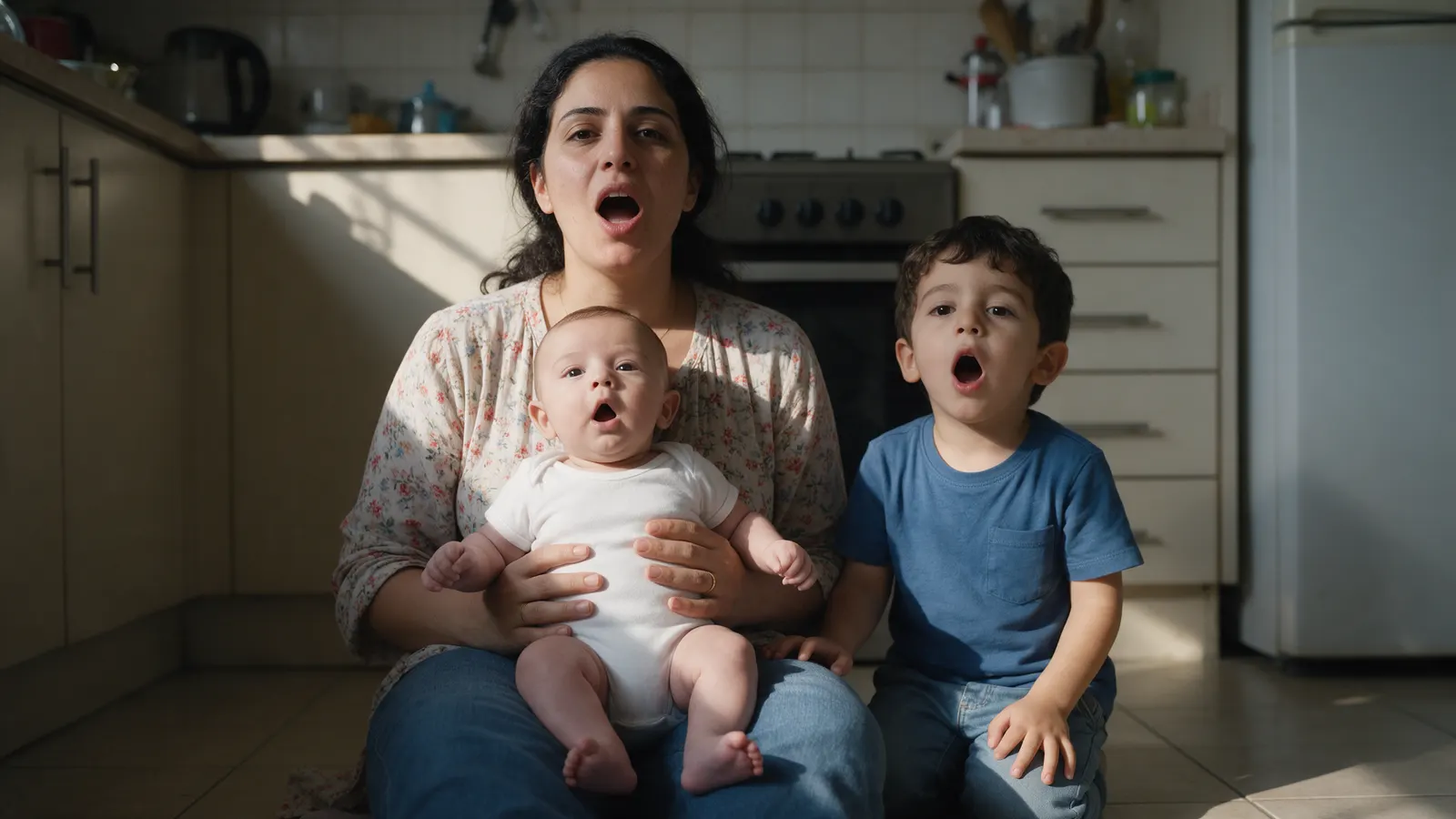
Fourteen weeks. The coos are getting company: growls, squeaks, bubbles, a sound you can't name. Today is about what those are, and what they're listening for in you.
Heart
By 4 months, many babies amuse themselves making strange new sounds and grow more sensitive to your tone of voice (AAP). Cooing, making sounds back when you talk, and turning toward your voice are on the 4-month list (CDC). The new part is the tone: a baby who went quiet when you snapped at the dog, or lit up when you said their name in your sing-song voice, is reading the music, not the words.
Head
What's ahead, and what isn't yet. Squeals and raspberries are 6-month milestones (CDC). True babbling, with syllables like "bababa," comes later; nearly all babies with typical hearing start by 10 months (Oller et al., 1999). The AAP's suggestion for now is simple: copy your baby's sounds, then add simple words with that sound (AAP). "Bah! You said bah. Bah, ball. Here's your ball."
Body
Every sound is mouth, tongue, and breath practice, and it needs a listener. CDC suggests copying your baby's sounds and seeing how long you can keep the "conversation" going (CDC). The listening side has a deadline of its own: between 4 and 7 months, the AAP lists not turning toward sounds by 4 months as a sign to raise with your pediatrician (AAP).
Try today
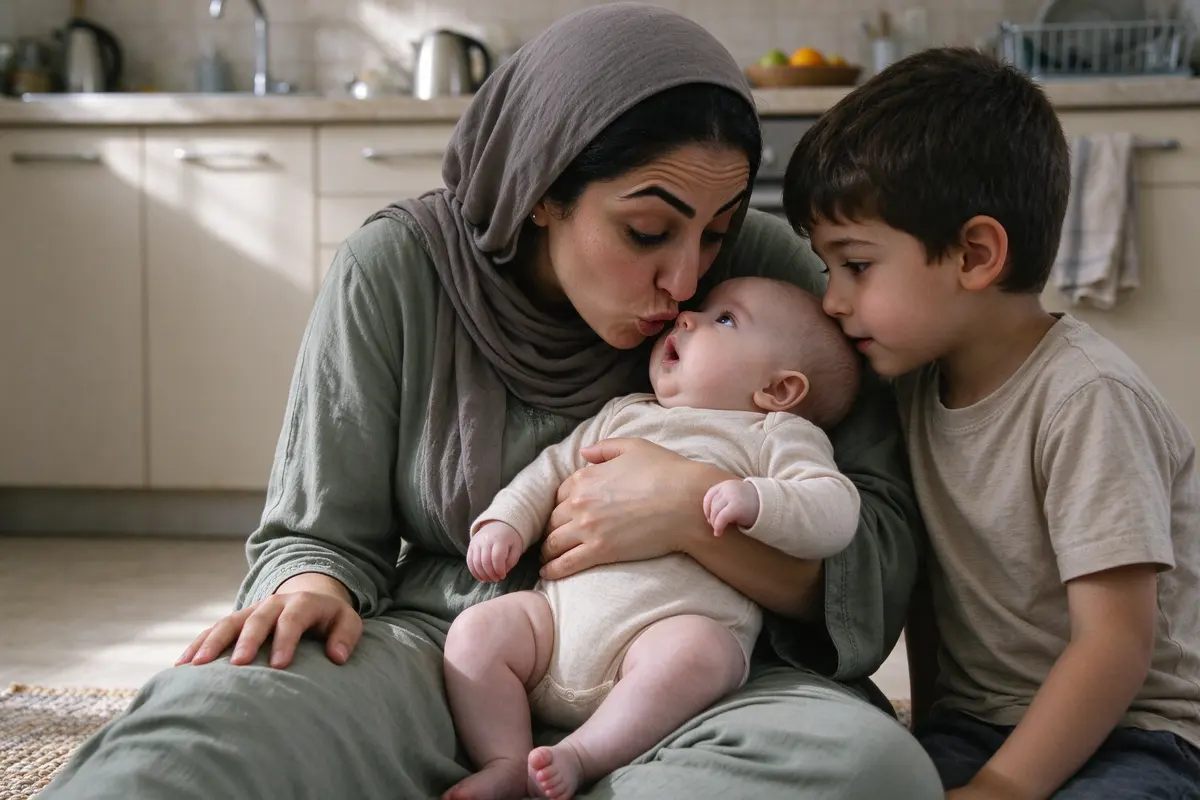
Sound copycat
Time: 2 to 5 minutes, several times a day · Sound copycat in the guide
Wait for your baby to coo, squeal, growl, or gurgle.
Copy the sound back, face to face, as exactly as you can, strange ones included.
Pause for a reply, then say a simple word that starts with that sound.
Keep the volley going until your baby looks away.
Make it work:Siblings are good at this; a four-year-old will copy a growl with more commitment than you will. Babies this age are intrigued by other children (AAP).
Watch for
Normal
a squeal in play, a growl at the ceiling, a quiet day after a loud one.
Call 911
for new grunting, wheezing, or whistling sounds with breathing, or a baby struggling for each breath (Nationwide Children's; AAP).
Normal
a baby who turns toward your voice most of the time but not every time.
Ask now
about follow-up testing if your baby didn't pass the newborn hearing screen; it should have happened by 3 months (Hecht, AAP).
Normal
a cry when a voice gets sharp; they're more sensitive to tone now (AAP).
Call your pediatrician right away
if your baby cries nonstop or cries when touched and has a fever (AAP).
For you

Your tone counts now, which is not the same as having to be cheerful. Babies this age grow more sensitive to how you sound (AAP), so the hard sentence belongs with an adult, not murmured at the baby. Say it to your partner, a friend, your own mother, the nurse line. Low mood, anxiety, or emptiness that is severe or lasts more than 2 weeks may be postpartum depression, and it usually doesn't improve without treatment but does respond to therapy, medication, or both (NIMH).
The phone line is an adult who will listen: call or text the National Maternal Mental Health Hotline at 1-833-TLC-MAMA (1-833-852-6262), or call or text 988 (CDC).
If you're the partner: your tone counts too, with the baby and with her. Be the adult she says the hard thing to tonight.
Sources
- American Academy of Pediatrics. "Hearing & Making Sounds: Your Baby's Milestones." HealthyChildren.org, 2021. https://www.healthychildren.org/English/ages-stages/baby/Pages/Hearing-and-Making-Sounds.aspx
- Centers for Disease Control and Prevention. "Milestones by 4 Months." Learn the Signs. Act Early., 2026. https://www.cdc.gov/act-early/milestones/4-months.html
- Centers for Disease Control and Prevention. "Milestones by 6 Months." Learn the Signs. Act Early., 2026. https://www.cdc.gov/act-early/milestones/6-months.html
- Oller DK, Eilers RE, Neal AR, Schwartz HK. "Precursors to speech in infancy: the prediction of speech and language disorders." Journal of Communication Disorders, 1999. https://pubmed.ncbi.nlm.nih.gov/10466095/
- American Academy of Pediatrics. "Language Development: 4 to 7 Months." HealthyChildren.org, 2009. https://www.healthychildren.org/English/ages-stages/baby/Pages/Language-Development-4-to-7-Months.aspx
- American Academy of Pediatrics. "Developmental Milestones: 7 Months." HealthyChildren.org, 2009. https://www.healthychildren.org/English/ages-stages/baby/Pages/Developmental-Milestones-7-Months.aspx
- American Academy of Pediatrics. "Emotional & Social Development: Birth Through 3 Months." HealthyChildren.org, 2026. https://www.healthychildren.org/English/ages-stages/baby/Pages/Emotional-and-Social-Development-Birth-to-3-Months.aspx
- Nationwide Children's Hospital. "Newborn Warning Signs." 2023. https://www.nationwidechildrens.org/conditions/health-library/newborn-warning-signs
- American Academy of Pediatrics. "Breathing Trouble" (symptom checker). HealthyChildren.org, 2026. https://www.healthychildren.org/English/tips-tools/symptom-checker/Pages/symptomviewer.aspx?symptom=Breathing+Trouble
- Hecht JL. "Hearing Screening for Newborns, Children & Adolescents: AAP Policy Explained." HealthyChildren.org, 2023. https://www.healthychildren.org/English/ages-stages/baby/Pages/Purpose-of-Newborn-Hearing-Screening.aspx
- American Academy of Pediatrics. "Fever" (symptom checker). HealthyChildren.org, 2026. https://www.healthychildren.org/English/tips-tools/symptom-checker/Pages/symptomviewer.aspx?symptom=Fever
- National Institute of Mental Health. "Perinatal Depression." 2026. https://www.nimh.nih.gov/health/publications/perinatal-depression
- Centers for Disease Control and Prevention. "Symptoms of Depression Among Women." 2024. https://www.cdc.gov/reproductive-health/depression/index.html
This guide is general education that summarizes published research and guidance from groups like the American Academy of Pediatrics, the CDC, and the WHO. It isn’t medical advice, and every child develops on their own timeline. Your pediatrician knows your child; if something feels wrong, call them. In an emergency, call 911.
Get each day’s note the morning it applies
Add your baby to a free Chorevia household with their date of birth, and every morning for 120 days the day’s note arrives in the app and by email: what’s developing, one thing to try, what to watch for, and a word for you.
Create your household