Day 101 of 120 · Week 14
Drool, and the teething question
Last reviewed · 4 min read · 10 sources · Plain-text version
The wet chin started weeks ago and teeth are months off for most babies. What teething does and doesn't cause, and something cool to gum, held by you.

Someone will tell you this week that your baby is teething. Today: what the drool is, what teeth would look like, and what to do with a gnawing, dribbling baby in the meantime.
Heart
The drool came first. Salivary glands kick into high gear at 2 to 3 months, before babies can swallow all that spit, so a wet chin on its own isn't a sign of anything (Shu, AAP). What your baby does with it is the sweeter part: everything they catch goes straight to the mouth now, and the mouth is how they learn what a thing is (AAP). A fist, a sleeve, your knuckle. It isn't hunger every time, and it isn't a tooth every time either.
Head
First teeth usually appear between 6 and 10 months, though some babies feel discomfort as early as 3 months (AAP). In a study that followed 125 babies from the 4-month visit to age 1, symptoms clustered in the 8 days around a tooth's arrival, and none reliably predicted it (Macknin et al., 2000). So the honest answer to "is it teeth?" is usually "not yet, and you'll know when it is." The part that matters for a baby this age: teething doesn't cause fever, diarrhea, or extra crying (AAP). If your baby has any of those, something else is going on, and that's a call, not a teether.
Body
What helps a gnawing baby is pressure and cold, not medicine. The AAP warns against benzocaine or lidocaine gels, homeopathic teething tablets, and teething necklaces (AAP). Skip liquid-filled teethers too (AAP). Whatever goes in the mouth has to be too big to choke on and not sharp or hot (CDC). A clean washcloth, chilled and held by you, meets every one of those rules.
Try today

Something cool to gum
Time: 2 to 5 minutes, when your baby is gnawing at everything · Reach-and-grab in the guide
Wet a clean washcloth, wring it out, and put it in the fridge for a few minutes. Cool, not frozen.
Sit your baby on your lap and hold one corner of the cloth to their mouth, keeping the rest bunched in your hand.
Let them grab your wrist and gum the corner; name it: "Cold. That's cold."
Offer it from the left and from the right so they reach across, then put it away when they lose interest.
Make it work:You hold it the whole time. Nothing stays in the crib, nothing goes around the neck, and the bib comes off before sleep (Shu, AAP).
Watch for
Normal
a chin that's always wet and a shirt that needs changing by noon.
Call your pediatrician
if heavy drooling comes with fever, trouble swallowing, or illness (Shu, AAP).
Normal
gnawing on fists and fussing a bit more than usual.
Normal
a baby who spits up a mouthful after a long gum on the cloth.
Call your pediatrician right away
if your baby vomits 2 or more times, or has no wet diaper in more than 8 hours (AAP).
For you
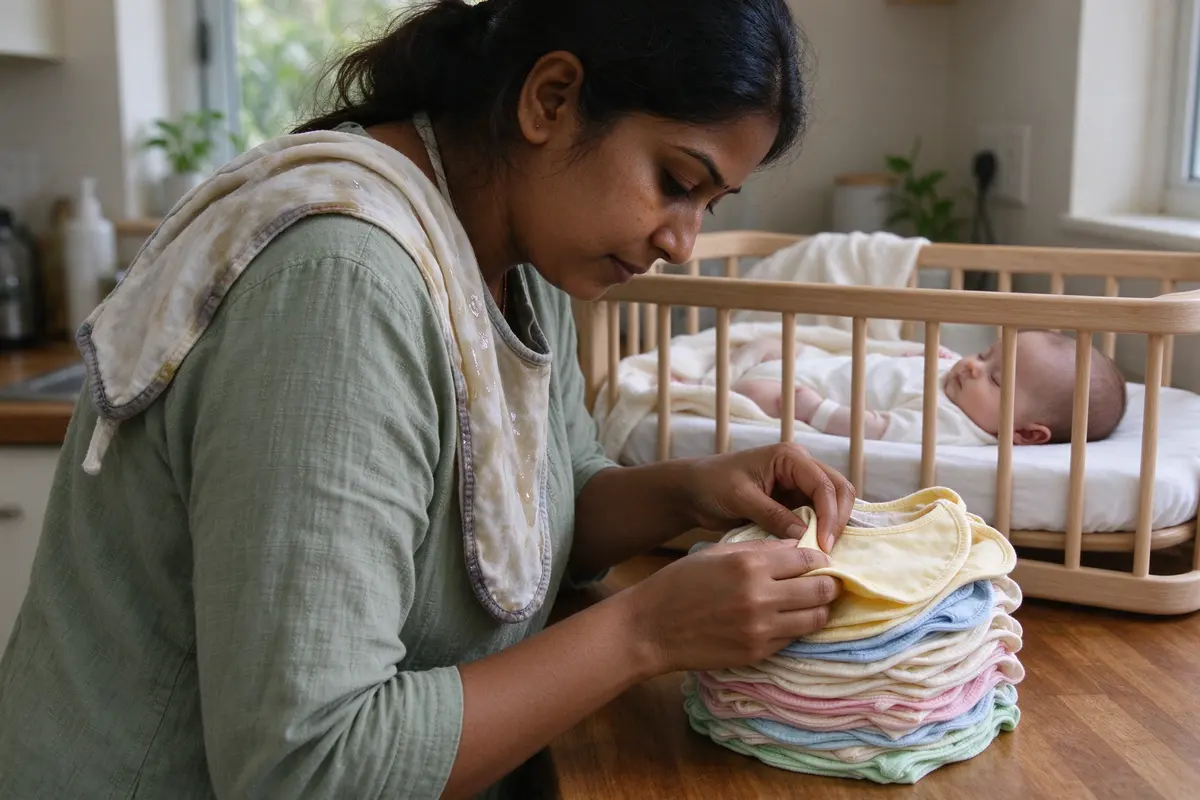
Bibs. A soft one while your baby is awake, off for every sleep (Shu, AAP). Buy the cheap ones in bulk and stop washing shirts.
No necklaces and no gels, whoever offers. The FDA warned against amber and other teething necklaces in 2018 after reports of choking and a strangulation death, and the AAP doesn't recommend any jewelry for babies (AAP). If a relative sends one, it's fine to say thank you and put it in a drawer.
And a line for your own body: if you have a fever of 100.4°F or higher, that's on the CDC's list of urgent maternal warning signs, and the rule is still to seek care and say you were pregnant within the last year (CDC).
If you're the partner: the washcloth is yours tonight. So is the bib laundry.
Sources
- Shu J. "Drooling Baby? Here's Why Spit Happens." HealthyChildren.org, 2026. https://www.healthychildren.org/English/ages-stages/baby/teething-tooth-care/Pages/Drooling-and-Your-Baby.aspx
- American Academy of Pediatrics. "Movement Milestones: Babies 4 to 7 Months." HealthyChildren.org, 2021. https://www.healthychildren.org/English/ages-stages/baby/Pages/Movement-4-to-7-Months.aspx
- American Academy of Pediatrics. "Teething Pain Relief: How to Soothe Your Baby's Discomfort." HealthyChildren.org, 2025. https://www.healthychildren.org/English/ages-stages/baby/teething-tooth-care/Pages/Teething-Pain.aspx
- Macknin ML, Piedmonte M, Jacobs J, Skibinski C. "Symptoms associated with infant teething: a prospective study." Pediatrics, 2000. https://pubmed.ncbi.nlm.nih.gov/10742315/
- Centers for Disease Control and Prevention. "Milestones by 4 Months." Learn the Signs. Act Early., 2026. https://www.cdc.gov/act-early/milestones/4-months.html
- American Academy of Pediatrics. "Fever and Your Baby." HealthyChildren.org, 2025. https://www.healthychildren.org/English/health-issues/conditions/fever/Pages/Fever-and-Your-Baby.aspx
- American Academy of Pediatrics. "Fever" (symptom checker). HealthyChildren.org, 2026. https://www.healthychildren.org/English/tips-tools/symptom-checker/Pages/symptomviewer.aspx?symptom=Fever
- American Academy of Pediatrics. "Vomiting Without Diarrhea" (symptom checker). HealthyChildren.org, 2026. https://www.healthychildren.org/English/tips-tools/symptom-checker/Pages/symptomviewer.aspx?symptom=Vomiting+Without+Diarrhea
- American Academy of Pediatrics. "Teething Necklaces and Beads: A Caution for Parents." HealthyChildren.org, 2018. https://www.healthychildren.org/English/ages-stages/baby/teething-tooth-care/Pages/Amber-Teething-Necklaces.aspx
- Centers for Disease Control and Prevention. "Urgent Maternal Warning Signs and Symptoms." HEAR HER, 2024. https://www.cdc.gov/hearher/maternal-warning-signs/index.html
This guide is general education that summarizes published research and guidance from groups like the American Academy of Pediatrics, the CDC, and the WHO. It isn’t medical advice, and every child develops on their own timeline. Your pediatrician knows your child; if something feels wrong, call them. In an emergency, call 911.
Get each day’s note the morning it applies
Add your baby to a free Chorevia household with their date of birth, and every morning for 120 days the day’s note arrives in the app and by email: what’s developing, one thing to try, what to watch for, and a word for you.
Create your household