Day 100 of 120 · Week 14
One hundred days
Last reviewed · 3 min read · 12 sources · Plain-text version
A hundred days in. How growth works now, why slower gains from 3 months are normal in breastfed babies, feeds that get interrupted by the world, and a quiet corner to feed in.

One hundred days. Today is about how your baby is growing, why the growth chart may look different from here, and the feeds that keep getting interrupted by a world that just got interesting.
Heart
From 1 to 4 months, babies typically gain 1.5 to 2 pounds a month (AAP), which is why the baby on your hip feels like a different animal from the one in the hospital photo. The growth charts CDC recommends for babies under 2 use breastfed babies as the standard, and slower growth among breastfed babies from 3 months on is normal (Grummer-Strawn et al., 2010). A line on the chart that flattens a little from here is the chart working, not your milk failing. No water, other drinks, or solids yet (CDC).
Head
Feeds are changing shape. Babies get far more aware of the world around 4 to 6 months, so a phone, a pet, or a voice can pull them off mid-feed (Australian Breastfeeding Association). Shorter, interrupted feeds don't mean your baby is done with feeding; they mean the room is more interesting than it was. A quiet room helps, a fan masks sudden noises, and something soft to hold gives the hands a job (Australian Breastfeeding Association). With bottles, offer a little less and pause; you can always give more (Jain & Bunik, AAP).
Body
How you know it's enough. Plenty of wet diapers and steady growth on the chart are good signs your baby is getting enough (Jain & Bunik, AAP), and the 4-month checkup will put a number on it with measurements and an exam (AAP). Keep giving 400 IU of vitamin D a day if your baby gets any breast milk, or less than 32 ounces of formula a day (AAP).
Try today

Quiet-corner feeds
Time: Daytime feeds that keep getting interrupted · Quiet-corner feeds in the guide
Pick a quiet room, and turn on a fan or soft music to mask sudden noises.
Sit facing a plain wall and give your baby something soft to hold.
Keep your phone in another room and your attention on your baby.
If your baby pulls off and won't go back, stop, and try again in a little while.
Make it work:These are practical tips for a newly distractible baby (Australian Breastfeeding Association); they haven't been tested in trials. Most babies learn to feed through distractions as they get older.
Watch for
Normal
a slower climb on the chart from 3 months in a breastfed baby (Grummer-Strawn et al., 2010).
Call your pediatrician
if your baby seems unwell, has fewer wet diapers, or isn't growing as expected (Jain & Bunik, AAP).
Normal
pulling off to look at the dog, then coming back (Australian Breastfeeding Association).
Normal
knowing this baby better than anyone alive.
Call anyway
if your baby just doesn't seem right to you. Trust your instincts; a hundred days have trained them (Lurie Children's).
For you
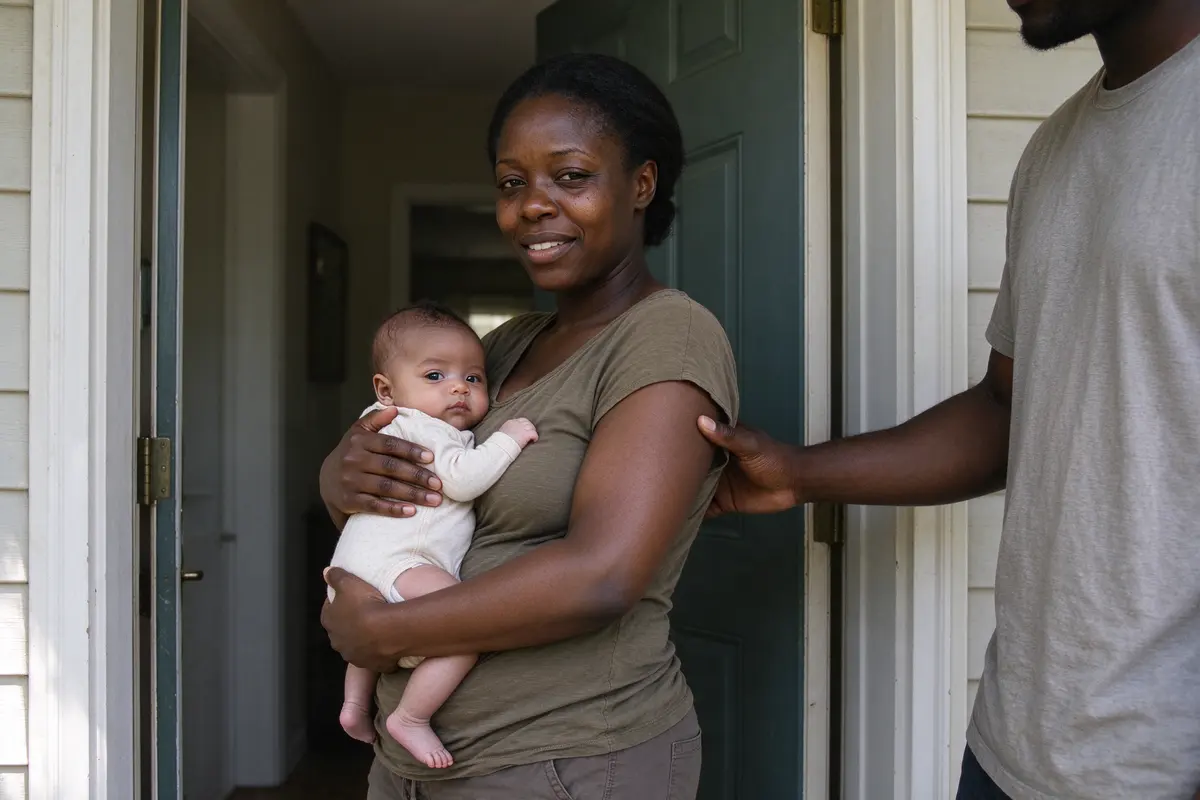
One hundred days of you. Count what you've done since the hospital: every feed, every night, every call you made or decided not to make. Nobody else has that record. Your pediatrician will ask how you're doing at the 4-month visit (AAP); practice an honest answer now, out loud, to someone who isn't the baby.
Keep the two numbers where you can find them, for you or for a friend: call or text the National Maternal Mental Health Hotline at 1-833-TLC-MAMA (1-833-852-6262), or call or text 988 (CDC). Partners count too; anyone can call or text 988 (NIMH).
If you're the partner: take the photo of her at a hundred days, baby on her hip, as she is. Then tell her one thing from the record above that you watched her do.
Sources
- American Academy of Pediatrics. "Your Baby's Growth & Physical Development: 1 to 4 Months Old." HealthyChildren.org, 2026. https://www.healthychildren.org/English/ages-stages/baby/Pages/Physical-Appearance-and-Growth-1-To-3-Months.aspx
- Grummer-Strawn LM, Reinold C, Krebs NF; CDC. "Use of World Health Organization and CDC growth charts for children aged 0-59 months in the United States." MMWR Recommendations and Reports, 2010. https://pubmed.ncbi.nlm.nih.gov/20829749/
- Centers for Disease Control and Prevention. "Milestones by 4 Months." Learn the Signs. Act Early., 2026. https://www.cdc.gov/act-early/milestones/4-months.html
- Australian Breastfeeding Association. "Feeding your distractible baby." 2025. https://www.breastfeeding.asn.au/resources/distractible-baby
- Jain S, Bunik M. "How Often and How Much Should Your Baby Eat?" HealthyChildren.org, 2024. https://www.healthychildren.org/English/ages-stages/baby/feeding-nutrition/Pages/How-Often-and-How-Much-Should-Your-Baby-Eat.aspx
- American Academy of Pediatrics. "Checkup Checklist: 4 Months Old." HealthyChildren.org, 2023. https://www.healthychildren.org/English/ages-stages/Your-Childs-Checkups/Pages/Your-Checkup-Checklist-4-Months-Old.aspx
- American Academy of Pediatrics Section on Gastroenterology, Hepatology and Nutrition. "Vitamin D for Babies, Children & Adolescents." HealthyChildren.org, 2022. https://www.healthychildren.org/English/healthy-living/nutrition/Pages/vitamin-d-on-the-double.aspx
- American Academy of Pediatrics. "Fever" (symptom checker). HealthyChildren.org, 2026. https://www.healthychildren.org/English/tips-tools/symptom-checker/Pages/symptomviewer.aspx?symptom=Fever
- American Academy of Pediatrics. "Fever and Your Baby." HealthyChildren.org, 2025. https://www.healthychildren.org/English/health-issues/conditions/fever/Pages/Fever-and-Your-Baby.aspx
- Latimer T. "When to Call the Pediatrician for Your Newborn." Lurie Children's Hospital of Chicago, 2022. https://www.luriechildrens.org/en/blog/when-to-call-the-pediatrician-for-your-newborn/
- Centers for Disease Control and Prevention. "Symptoms of Depression Among Women." 2024. https://www.cdc.gov/reproductive-health/depression/index.html
- National Institute of Mental Health. "Perinatal Depression." 2026. https://www.nimh.nih.gov/health/publications/perinatal-depression
This guide is general education that summarizes published research and guidance from groups like the American Academy of Pediatrics, the CDC, and the WHO. It isn’t medical advice, and every child develops on their own timeline. Your pediatrician knows your child; if something feels wrong, call them. In an emergency, call 911.
Get each day’s note the morning it applies
Add your baby to a free Chorevia household with their date of birth, and every morning for 120 days the day’s note arrives in the app and by email: what’s developing, one thing to try, what to watch for, and a word for you.
Create your household