Day 114 of 120 · Week 16
Big siblings as helpers
Last reviewed · 3 min read · 10 sources · Plain-text version
Babies this age are intrigued by other children. How to give an older child a real job with the baby, the one rule that never bends, and what to keep off the floor.

If there's an older child in the house, the baby has noticed. Today: a job for the big kid, with rules.
Heart
Babies this age are intrigued by other children (AAP), and the AAP suggests inviting older siblings to play with the baby, with clear rules such as never picking the baby up without permission (AAP). A preschooler who picks the bedtime book, fetches a diaper, or sings to the baby has a real family job (AAP). It is also how the older child gets to be part of this instead of beside it.
Head
Singing is the job to start with, because songs are social signals to a baby. In a lab study, 5-month-olds whose parent sang them a new song at home for 1 to 2 weeks later paid more attention to a stranger who sang that melody; hearing it from a toy didn't do that (Mehr et al., 2016). A big sibling is no stranger. If your family already has a song, hand it over; if not, any song the older child knows counts. Looking away mid-song is normal; it keeps the baby from getting overwhelmed (AAP), and the older child can learn to wait for the eyes to come back.
Body
The safety side is about the floor, not the sibling. Play happens on a blanket on the floor, with an adult right there (CDC), never with the baby parked on a bed or couch; among young children hospitalized for furniture falls in one study, a third fell from beds (Pomerantz et al., 2012). And because most of what a baby catches goes straight to the mouth (AAP), the big kid's small toys live somewhere the baby isn't: remove anything your baby could choke on or get hurt by (AAP).
Try today
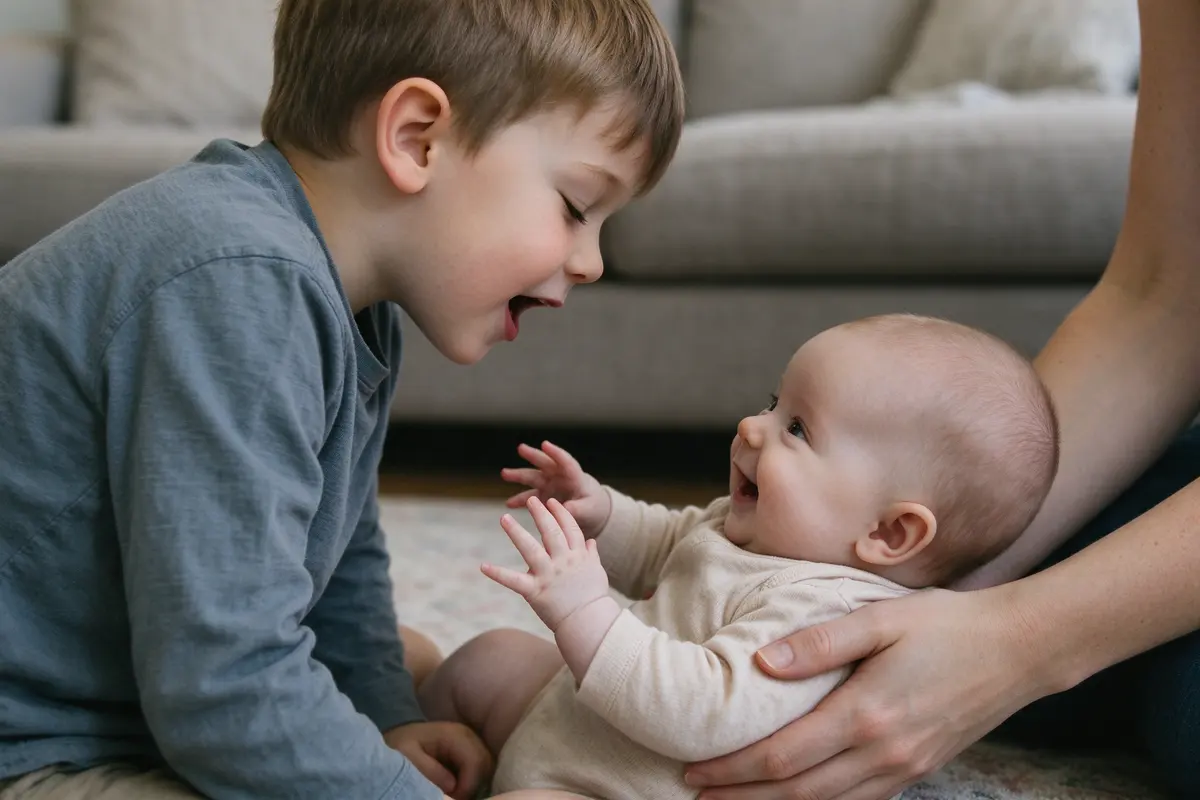
The sibling song
Time: One song, with an adult holding the baby · Your family song in the guide
Sit on the floor with the baby upright on your lap, facing the older child, your hands around the baby's chest.
Ask the big kid to sit an arm's length away and sing the family song, or any song they know, to the baby's face.
If the baby looks away, say "She's taking a break," and have the singer wait for the eyes to come back (AAP).
Thank the singer by name for the job, and make it theirs again tomorrow at the same time (Mehr et al., 2016).
Make it work:The rule, said out loud before you start: nobody picks the baby up without asking (AAP).
Watch for
Normal
a baby who grins at a sibling's noise and then turns away for a rest (AAP).
Raise it with your pediatrician
if your baby doesn't turn toward sounds by 4 months (AAP).
Normal
a sibling's cold reaching the baby as a runny nose. At 3 to 6 months,
Normal
a big kid's block found in the baby's fist.
Call 911
if your baby choked on a small object that could be stuck in the throat, or is struggling to breathe (AAP).
For you
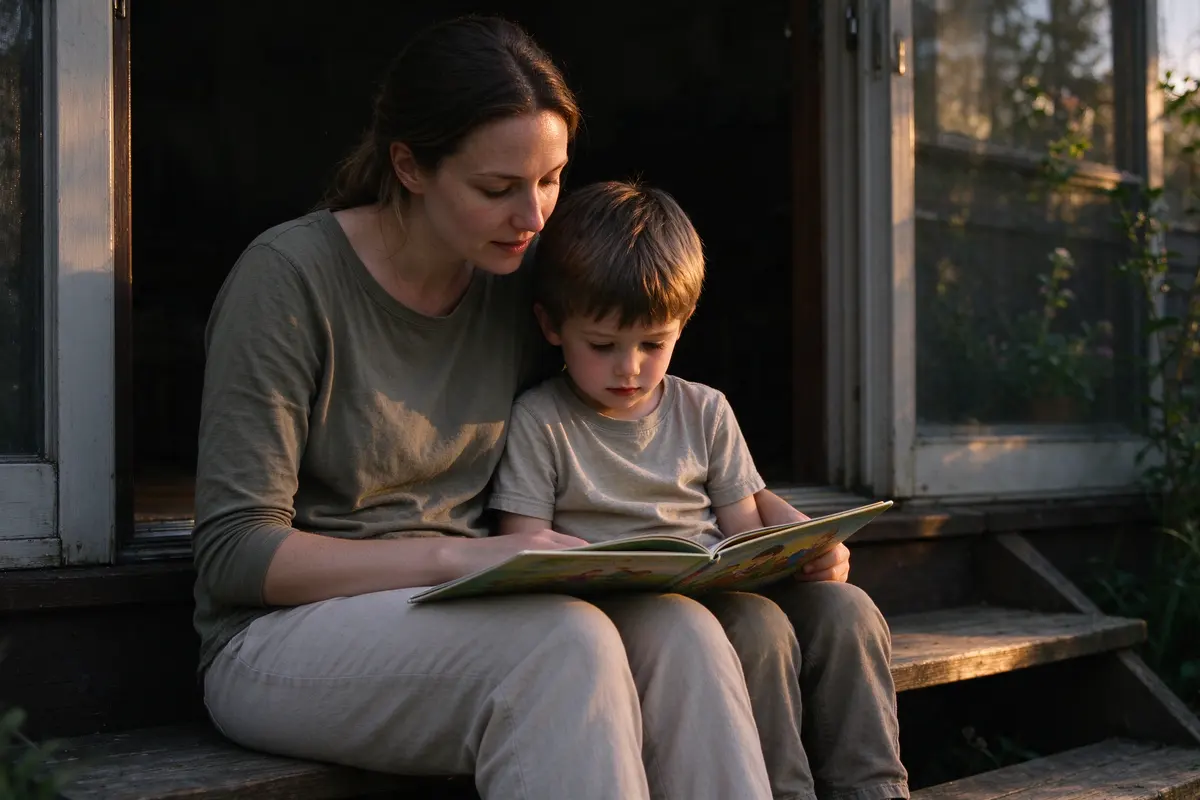
A few minutes for the older child, alone. Not a lesson, not a task; a book on the step, or the walk to the mailbox with nobody small strapped to you. The AAP's suggestion to invite siblings in comes with rules (AAP), and a child who gets a slice of you that isn't about the baby finds the rules easier to keep. Let the older child pick what you do.
If you're the partner: this is a two-adult day. One of you takes the baby somewhere else in the house for that slice, so it's real.
Sources
- American Academy of Pediatrics. "Emotional & Social Development in Babies: Birth Through 3 Months." HealthyChildren.org, 2026. https://www.healthychildren.org/English/ages-stages/baby/Pages/Emotional-and-Social-Development-Birth-to-3-Months.aspx
- American Academy of Pediatrics. "Developmental Milestones: 1-4 Months Old." HealthyChildren.org, 2026. https://www.healthychildren.org/English/ages-stages/baby/Pages/Developmental-Milestones-3-Months.aspx
- Mehr SA, Song LA, Spelke ES. "For 5-Month-Old Infants, Melodies Are Social." Psychological Science, 2016. https://pubmed.ncbi.nlm.nih.gov/26917211/
- Centers for Disease Control and Prevention. "Milestones by 4 Months." Learn the Signs. Act Early., 2026. https://www.cdc.gov/act-early/milestones/4-months.html
- Pomerantz WJ, Gittelman MA, Hornung R, Husseinzadeh H. "Falls in children birth to 5 years: different mechanisms lead to different injuries." Journal of Trauma and Acute Care Surgery, 2012. https://pubmed.ncbi.nlm.nih.gov/23026963/
- American Academy of Pediatrics. "Movement Milestones: Babies 4 to 7 Months." HealthyChildren.org, 2021. https://www.healthychildren.org/English/ages-stages/baby/Pages/Movement-4-to-7-Months.aspx
- American Academy of Pediatrics. "Developmental Milestones: 7 Months." HealthyChildren.org, 2009. https://www.healthychildren.org/English/ages-stages/baby/Pages/Developmental-Milestones-7-Months.aspx
- American Academy of Pediatrics. "Fever" (symptom checker). HealthyChildren.org, 2026. https://www.healthychildren.org/English/tips-tools/symptom-checker/Pages/symptomviewer.aspx?symptom=Fever
- American Academy of Pediatrics. "Fever and Your Baby." HealthyChildren.org, 2025. https://www.healthychildren.org/English/health-issues/conditions/fever/Pages/Fever-and-Your-Baby.aspx
- American Academy of Pediatrics. "Breathing Trouble" (symptom checker). HealthyChildren.org, 2026. https://www.healthychildren.org/English/tips-tools/symptom-checker/Pages/symptomviewer.aspx?symptom=Breathing+Trouble
This guide is general education that summarizes published research and guidance from groups like the American Academy of Pediatrics, the CDC, and the WHO. It isn’t medical advice, and every child develops on their own timeline. Your pediatrician knows your child; if something feels wrong, call them. In an emergency, call 911.
Get each day’s note the morning it applies
Add your baby to a free Chorevia household with their date of birth, and every morning for 120 days the day’s note arrives in the app and by email: what’s developing, one thing to try, what to watch for, and a word for you.
Create your household