Day 116 of 120 · Week 16
Seventeen weeks
Last reviewed · 3 min read · 12 sources · Plain-text version
Head steady when held is a 4-month milestone. A gentle pull-to-sit on the floor shows you what the neck can do now, and what it means if the head still lags.
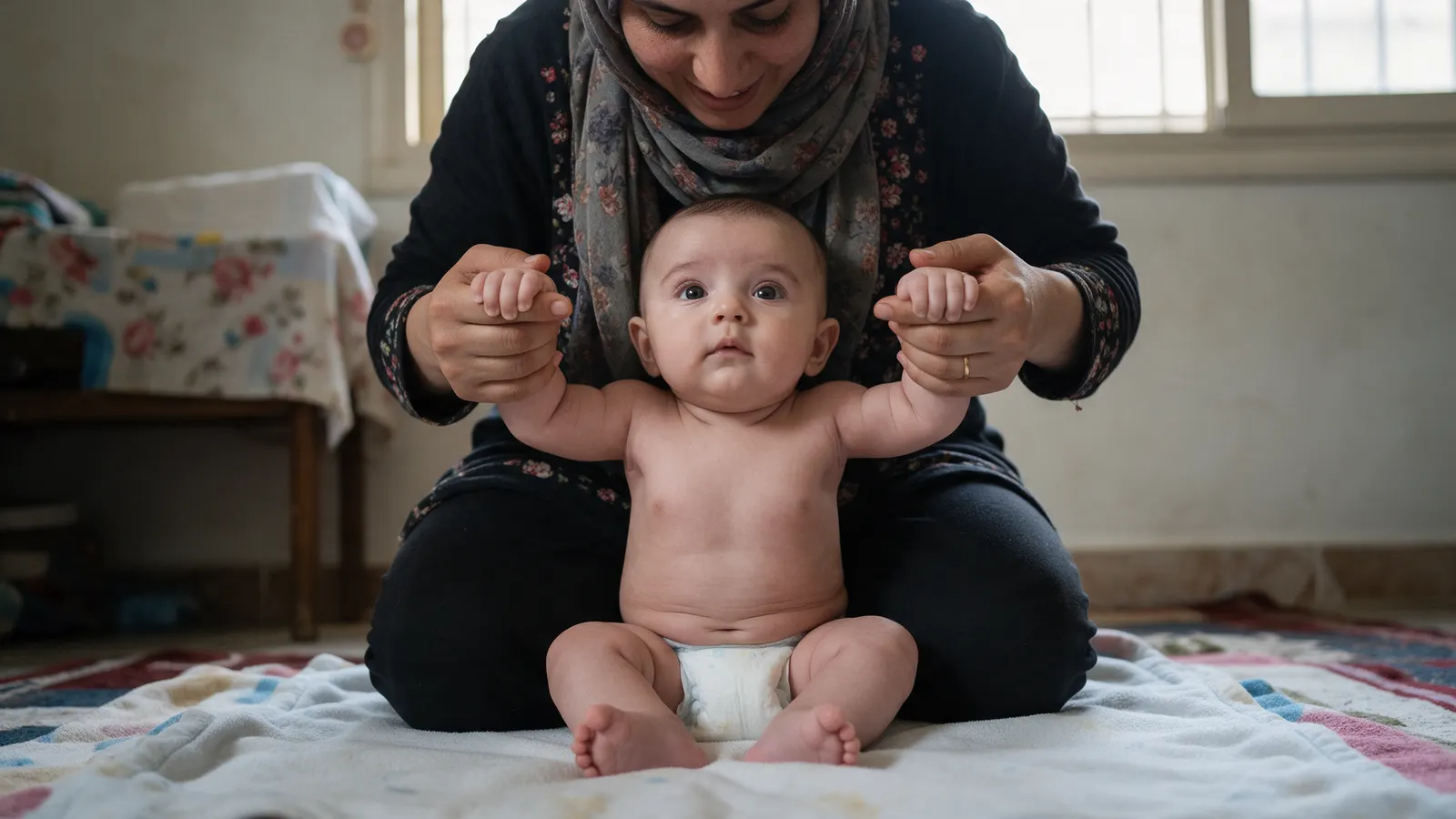
The neck that flopped in week one now holds a head up to look around. Today, a small way to see it, and what to notice.
Heart
By 4 months, most babies hold their head steady without support when you hold them (CDC). Between 4 and 7 months, the AAP lists a head that still flops back when your baby is pulled up to sitting as a sign to raise with your pediatrician (AAP). It's a useful thing to have seen for yourself before you're asked about it.
Head
Where the strength came from: tummy time. A systematic review of 16 mostly observational studies linked tummy time to better gross motor development, and to rolling and moving on the tummy (Hewitt et al., 2020); in a study of 100 four-month-olds, those who spent more awake time on their tummies had reached more motor milestones, an association rather than proof (Dudek-Shriber & Zelazny, 2007). WHO advises at least 30 minutes a day, spread out, for babies who aren't mobile yet (WHO).
Body
Try today
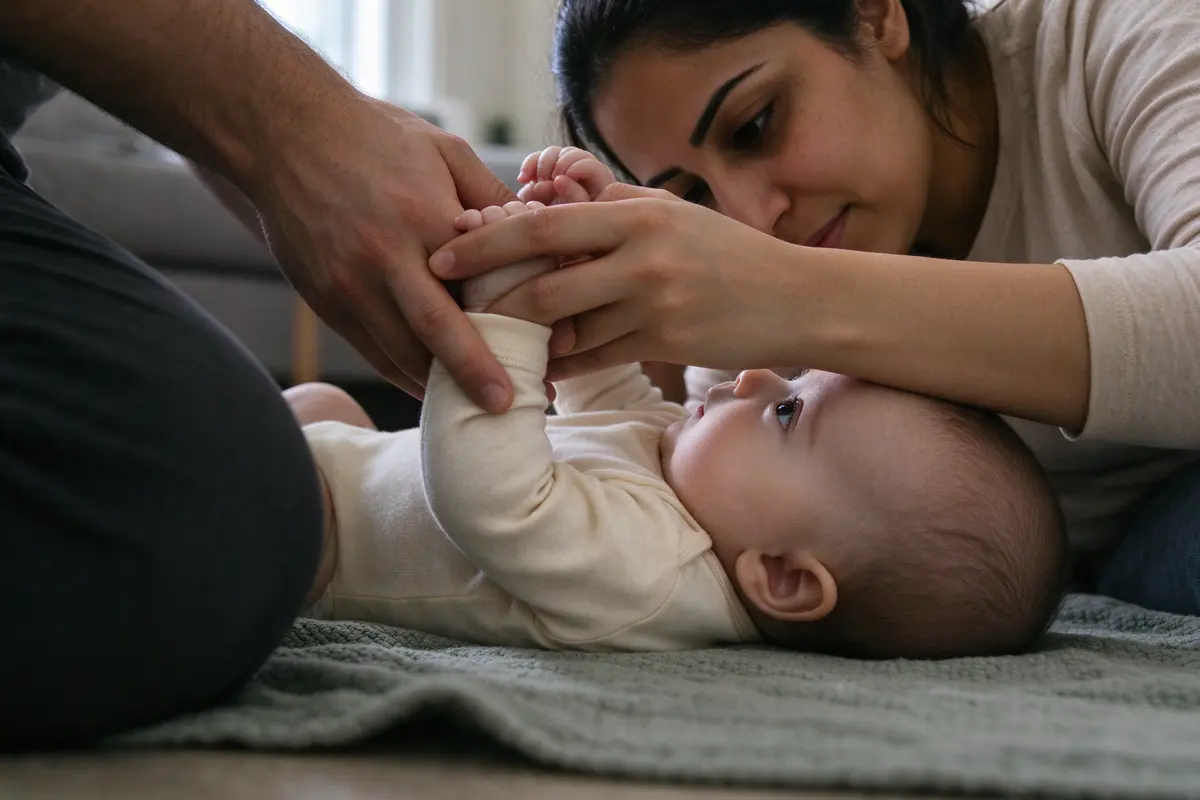
Pull-to-sit, gently
Time: 1 to 2 minutes, once, on the floor · Tummy-time look-around in the guide
Lay your baby on their back on a floor blanket and kneel at their feet, face to face.
Offer your thumbs; when they grip, wrap your fingers around their forearms.
Lift slowly toward sitting, watching the head: does the chin tuck and come along with the body, or does the head lag behind (AAP)?
If the head lags, stop, lower them, and support behind the shoulders instead; if it comes along, let them sit for a breath, then lower slowly.
Once or twice is plenty. Finish with the toy from yesterday within reach.
Make it work:Floor only. This hasn't been studied as an exercise; it's a way to see, and tummy time is still what builds the neck (Hewitt et al., 2020). A head that flops back goes on the question list, not the emergency list.
Watch for
Normal
a chin that tucks a beat late, then holds.
Raise it with your pediatrician
if the head still flops back when pulled to sitting, or your baby seems very stiff or very floppy (AAP).
Normal
rolling one way and not the other for a while (AAP).
Mention it
if your baby doesn't roll in either direction by 5 months (AAP).
Normal
a few sleepy, floppy minutes after a feed.
Call 911
if your baby can't be woken up, or is not moving or very weak (AAP).
Normal
a bump from a toy they swung themselves.
Call your pediatrician now
for any head injury from a fall, even if your baby seems fine (AAP).
For you
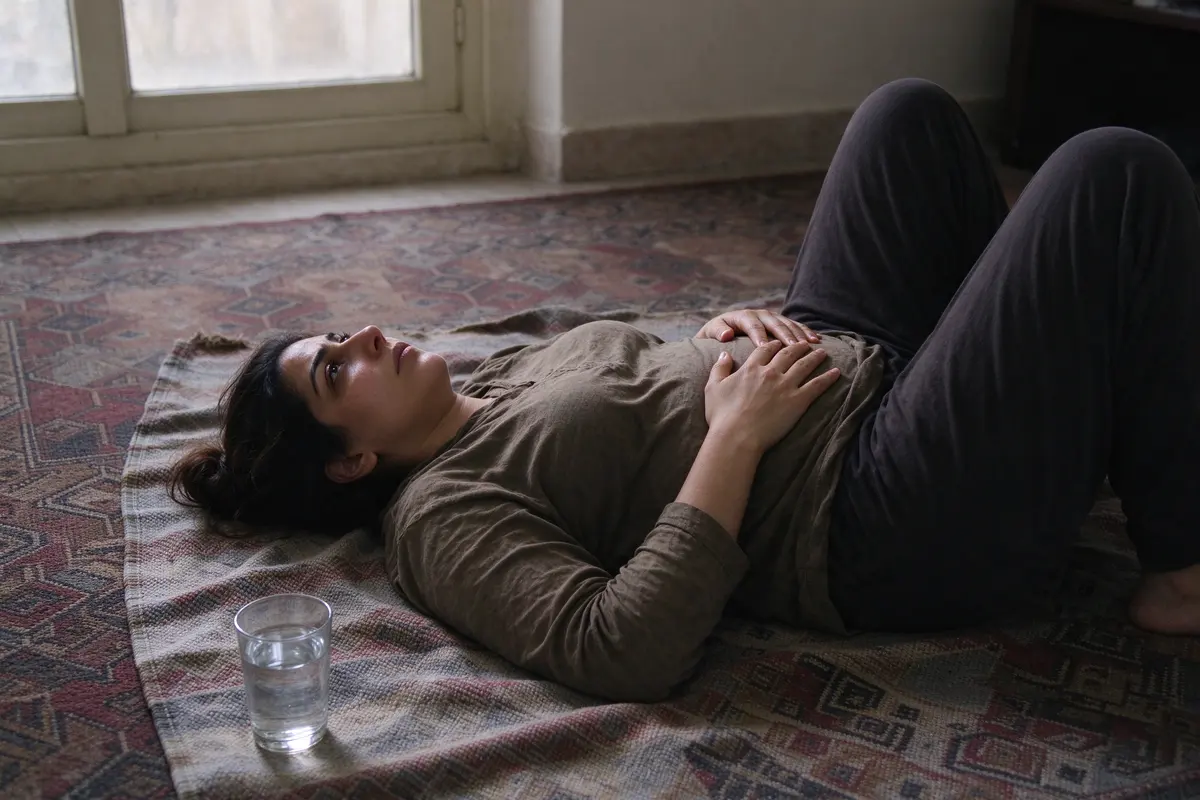
Your own core, and the pelvic floor question. If you had a C-section, most regular activities are back within 4 to 8 weeks, and the lifting limit is long past (MedlinePlus); whichever way you gave birth, the middle of you may still feel like it belongs to someone else. ACOG wants every mother to have had a full postpartum visit no later than 12 weeks after birth, covering recovery among other things (ACOG, 2018). At seventeen weeks, if that visit hasn't happened, book it; if it has, and leaking, heaviness, or a belly that bulges down the middle when you sit up didn't come up, call and ask who treats that. It's a question for your provider, not something to push through.
If you're the partner: the heavy things are yours a while longer. Carry the car seat, the laundry basket, the stroller up the steps, without being asked.
Sources
- Centers for Disease Control and Prevention. "Milestones by 4 Months." Learn the Signs. Act Early., 2026. https://www.cdc.gov/act-early/milestones/4-months.html
- American Academy of Pediatrics. "Developmental Milestones: 7 Months." HealthyChildren.org, 2009. https://www.healthychildren.org/English/ages-stages/baby/Pages/Developmental-Milestones-7-Months.aspx
- Hewitt L, Kerr E, Stanley RM, Okely AD. "Tummy Time and Infant Health Outcomes: A Systematic Review." Pediatrics, 2020. https://pubmed.ncbi.nlm.nih.gov/32371428/
- Dudek-Shriber L, Zelazny S. "The effects of prone positioning on the quality and acquisition of developmental milestones in four-month-old infants." Pediatric Physical Therapy, 2007. https://pubmed.ncbi.nlm.nih.gov/17304097/
- World Health Organization. "To grow up healthy, children need to sit less and play more." 2019. https://www.who.int/news/item/24-04-2019-to-grow-up-healthy-children-need-to-sit-less-and-play-more
- Wusthoff CJ. "Movement Milestones: Birth to 3 Months." HealthyChildren.org, 2020. https://www.healthychildren.org/English/ages-stages/baby/Pages/Movement-Birth-to-Three-Months.aspx
- Moon RY. "How to Keep Your Sleeping Baby Safe: AAP Policy Explained." HealthyChildren.org, 2026. https://www.healthychildren.org/English/ages-stages/baby/sleep/Pages/a-parents-guide-to-safe-sleep.aspx
- American Academy of Pediatrics. "Movement Milestones: Babies 4 to 7 Months." HealthyChildren.org, 2021. https://www.healthychildren.org/English/ages-stages/baby/Pages/Movement-4-to-7-Months.aspx
- American Academy of Pediatrics. "Fever" (symptom checker). HealthyChildren.org, 2026. https://www.healthychildren.org/English/tips-tools/symptom-checker/Pages/symptomviewer.aspx?symptom=Fever
- American Academy of Pediatrics. "Head Injury" (symptom checker). HealthyChildren.org, 2026. https://www.healthychildren.org/English/tips-tools/symptom-checker/Pages/symptomviewer.aspx?symptom=Head+Injury
- MedlinePlus. "Going home after a C-section." National Library of Medicine. https://medlineplus.gov/ency/patientinstructions/000624.htm
- American College of Obstetricians and Gynecologists. "ACOG Committee Opinion No. 736: Optimizing Postpartum Care." Obstetrics & Gynecology, 2018. https://pubmed.ncbi.nlm.nih.gov/29683911/
This guide is general education that summarizes published research and guidance from groups like the American Academy of Pediatrics, the CDC, and the WHO. It isn’t medical advice, and every child develops on their own timeline. Your pediatrician knows your child; if something feels wrong, call them. In an emergency, call 911.
Get each day’s note the morning it applies
Add your baby to a free Chorevia household with their date of birth, and every morning for 120 days the day’s note arrives in the app and by email: what’s developing, one thing to try, what to watch for, and a word for you.
Create your household