Day 103 of 120 · Week 14
Your family song
Last reviewed · 3 min read · 12 sources · Plain-text version
A song your baby hears from you, at the same moments every day, becomes a cue they recognize. Why the melody is social, and why the song is yours to pick.
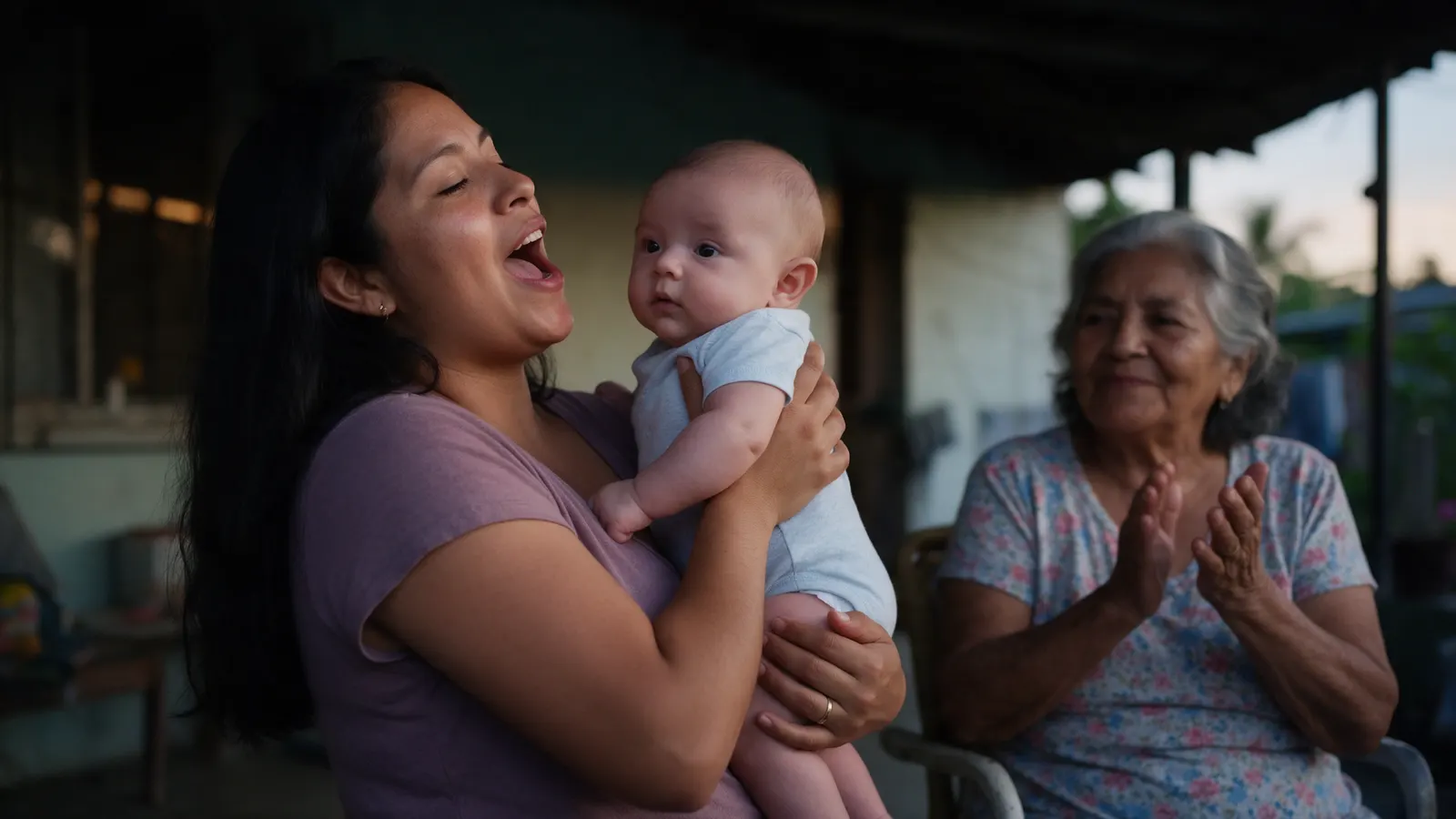
You've been singing for months, probably without deciding to. Today is about picking one song and making it the family's.
Heart
To your baby, a melody is a message about who sings it. In a lab study, 5-month-olds whose parent sang them a new song at home for 1 to 2 weeks later paid more attention to a stranger who sang that melody; hearing the song from a toy didn't do that (Mehr et al., 2016). The song isn't the point. The person is. A tune that comes from your mouth, your partner's, or a grandparent's becomes a sign of "my people," and your baby carries it into rooms you aren't in.
Head
A song is also a cue. The AAP suggests doing the same few things, in the same order, at naptime and bedtime, with steps you and your partner can both do (Moon, AAP), and in a survey of mothers of 10,085 children, more consistent bedtime routines went with better sleep, which can't prove cause (Mindell et al., 2015). A song that always comes before the crib is a routine your baby can hear coming. The same song at bath time tells them what happens next. Singing is also on the AAP's list of ways to soothe a crying baby (AAP), so the song you sing at bedtime is one you can reach for in the car.
Body
Your baby's ears are ready for this. By 4 months, many babies amuse themselves making strange new sounds and grow more sensitive to your tone of voice (AAP), and most turn their head toward your voice (CDC). Add a little movement, rocking or moving their arms in rhythm, and the song becomes something the whole body knows (CDC).
Try today
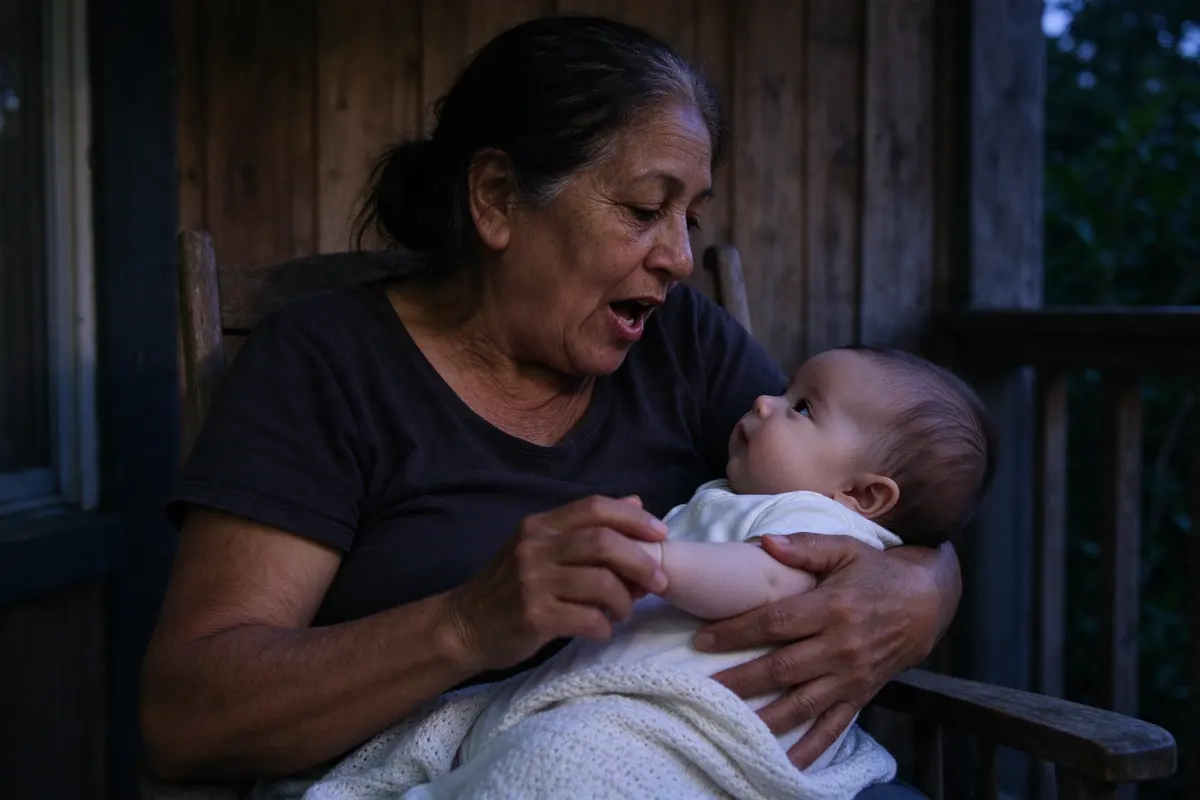
Your family song
Time: A song or two, every day · Your family song in the guide
Pick one song you actually like, in any language. A lullaby, a pop chorus, something your own parent sang.
Sing it today at two fixed moments, like after the bath and before the crib, face to face if you can.
Add gentle movement: rock, sway, or move your baby's arms in time.
Teach it to your partner and anyone who watches your baby, so it sounds the same from every lap.
Make it work:Singing counts even if you think you can't sing. Keep the song short enough to finish before your baby looks away or fusses, and stop there (AAP).
Watch for
Normal
going quiet and still when you sing, or squealing over the top of you; squeals and raspberries are 6-month milestones already on their way (CDC).
Bring it up with your pediatrician
if your baby doesn't turn toward sounds by 4 months (AAP).
Normal
a grunt or a hum of their own while they listen.
Call 911
for new grunting, wheezing, or whistling sounds with breathing, or if your baby is struggling for each breath (AAP).
Normal
a baby who drifts off during the bedtime verse.
Lay them down on their back
in their own bare sleep space, drowsy if possible, not on your chest on the sofa (Moon, AAP).
For you
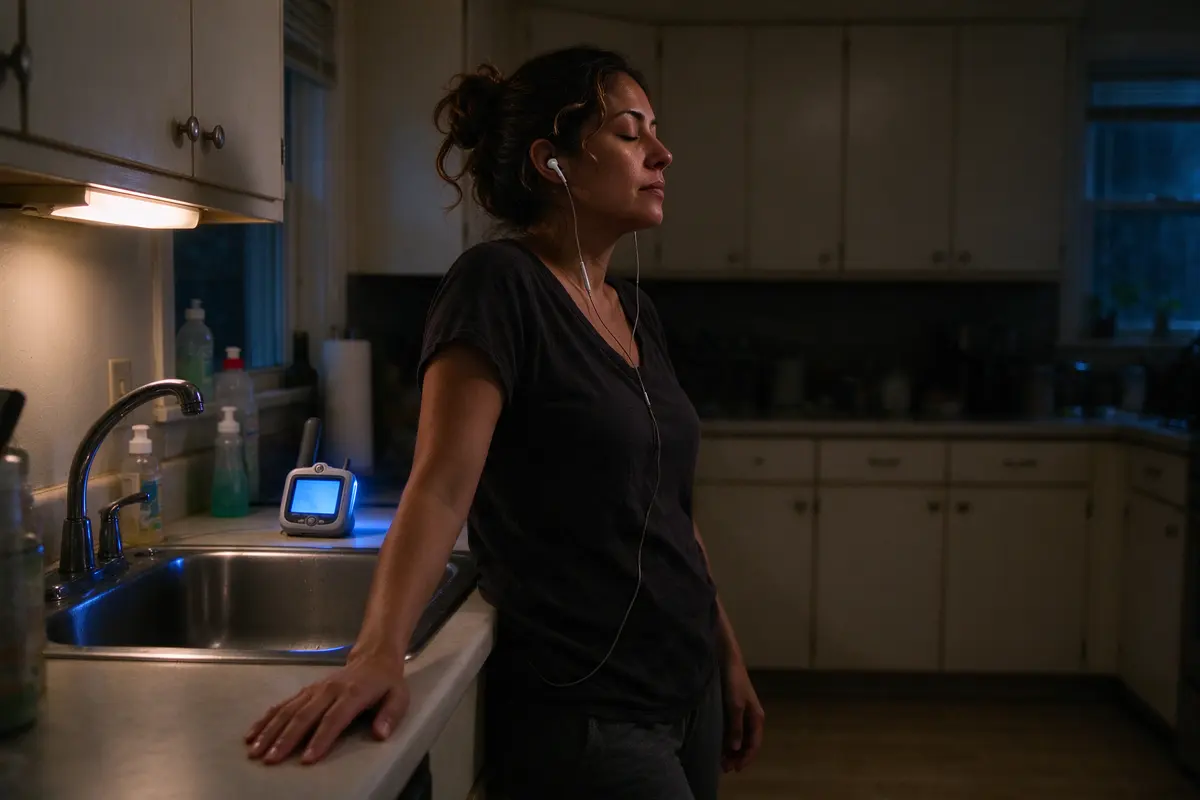
The song is yours to pick. Not the one from the app, not the one your mother-in-law prefers. If the song that comes out is sad, that's allowed too; your baby hears a voice they love, not the lyrics.
Listen to one of your own songs today, the kind you haven't played since the birth, with the baby asleep or in someone else's arms. It won't fix tiredness, and it isn't meant to. What it can do is remind you that you existed before this and still do. If low mood, anxiety, or emptiness has been severe or has lasted more than 2 weeks, that's possible postpartum depression, which usually doesn't improve without treatment but does respond to it (NIMH). Say so to someone.
If you're the partner: learn the words today. The song has to sound the same from you, and your baby will notice if it doesn't.
Sources
- Mehr SA, Song LA, Spelke ES. "For 5-Month-Old Infants, Melodies Are Social." Psychological Science, 2016. https://pubmed.ncbi.nlm.nih.gov/26917211/
- Moon RY. "Safe Sleep Tips for Sleep-Deprived New Parents." HealthyChildren.org, 2026. https://www.healthychildren.org/English/ages-stages/baby/sleep/Pages/safe-sleep-tips-for-sleep-deprived-parents.aspx
- Mindell JA, Li AM, Sadeh A, Kwon R, Goh DY. "Bedtime routines for young children: a dose-dependent association with sleep outcomes." Sleep, 2015. https://pubmed.ncbi.nlm.nih.gov/25325483/
- American Academy of Pediatrics. "Responding to Your Baby's Cries." HealthyChildren.org, 2025. https://www.healthychildren.org/English/ages-stages/baby/crying-colic/Pages/Responding-to-Your-Babys-Cries.aspx
- American Academy of Pediatrics. "Hearing & Making Sounds: Your Baby's Milestones." HealthyChildren.org, 2021. https://www.healthychildren.org/English/ages-stages/baby/Pages/Hearing-and-Making-Sounds.aspx
- Centers for Disease Control and Prevention. "Milestones by 4 Months." Learn the Signs. Act Early., 2026. https://www.cdc.gov/act-early/milestones/4-months.html
- American Academy of Pediatrics. "Emotional & Social Development in Babies: Birth Through 3 Months." HealthyChildren.org, 2026. https://www.healthychildren.org/English/ages-stages/baby/Pages/Emotional-and-Social-Development-Birth-to-3-Months.aspx
- Centers for Disease Control and Prevention. "Milestones by 6 Months." Learn the Signs. Act Early., 2026. https://www.cdc.gov/act-early/milestones/6-months.html
- American Academy of Pediatrics. "Developmental Milestones: 7 Months." HealthyChildren.org, 2009. https://www.healthychildren.org/English/ages-stages/baby/Pages/Developmental-Milestones-7-Months.aspx
- American Academy of Pediatrics. "Breathing Trouble" (symptom checker). HealthyChildren.org, 2026. https://www.healthychildren.org/English/tips-tools/symptom-checker/Pages/symptomviewer.aspx?symptom=Breathing+Trouble
- Moon RY. "How to Keep Your Sleeping Baby Safe: AAP Policy Explained." HealthyChildren.org, 2026. https://www.healthychildren.org/English/ages-stages/baby/sleep/Pages/a-parents-guide-to-safe-sleep.aspx
- National Institute of Mental Health. "Perinatal Depression." 2026. https://www.nimh.nih.gov/health/publications/perinatal-depression
This guide is general education that summarizes published research and guidance from groups like the American Academy of Pediatrics, the CDC, and the WHO. It isn’t medical advice, and every child develops on their own timeline. Your pediatrician knows your child; if something feels wrong, call them. In an emergency, call 911.
Get each day’s note the morning it applies
Add your baby to a free Chorevia household with their date of birth, and every morning for 120 days the day’s note arrives in the app and by email: what’s developing, one thing to try, what to watch for, and a word for you.
Create your household