Day 111 of 120 · Week 15
Sixteen weeks
Last reviewed · 3 min read · 12 sources · Plain-text version
The 4-month list, looked at gently one more time before the checkup: what most babies do by now, what a gap means, and why the answer is never to wait and see.
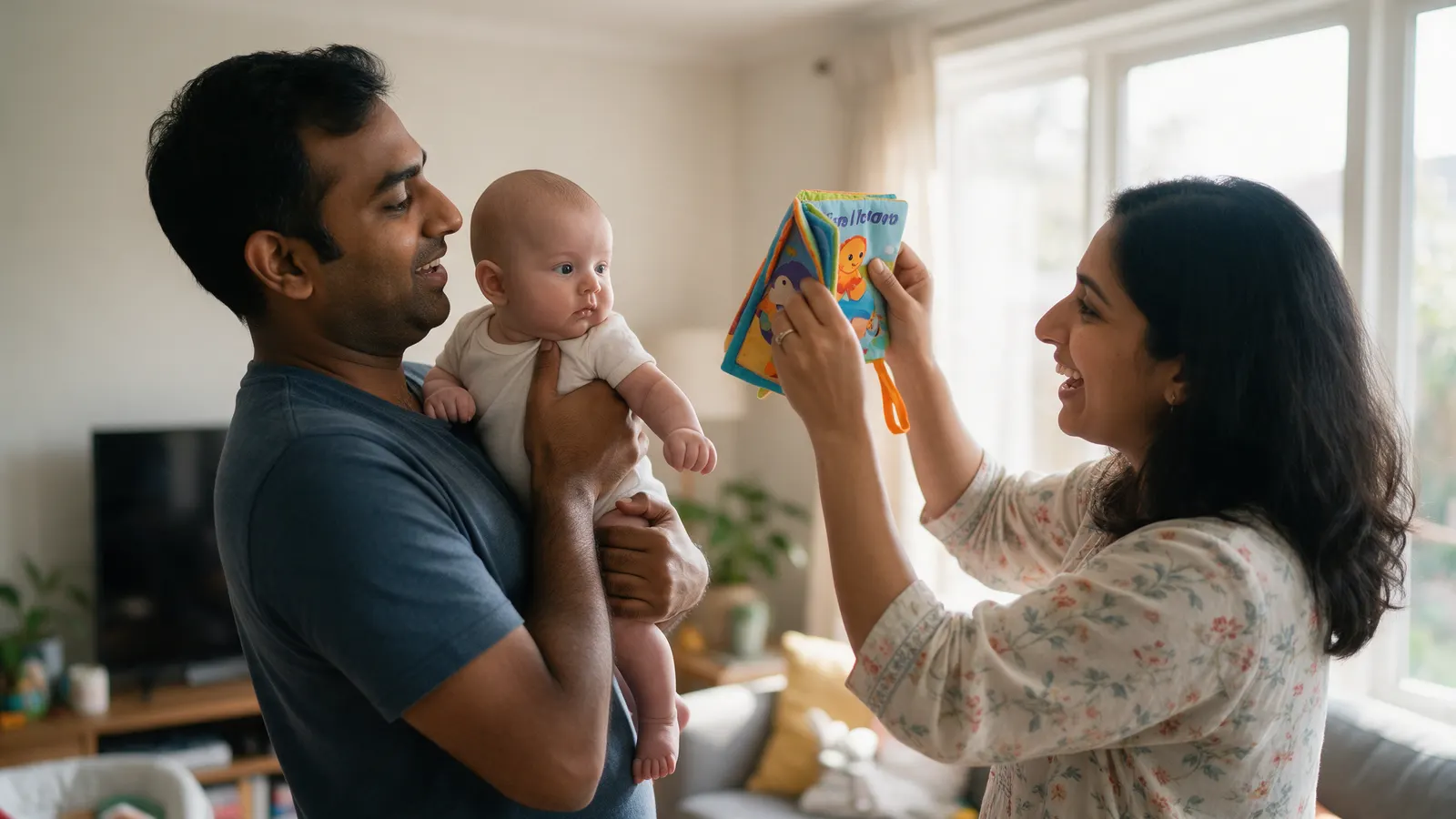
Sixteen weeks. The checkup is close, and the list it uses is worth one more calm look at home, where nobody is scoring.
Heart
Sixteen weeks is a real number in the research: lab tests first detect depth vision at about 16 weeks on average (Held et al., 1980), and in one study babies first grasped objects they could see at 16.0 weeks (Clifton et al., 1993). Averages, not deadlines. CDC's milestone lists name skills that at least 75% of babies show by each age, so a gap at sixteen weeks is a question for the visit, not a verdict (Zubler et al., 2022).
Head
By 4 months, most babies smile on their own to get your attention, chuckle when you try to make them laugh, coo, make sounds back, turn toward your voice, open their mouth at the sight of the breast or bottle, and look at their hands with interest (CDC). If your baby was born early, use corrected age for the first 2 years (AAP). And if something on the list worries you, the advice is not to wait: ask about developmental screening, or call your state's early intervention program for a free evaluation, no referral needed (CDC).
Body
The movement half of the list: holds the head steady without support when held, holds a toy you put in the hand, swings an arm at toys, brings hands to mouth, and pushes up onto elbows or forearms on the tummy (CDC). Reaching typically starts at around 3 months (AOA), and by 4 months many babies reach for and grasp nearby objects they see (AAP). Rolling is on the 6-month list, not this one (CDC).
Try today

A milestone look, month four
Time: 10 minutes, spread across the day, when your baby is alert · What's developing in the guide
Hold your baby upright against your chest and notice whether the head stays steady on its own (CDC).
On a floor blanket, tummy-down with you right there, watch for a push up onto elbows or forearms, then put a rattle in their hand and hold a toy within reach: do they hold it, swing at it, bring hands to mouth (CDC)?
Talk, then go quiet: a coo back, a turn toward your voice, a chuckle at a silly face (CDC).
At the next feed, watch the mouth as the breast or bottle comes into view (CDC).
Write down what you saw, what you didn't, and what you're not sure about, for tomorrow's visit.
Make it work:Nothing here is a test; a skill that shows up on Tuesday and hides on Wednesday is still a skill. Use corrected age if your baby was born early (AAP).
Watch for
Normal
a list with a gap or two at sixteen weeks; it describes 4 months (Zubler et al., 2022).
Don't wait
if your baby has lost a skill they had: ask about screening, or call early intervention for a free evaluation (CDC).
Normal
a head that wobbles at the end of a long upright hold.
Raise it with your pediatrician
if your baby seems very stiff or very floppy, or the head still flops back when pulled up to sitting (AAP).
Normal
eyes that mostly hold steady now.
Ask about an eye exam
if an eye seems to turn in or out all the time (AOA).
For you
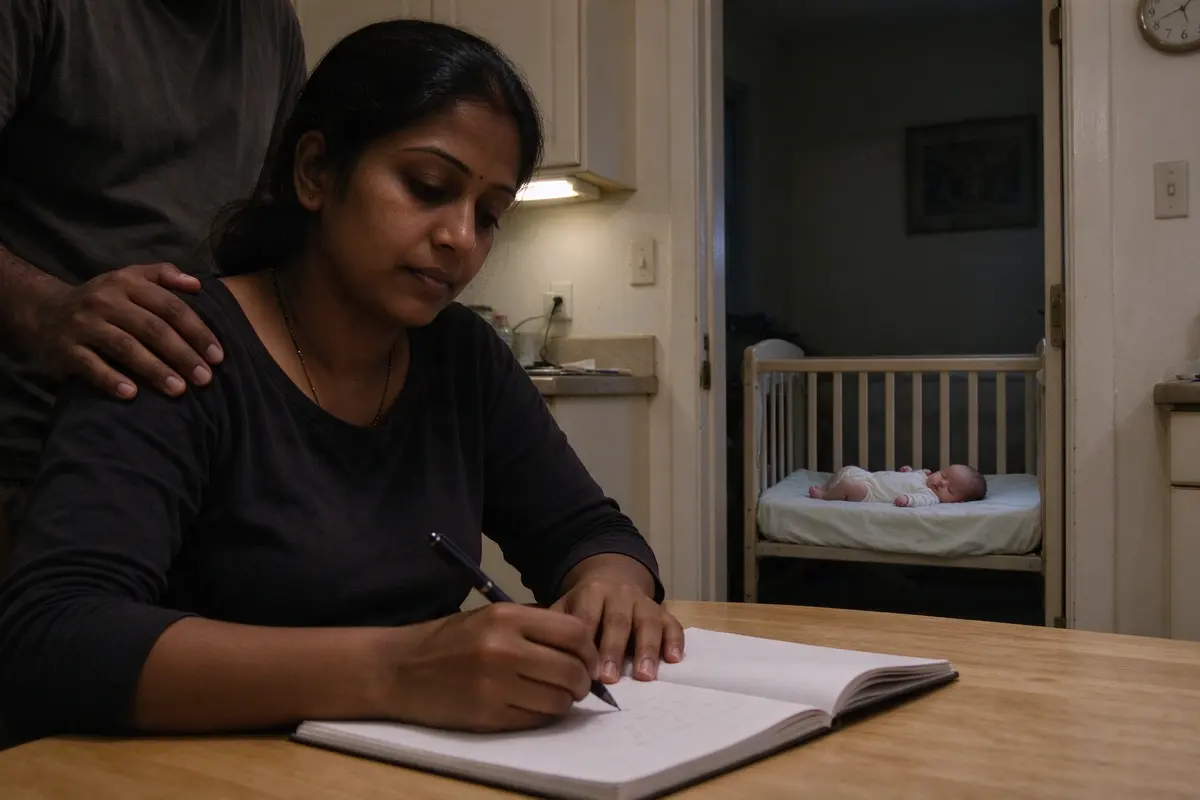
Finish the page for tomorrow, and keep your own two questions at the top. Your pediatrician will ask how you're doing at the 4-month visit (AAP); the AAP wants that question asked at the 1-, 2-, 4-, and 6-month visits (Earls et al., 2019). A written question gets a longer answer than "fine." Try "My body still doesn't feel like mine. Who should I see?"
Then the baby's: today's look, feeding, sleep, head shape.
If you're the partner: read the page tonight and add one line. Tomorrow, you ask it.
Sources
- Held R, Birch E, Gwiazda J. "Stereoacuity of human infants." Proceedings of the National Academy of Sciences, 1980. https://pubmed.ncbi.nlm.nih.gov/6933571/
- Clifton RK, Muir DW, Ashmead DH, Clarkson MG. "Is visually guided reaching in early infancy a myth?" Child Development, 1993. https://pubmed.ncbi.nlm.nih.gov/8404258/
- Zubler JM, Wiggins LD, Macias MM, et al. "Evidence-Informed Milestones for Developmental Surveillance Tools." Pediatrics, 2022. https://pubmed.ncbi.nlm.nih.gov/35132439/
- Centers for Disease Control and Prevention. "Milestones by 4 Months." Learn the Signs. Act Early., 2026. https://www.cdc.gov/act-early/milestones/4-months.html
- Centers for Disease Control and Prevention. "Milestones by 6 Months." Learn the Signs. Act Early., 2026. https://www.cdc.gov/act-early/milestones/6-months.html
- American Academy of Pediatrics. "Corrected Age For Preemies." HealthyChildren.org, 2018. https://www.healthychildren.org/English/ages-stages/baby/preemie/Pages/Corrected-Age-For-Preemies.aspx
- Centers for Disease Control and Prevention. "Concerned About Your Child's Development?" 2026. https://www.cdc.gov/act-early/families/concerned.html
- American Optometric Association. "Infant Vision: Birth to 24 Months of Age." 2026. https://www.aoa.org/healthy-eyes/eye-health-for-life/infant-vision
- American Academy of Pediatrics. "Infant Vision Development: What Can Babies See?" HealthyChildren.org, 2024. https://www.healthychildren.org/English/ages-stages/baby/Pages/Babys-Vision-Development.aspx
- American Academy of Pediatrics. "Developmental Milestones: 7 Months." HealthyChildren.org, 2009. https://www.healthychildren.org/English/ages-stages/baby/Pages/Developmental-Milestones-7-Months.aspx
- American Academy of Pediatrics. "Checkup Checklist: 4 Months Old." HealthyChildren.org, 2023. https://www.healthychildren.org/English/ages-stages/Your-Childs-Checkups/Pages/Your-Checkup-Checklist-4-Months-Old.aspx
- Earls MF, Yogman MW, Mattson G, Rafferty J. "Incorporating Recognition and Management of Perinatal Depression Into Pediatric Practice." Pediatrics, 2019. https://pubmed.ncbi.nlm.nih.gov/30559120/
This guide is general education that summarizes published research and guidance from groups like the American Academy of Pediatrics, the CDC, and the WHO. It isn’t medical advice, and every child develops on their own timeline. Your pediatrician knows your child; if something feels wrong, call them. In an emergency, call 911.
Get each day’s note the morning it applies
Add your baby to a free Chorevia household with their date of birth, and every morning for 120 days the day’s note arrives in the app and by email: what’s developing, one thing to try, what to watch for, and a word for you.
Create your household