Day 92 of 120 · Week 13
Laughs
Last reviewed · 3 min read · 9 sources · Plain-text version
Laughter first shows up at about 4 months on average, and your own laugh is part of how a baby learns what's funny. Chuckles, looking away, and the raspberry game.
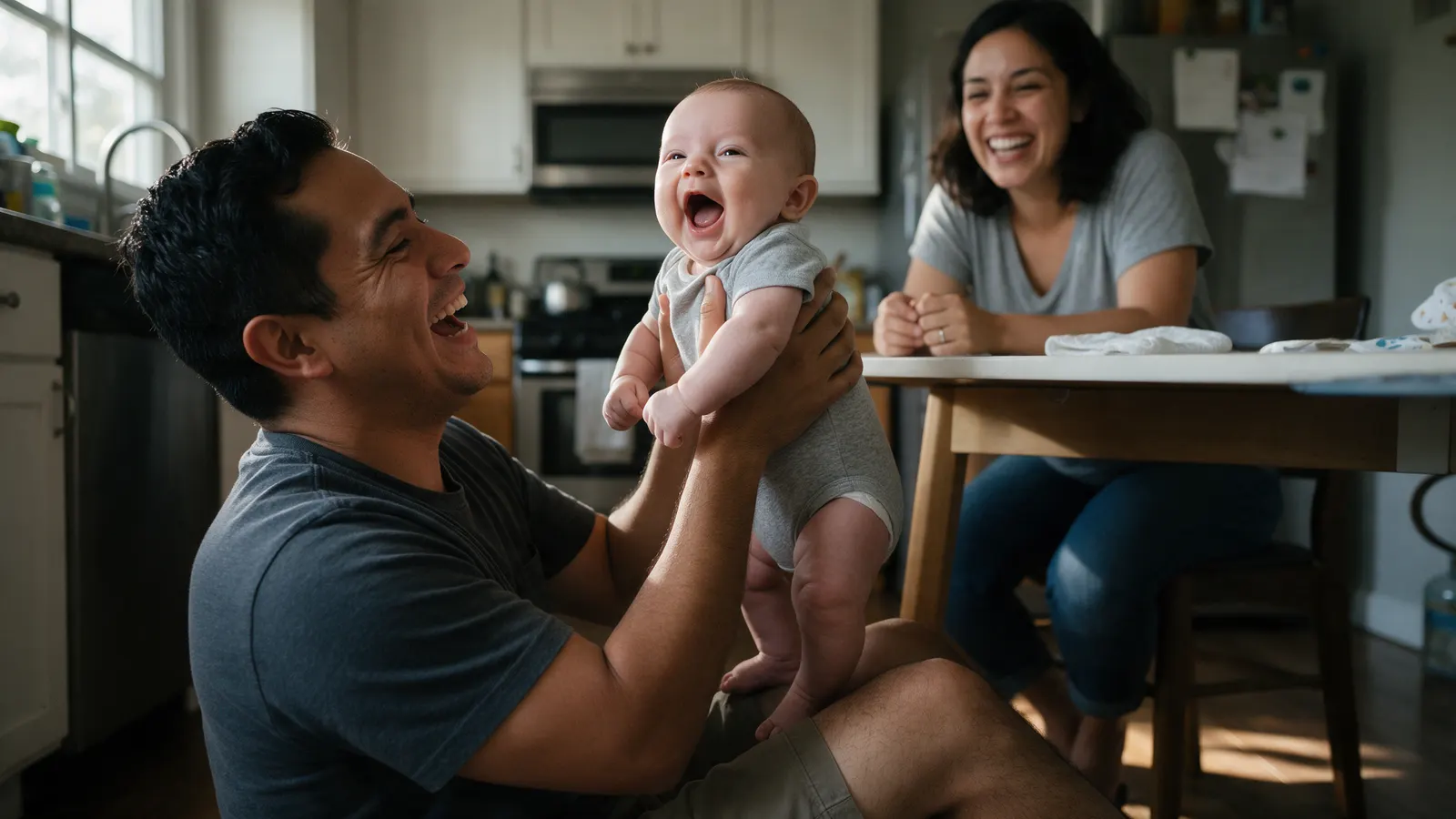
Somewhere between a coo and a hiccup is a chuckle. Today is about finding it, and about the one thing in the room that teaches a baby what's funny: you.
Heart
Laughter first appears at about 4 months on average, and in the second half of the first year babies start laughing at silly surprises, like a parent putting a book on their head (Mireault et al., 2015). Chuckles are a 4-month milestone and full laughs a 6-month one, so the window is wide (CDC; CDC). If your baby looks away in the middle of a game, that's control, not rejection; it keeps them from getting overwhelmed (AAP).
Head
Fun is shared, and your face is the lesson. In a study of 37 babies tested at 5 to 7 months, babies smiled longer, or sooner and more often, at a parent's raspberries when the parent laughed too (Mireault et al., 2015). Your laughter helps your baby figure out what's funny (Mireault et al., 2015). So the game isn't the raspberry; it's the raspberry plus your reaction. Laugh first, then wait and watch what comes back.
Body
A laugh needs an alert, fed, rested baby, so pick your moment. CDC suggests peekaboo at this age and paying close attention to how your baby reacts to different things (CDC); one baby chuckles at a sneeze, another at a sock on your hand. Squeals come later; they're a 6-month milestone (CDC). Stop while it's still fun, before the look-away turns into a fuss (AAP).
Try today

Raspberry laugh game
Time: A few minutes, when your baby is happy and alert · Raspberry laugh game in the guide
Blow a gentle raspberry on your baby's tummy or on your own hand.
Laugh, then pause and watch your baby's face.
Repeat whatever gets a smile or a chuckle, and change it up if nothing does: a slower raspberry, a sillier face.
Stop while it's still fun, and take a break when your baby looks away.
Make it work:Laugh games haven't been tested at 3 to 4 months, and the raspberry study was done with 5- to 7-month-olds (Mireault et al., 2015). A game with no laugh yet is still a game.
Watch for
Normal
Raise it with your pediatrician
if your baby doesn't smile on their own by 5 months (AAP).
Normal
a laugh that ends in a hiccup or a cough.
Call 911
if your baby is struggling to breathe, has stopped breathing, or has bluish lips or face (AAP).
Normal
a game that ends in fussing because you went one round too long.
Call your pediatrician right away
if your baby has a fever and cries nonstop or cries when touched (AAP).
For you

Laugh along; your reaction is part of the game (Mireault et al., 2015). That's an instruction, not a performance review. Nobody laughs on command at week thirteen on broken sleep, and a baby can't tell a tired laugh from a rested one.
If nothing has felt funny for a while, notice that. Low mood, anxiety, or emptiness that is severe or lasts more than 2 weeks may be postpartum depression, which usually doesn't improve without treatment but does respond to therapy, medication, or both (NIMH). Call or text the National Maternal Mental Health Hotline at 1-833-TLC-MAMA (1-833-852-6262), or call or text 988 (CDC).
If you're the partner: the raspberry is yours tonight. Then tell her the thing that made the baby laugh, so she gets the laugh twice.
Sources
- Mireault GC, Crockenberg SC, Sparrow JE, et al. "Laughing matters: Infant humor in the context of parental affect." Journal of Experimental Child Psychology, 2015. https://pubmed.ncbi.nlm.nih.gov/25897958/
- Centers for Disease Control and Prevention. "Milestones by 4 Months." Learn the Signs. Act Early., 2026. https://www.cdc.gov/act-early/milestones/4-months.html
- Centers for Disease Control and Prevention. "Milestones by 6 Months." Learn the Signs. Act Early., 2026. https://www.cdc.gov/act-early/milestones/6-months.html
- American Academy of Pediatrics. "Emotional & Social Development: Birth Through 3 Months." HealthyChildren.org, 2026. https://www.healthychildren.org/English/ages-stages/baby/Pages/Emotional-and-Social-Development-Birth-to-3-Months.aspx
- American Academy of Pediatrics. "Developmental Milestones: 7 Months." HealthyChildren.org, 2009. https://www.healthychildren.org/English/ages-stages/baby/Pages/Developmental-Milestones-7-Months.aspx
- American Academy of Pediatrics. "Breathing Trouble" (symptom checker). HealthyChildren.org, 2026. https://www.healthychildren.org/English/tips-tools/symptom-checker/Pages/symptomviewer.aspx?symptom=Breathing+Trouble
- American Academy of Pediatrics. "Fever" (symptom checker). HealthyChildren.org, 2026. https://www.healthychildren.org/English/tips-tools/symptom-checker/Pages/symptomviewer.aspx?symptom=Fever
- National Institute of Mental Health. "Perinatal Depression." 2026. https://www.nimh.nih.gov/health/publications/perinatal-depression
- Centers for Disease Control and Prevention. "Symptoms of Depression Among Women." 2024. https://www.cdc.gov/reproductive-health/depression/index.html
This guide is general education that summarizes published research and guidance from groups like the American Academy of Pediatrics, the CDC, and the WHO. It isn’t medical advice, and every child develops on their own timeline. Your pediatrician knows your child; if something feels wrong, call them. In an emergency, call 911.
Get each day’s note the morning it applies
Add your baby to a free Chorevia household with their date of birth, and every morning for 120 days the day’s note arrives in the app and by email: what’s developing, one thing to try, what to watch for, and a word for you.
Create your household