Day 95 of 120 · Week 13
A steadier head
Last reviewed · 3 min read · 9 sources · Plain-text version
By 4 months most babies hold their head steady when held. How tummy time builds it, the one sign to raise between 4 and 7 months, and a look-around game on the floor.
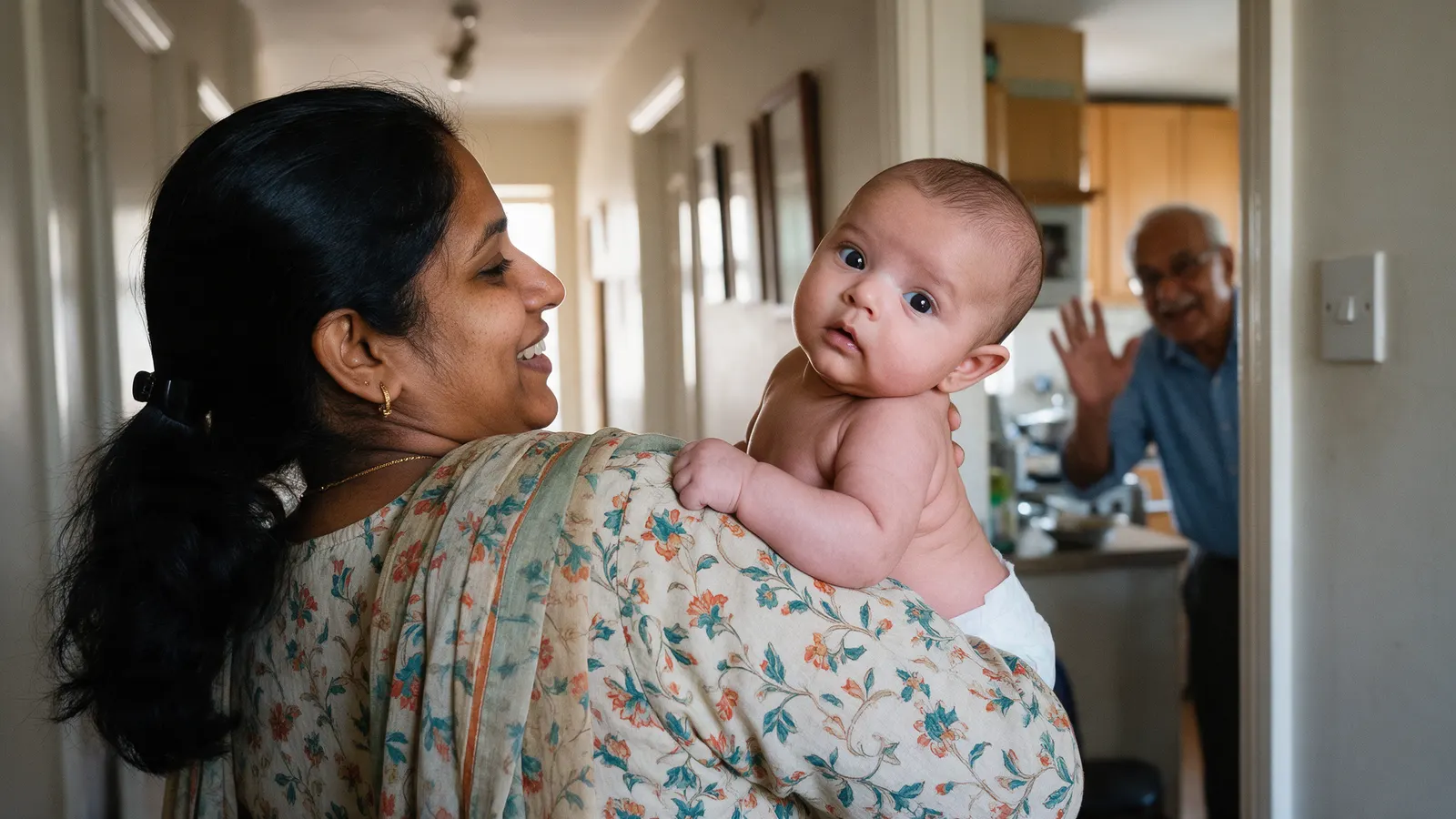
The wobble is going. A head that holds itself up changes what your baby can see, and what you can do with your hands. Today is about how it gets there.
Heart
By 4 months, most babies hold their head steady without support when you hold them (CDC). You'll feel it before you see it: the hand you've kept behind the neck since day one has less to do. Between 4 and 7 months, the AAP lists a head that still flops back when your baby is pulled up to sitting as a sign to raise with your pediatrician (AAP). Not today's test; just the one thing to notice over the coming weeks.
Head
A steady head is built on the floor. A systematic review of 16 mostly observational studies linked tummy time to better gross motor development and to rolling and moving on the tummy (Hewitt et al., 2020), and WHO recommends at least 30 minutes a day, spread out, for babies who aren't mobile yet (WHO). In a study of 100 four-month-olds, those who spent more awake time on their tummies had reached more motor milestones, an association rather than proof (Dudek-Shriber & Zelazny, 2007). Pushing up onto elbows or forearms is on the 4-month list (CDC), and every push-up is a neck workout.
Body
Give the head a reason to lift. On the tummy, an interesting toy coaxes your baby to lift their head and look around (AAP), and turning toward your voice is a 4-month skill too (CDC). Seats work against it: WHO says no more than 1 hour at a time strapped into a seat or carrier (WHO), and CDC advises avoiding long stretches in swings, strollers, and bouncy seats (CDC).
Try today
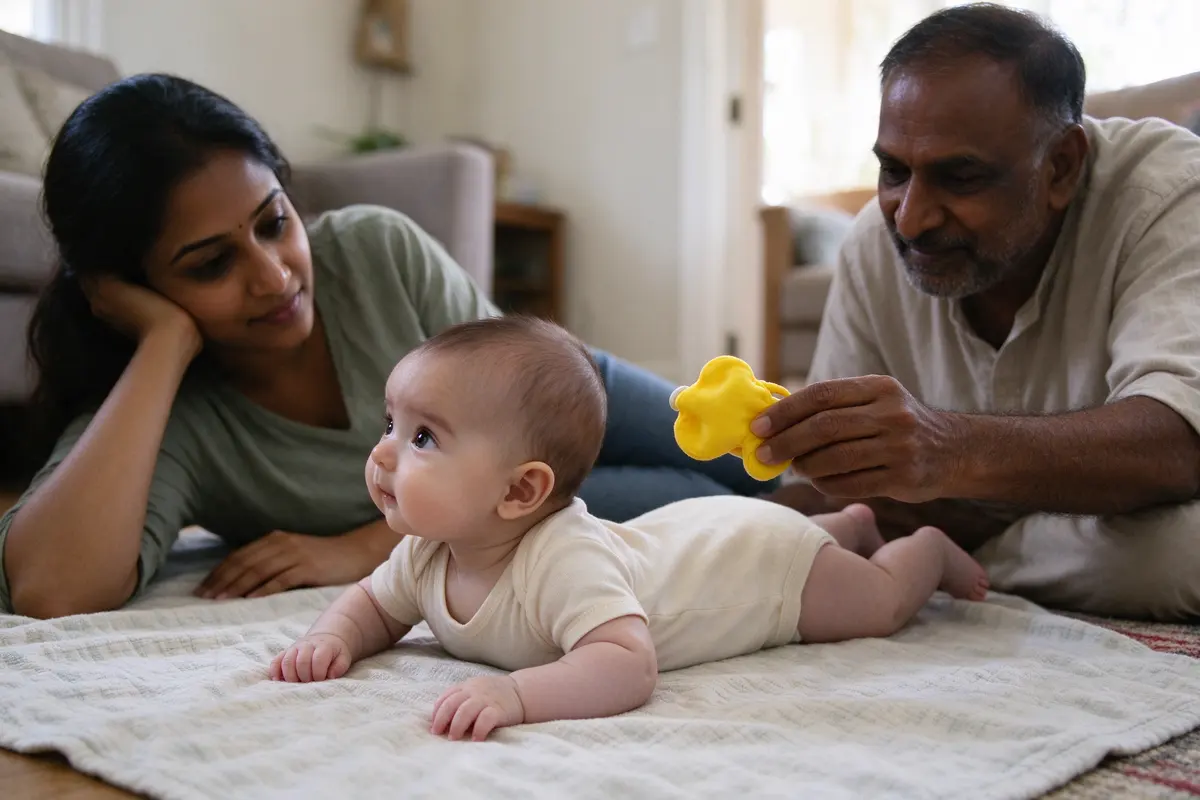
Tummy-time look-around
Time: 3 to 10 minutes, several times a day · Tummy-time look-around in the guide
Lay your baby tummy-down on a firm, flat surface on the floor with their arms forward.
Hold a bright toy in front of them, then slowly raise it so they lift their head and chest.
Move it a little to each side so they turn and shift their weight.
End the session while they're still happy, and lay them on their back if they get sleepy.
Make it work:Several short sessions count toward the day's total. Stay with your baby the whole time.
Watch for
Normal
a head that bobs when your baby is tired and holds steady when they're fresh (CDC).
Raise it with your pediatrician
if your baby seems very stiff or very floppy, or their head still flops back when pulled up to sitting over the next few months (AAP).
Normal
a fussy few minutes on the tummy before the head comes up.
Go to the ER now
if your baby has a fever with a bulging soft spot or stiff neck, or isn't alert when awake (AAP).
Normal
a baby who melts into your shoulder after a long floor session.
Call 911
if your baby can't be woken up, or is not moving or very weak (AAP).
For you

Your own neck and shoulders. Thirteen weeks of looking down at a baby, and lifting one that now weighs noticeably more, has probably pulled your shoulders up and your chin forward. The AAP's rule for carrying is bend at the knees, not the waist, to pick things up (AAP); the floor-session version is to lie down beside your baby instead of hunching over them. Three slow shoulder rolls backward, every time you set the baby down, is a routine you can actually keep.
A sore neck is one thing. Chest pain or a fast-beating heart is on the CDC's urgent maternal warning signs list; seek care immediately for that, and tell the provider you were pregnant within the last year (CDC).
If you're the partner: tonight's floor sessions are yours. And when she's feeding, put a pillow behind her back before she asks.
Sources
- Centers for Disease Control and Prevention. "Milestones by 4 Months." Learn the Signs. Act Early., 2026. https://www.cdc.gov/act-early/milestones/4-months.html
- American Academy of Pediatrics. "Developmental Milestones: 7 Months." HealthyChildren.org, 2009. https://www.healthychildren.org/English/ages-stages/baby/Pages/Developmental-Milestones-7-Months.aspx
- Hewitt L, Kerr E, Stanley RM, Okely AD. "Tummy Time and Infant Health Outcomes: A Systematic Review." Pediatrics, 2020. https://pubmed.ncbi.nlm.nih.gov/32371428/
- World Health Organization. "To grow up healthy, children need to sit less and play more." 2019. https://www.who.int/news/item/24-04-2019-to-grow-up-healthy-children-need-to-sit-less-and-play-more
- Dudek-Shriber L, Zelazny S. "The effects of prone positioning on the quality and acquisition of developmental milestones in four-month-old infants." Pediatric Physical Therapy, 2007. https://pubmed.ncbi.nlm.nih.gov/17304097/
- American Academy of Pediatrics. "Movement Milestones: Babies 4 to 7 Months." HealthyChildren.org, 2021. https://www.healthychildren.org/English/ages-stages/baby/Pages/Movement-4-to-7-Months.aspx
- American Academy of Pediatrics. "Fever" (symptom checker). HealthyChildren.org, 2026. https://www.healthychildren.org/English/tips-tools/symptom-checker/Pages/symptomviewer.aspx?symptom=Fever
- American Academy of Pediatrics. "Baby Carriers: Backpacks, Front Packs & Slings." HealthyChildren.org, 2025. https://www.healthychildren.org/English/safety-prevention/on-the-go/Pages/Baby-Carriers.aspx
- Centers for Disease Control and Prevention. "Urgent Maternal Warning Signs and Symptoms." HEAR HER. https://www.cdc.gov/hearher/maternal-warning-signs/index.html
This guide is general education that summarizes published research and guidance from groups like the American Academy of Pediatrics, the CDC, and the WHO. It isn’t medical advice, and every child develops on their own timeline. Your pediatrician knows your child; if something feels wrong, call them. In an emergency, call 911.
Get each day’s note the morning it applies
Add your baby to a free Chorevia household with their date of birth, and every morning for 120 days the day’s note arrives in the app and by email: what’s developing, one thing to try, what to watch for, and a word for you.
Create your household