Day 102 of 120 · Week 14
Hidden things come back
Last reviewed · 3 min read · 10 sources · Plain-text version
Sometime after 4 months, babies start to grasp that a thing out of sight still exists. Peekaboo is the lesson, and it works on tired parents too.

Cover your face and your baby isn't sure you're still there. Uncover it and you're the best thing that has happened all morning. Today is the game that teaches a big idea.
Heart
Peekaboo looks like nothing and is a lesson in trust. Sometime after 4 months, babies start to grasp that things exist even when they're out of sight, and hiding games help (AAP). For now your baby lives in the moment: gone is gone, back is a small miracle. The pop-out is funny because it's a surprise, and your laughing along is part of how your baby learns what counts as funny (Mireault et al., 2015). Chuckles are a 4-month milestone and full laughs a 6-month one, so the window for the first real laugh is wide (CDC; CDC).
Head
This month's thinking list is short and important. My actions make things happen: a kick shakes the crib, a wave makes the rattle sound (AAP). Hidden things come back (AAP). Neither one needs a toy with batteries. CDC puts peekaboo on its 4-month list of things to do, alongside paying close attention to how your baby reacts to different things (CDC). Watch the reaction more than the game. A long stare, a kick, a chuckle, a look away: each one tells you where your baby is today.
Body
The look-away is the body's way of saying "enough for now." Looking away mid-game is normal; it keeps your baby from getting overwhelmed (AAP). It isn't rejection and it isn't boredom. Wait a beat, and the eyes usually come back on their own. By 4 months most babies look at you, move, or make sounds to get or keep your attention (CDC), so you'll be invited back in.
Try today
Peekaboo
Time: 1 to 3 minutes · Peekaboo in the guide
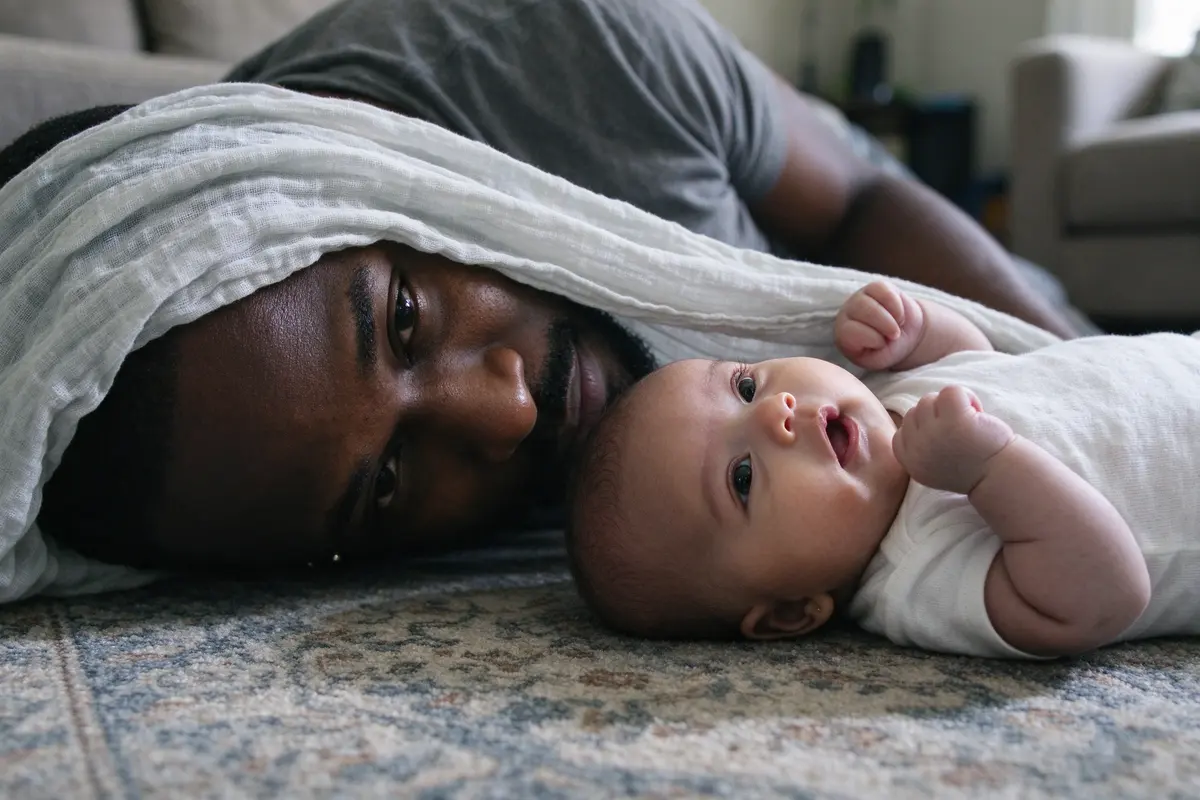
Lay your baby on their back on the floor, fed and alert, and get your face a foot or so above theirs.
Cover your face with your hands or a light cloth. Pause for a breath.
Pop out with a big smile: "Peekaboo!" Laugh if you feel like it; your reaction is part of the game (Mireault et al., 2015).
Repeat while your baby is smiling, and stop when they look away (AAP).
Make it work:Keep the cloth in your hands, never draped over your baby's face, and put it away when you're done; nothing loose goes in the crib (Moon, AAP).
Watch for
Normal
a baby who stares, kicks, and never cracks a smile at peekaboo this week; chuckling when you try to make them laugh is a 4-month milestone, not a 14-week one (CDC).
Bring it up with your pediatrician
if your baby doesn't smile on their own by 5 months (AAP).
Normal
turning toward your "peekaboo" before you've uncovered your face; most babies turn their head toward your voice by 4 months (CDC).
Bring it up
if your baby doesn't turn toward sounds by 4 months (AAP).
Normal
a little spit-up from laughing on a full stomach.
Call your pediatrician right away
if your baby vomits 2 or more times, not just spit-up (AAP).
For you

The game works on tired parents too. In a German study of 2,541 mothers and 2,118 fathers, sleep hit its low point in the first 3 months after birth, with mothers sleeping 62 minutes less a night than before pregnancy (Richter et al., 2019). You are coming out of the low point, not past it. A minute of peekaboo on the floor is a minute lying down, and a laugh you didn't plan is still a laugh.
Mood is a different thing from tiredness. If sadness has lasted more than two weeks, go to the doctor; don't wait for a visit (OWH).
If you're the partner: play it with her watching, then hide and let her do the pop-out. Her face is the one your baby looks for first.
Sources
- American Academy of Pediatrics. "Cognitive Development in Infants: 4 to 7 Months." HealthyChildren.org, 2023. https://www.healthychildren.org/English/ages-stages/baby/Pages/Cognitive-Development-4-to-7-Months.aspx
- Mireault GC, Crockenberg SC, Sparrow JE, et al. "Laughing matters: Infant humor in the context of parental affect." Journal of Experimental Child Psychology, 2015. https://pubmed.ncbi.nlm.nih.gov/25897958/
- Centers for Disease Control and Prevention. "Milestones by 4 Months." Learn the Signs. Act Early., 2026. https://www.cdc.gov/act-early/milestones/4-months.html
- Centers for Disease Control and Prevention. "Milestones by 6 Months." Learn the Signs. Act Early., 2026. https://www.cdc.gov/act-early/milestones/6-months.html
- American Academy of Pediatrics. "Emotional & Social Development in Babies: Birth Through 3 Months." HealthyChildren.org, 2026. https://www.healthychildren.org/English/ages-stages/baby/Pages/Emotional-and-Social-Development-Birth-to-3-Months.aspx
- Moon RY. "How to Keep Your Sleeping Baby Safe: AAP Policy Explained." HealthyChildren.org, 2026. https://www.healthychildren.org/English/ages-stages/baby/sleep/Pages/a-parents-guide-to-safe-sleep.aspx
- American Academy of Pediatrics. "Developmental Milestones: 7 Months." HealthyChildren.org, 2009. https://www.healthychildren.org/English/ages-stages/baby/Pages/Developmental-Milestones-7-Months.aspx
- American Academy of Pediatrics. "Vomiting Without Diarrhea" (symptom checker). HealthyChildren.org, 2026. https://www.healthychildren.org/English/tips-tools/symptom-checker/Pages/symptomviewer.aspx?symptom=Vomiting+Without+Diarrhea
- Richter D, Krämer MD, Tang NKY, Montgomery-Downs HE, Lemola S. "Long-term effects of pregnancy and childbirth on sleep satisfaction and duration of first-time and experienced mothers and fathers." Sleep, 2019. https://pubmed.ncbi.nlm.nih.gov/30649536/
- Office on Women's Health. "Recovering from birth." US Department of Health and Human Services. https://womenshealth.gov/pregnancy/childbirth-and-beyond/recovering-birth
This guide is general education that summarizes published research and guidance from groups like the American Academy of Pediatrics, the CDC, and the WHO. It isn’t medical advice, and every child develops on their own timeline. Your pediatrician knows your child; if something feels wrong, call them. In an emergency, call 911.
Get each day’s note the morning it applies
Add your baby to a free Chorevia household with their date of birth, and every morning for 120 days the day’s note arrives in the app and by email: what’s developing, one thing to try, what to watch for, and a word for you.
Create your household