Day 106 of 120 · Week 15
A rough patch
Last reviewed · 4 min read · 8 sources · Plain-text version
Nights that were getting better and suddenly aren't. Days bright, nights boring, the routine held steady, and the one thing exhaustion must never move.
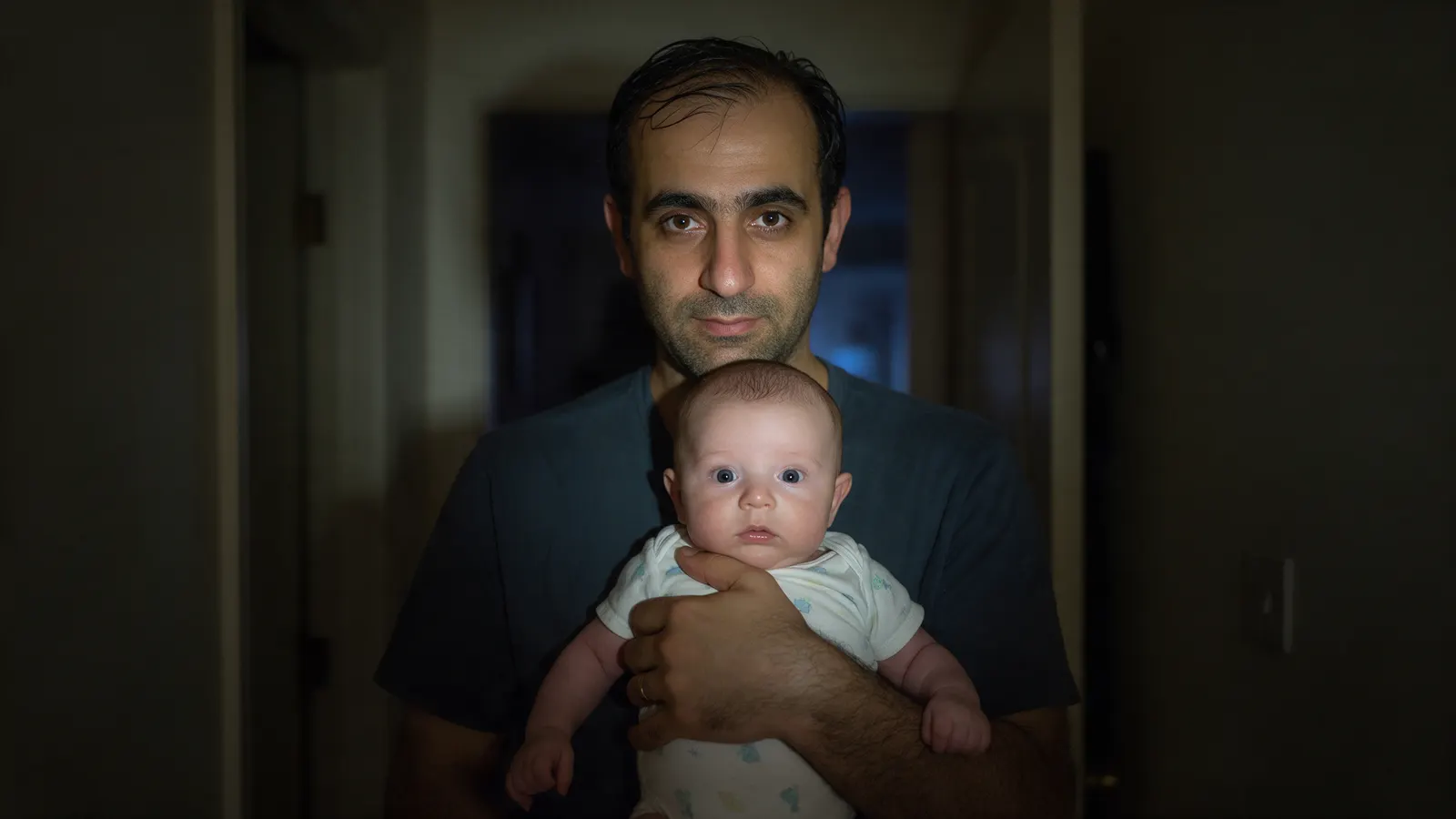
Last week had a six-hour stretch. This week has three wakings before midnight. Today is about getting through a rough patch without changing anything that matters.
Heart
A rough patch now is common, and it doesn't mean you did something wrong. The "4-month sleep regression" isn't a research term, and we couldn't find studies that test it directly; what is documented is that sleep is maturing and that babies vary enormously (Paavonen et al., 2020). In two Finnish birth cohorts, 1,427 babies at 3 months and 2,002 at 6, sleep varied widely, night sleep began to consolidate during the second year, and parents often reported sleep problems throughout (Paavonen et al., 2020). Your baby isn't broken, and neither is your routine.
Head
The AAP's advice for the hard weeks is plain: keep days bright and playful and nights calm and boring (AAP), and stick with your routine. Regular sleep cycles arrive at about 4 months (AAP), so some of what you're seeing is the new machinery switching on. If you added a step this week because the old ones stopped working, drop it and go back to the three you had; what research links to better sleep is doing the same steps consistently (Mindell et al., 2015).
Body
The one rule exhaustion must never bend. Sleeping with a baby on a couch or armchair raises the risk of sleep-related death up to 67 times, and bed sharing is 5 to 10 times riskier before 4 months (Moon, AAP). At 3 a.m. the sofa will look reasonable. It isn't. If you feel yourself fading during a feed, feed sitting up in a chair or bed with the bedding cleared, set an alarm, and if you nod off, move your baby to their own sleep space the moment you wake (Moon, AAP).
Try today

The boring night
Time: Every night contact, until morning · Three-step bedtime in the guide
Before bed, set the room: lights as low as you can work in, no toys in reach, phone face down.
At each waking, wait a moment and watch; if it builds, go in without turning on a light.
Keep everything at a murmur: "I'm here. Shh." A hand on the belly, then a feed or a change only if it's needed, with no play and no chat.
Lay your baby back down on their back in the bare crib, drowsy if you can manage it, and leave the same way every time.
Make it work:The point is sameness, not silence. Days stay bright and loud and playful so that night is the dull one (AAP).
Watch for
Normal
more wakings this week than last; large studies find infant sleep varies widely and parents report sleep problems at every age (Paavonen et al., 2020).
Call your pediatrician
if your baby seems sick or in pain; a rough patch is boring, not painful (AAP).
Normal
a warm head after a night feed.
Go to the ER now
for a fever with a bulging soft spot or stiff neck, or a baby who is hard to wake (AAP).
Normal
crying that stops when you pick up and starts when you put down.
Call your pediatrician right away
if your baby has a fever and cries nonstop, or cries when touched (AAP).
For you
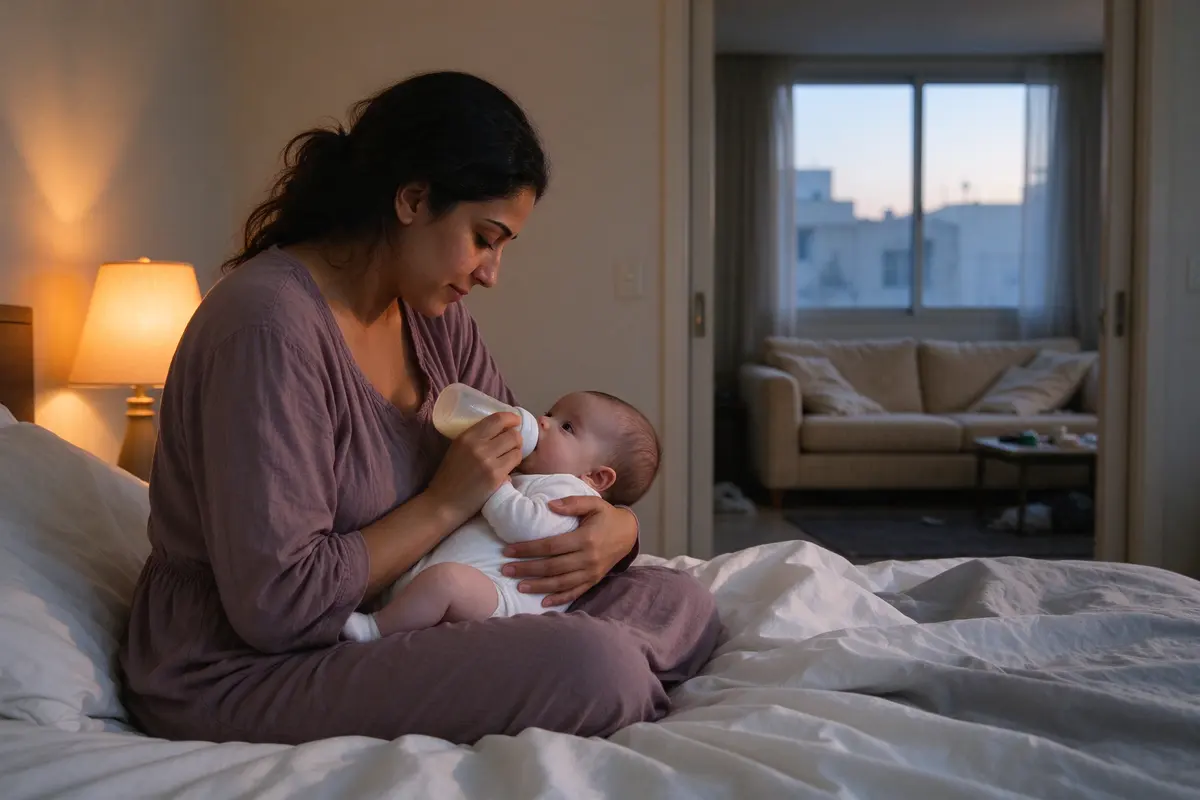
Exhaustion is not a reason to move sleep somewhere unsafe. It is a reason to ask for a shift or a nap. Nap when your baby naps and go to bed right after the last feed; the AAP's tips for sleep-deprived parents exist because this stretch is expected (Moon, AAP).
If the hard week has turned into something heavier, call or text the National Maternal Mental Health Hotline at 1-833-TLC-MAMA (1-833-852-6262), or call or text 988 (CDC). Low mood that is severe or lasts more than 2 weeks may be postpartum depression, and it responds to treatment (NIMH).
If you're the partner: the boring night is yours tonight, start to finish. Clear the sofa of pillows before you go to bed so nobody is tempted.
Sources
- Paavonen EJ, Saarenpää-Heikkilä O, Morales-Munoz I, et al. "Normal sleep development in infants: findings from two large birth cohorts." Sleep Medicine, 2020. https://pubmed.ncbi.nlm.nih.gov/32087408/
- American Academy of Pediatrics. "Getting Your Baby to Sleep." HealthyChildren.org, 2024. https://www.healthychildren.org/English/ages-stages/baby/sleep/Pages/getting-your-baby-to-sleep.aspx
- Mindell JA, Li AM, Sadeh A, Kwon R, Goh DY. "Bedtime routines for young children: a dose-dependent association with sleep outcomes." Sleep, 2015. https://pubmed.ncbi.nlm.nih.gov/25325483/
- Moon RY. "How to Keep Your Sleeping Baby Safe: AAP Policy Explained." HealthyChildren.org, 2026. https://www.healthychildren.org/English/ages-stages/baby/sleep/Pages/a-parents-guide-to-safe-sleep.aspx
- Moon RY. "Safe Sleep Tips for Sleep-Deprived New Parents." HealthyChildren.org, 2026. https://www.healthychildren.org/English/ages-stages/baby/sleep/Pages/safe-sleep-tips-for-sleep-deprived-parents.aspx
- American Academy of Pediatrics. "Fever" (symptom checker). HealthyChildren.org, 2026. https://www.healthychildren.org/English/tips-tools/symptom-checker/Pages/symptomviewer.aspx?symptom=Fever
- Centers for Disease Control and Prevention. "Symptoms of Depression Among Women." 2024. https://www.cdc.gov/reproductive-health/depression/index.html
- National Institute of Mental Health. "Perinatal Depression." 2026. https://www.nimh.nih.gov/health/publications/perinatal-depression
This guide is general education that summarizes published research and guidance from groups like the American Academy of Pediatrics, the CDC, and the WHO. It isn’t medical advice, and every child develops on their own timeline. Your pediatrician knows your child; if something feels wrong, call them. In an emergency, call 911.
Get each day’s note the morning it applies
Add your baby to a free Chorevia household with their date of birth, and every morning for 120 days the day’s note arrives in the app and by email: what’s developing, one thing to try, what to watch for, and a word for you.
Create your household