Day 105 of 120 · Week 15
Sharing the nights
Last reviewed · 4 min read · 9 sources · Plain-text version
Parents' sleep bottoms out in the first 3 months and recovers slowly. The numbers, how to bank sleep, the drowsy-feed rules, and a written shift plan for tonight.

Nobody is sleeping enough, and the research says that's exactly where you'd expect to be. Today is about splitting the nights on purpose.
Heart
Your tiredness has a shape. In a German study of 2,541 mothers and 2,118 fathers, sleep hit its low point in the first 3 months after birth: mothers slept 62 minutes less a night than before pregnancy, fathers 13 minutes less (Richter et al., 2019). The gap between those two numbers is the reason today's note exists. New mothers' sleep is more broken than short, and it gets less fragmented over the first 4 months (Montgomery-Downs et al., 2010). The direction is good; the pace is faster when two people carry it.
Head
The idea is shifts, not help. One adult is on from bedtime to a set hour and the other from then until morning, so each gets one longer, protected stretch; the off-duty adult sleeps in another room, with earplugs if needed (Richter et al., 2019). Fathers' involvement in baby care was linked to fewer infant night wakings in a small study (Tikotzky et al., 2011), though splitting nights hasn't been tested directly. If you're breastfeeding, your partner still has a shift: diapers, settling, and bringing the baby to you. And formula at night won't necessarily buy sleep; the studies disagree. In one study of 133 first-time parents at 3 months, parents whose babies were breastfed at night slept 40 to 45 minutes more than parents who gave formula at night (Doan et al., 2007). Talk to your pediatrician before changing how you feed for sleep's sake.
Body
Bank sleep. Nap when your baby naps, and go to bed right after the last feed (Moon, AAP). Plan for the drowsy feed: skip the couch and armchair, clear the bedding, set an alarm, and if you nod off, move your baby to their own sleep space as soon as you wake (Moon, AAP). Whoever is on duty follows the same rules.
Try today

Tag-team nights
Time: One shift each, every night · Tag-team nights in the guide
Tonight, before dinner, agree on the handover hour, such as one adult from bedtime to 2 a.m. and the other from 2 a.m. on.
The off-duty adult sleeps in another room, door shut, earplugs in.
If you're breastfeeding, the partner's shift is diapers and settling, and bringing the baby to you only when it's a feed.
In the morning, swap notes in one sentence each and adjust the hour, not the plan.
Make it work:Whoever is on duty sleeps nowhere near the baby on a couch or armchair, and lays the baby on their back in their own bare sleep space after every feed (Moon, AAP).
Watch for
Normal
waking at night; in a London video study, fewer than half of babies slept 5 hours straight at 3 months (St James-Roberts et al., 2015).
Call 911
if your baby can't be woken up, or is not moving or very weak (AAP).
Normal
stirring, fussing, and going back to sleep without you; about a quarter of 3-month-olds in that study resettled on their own after waking (St James-Roberts et al., 2015).
Go to the ER now
if your baby isn't alert when awake (AAP).
Normal
a longer stretch one night and short ones the next.
Call your pediatrician right away
if your baby has had no wet diaper in more than 8 hours (AAP).
For you
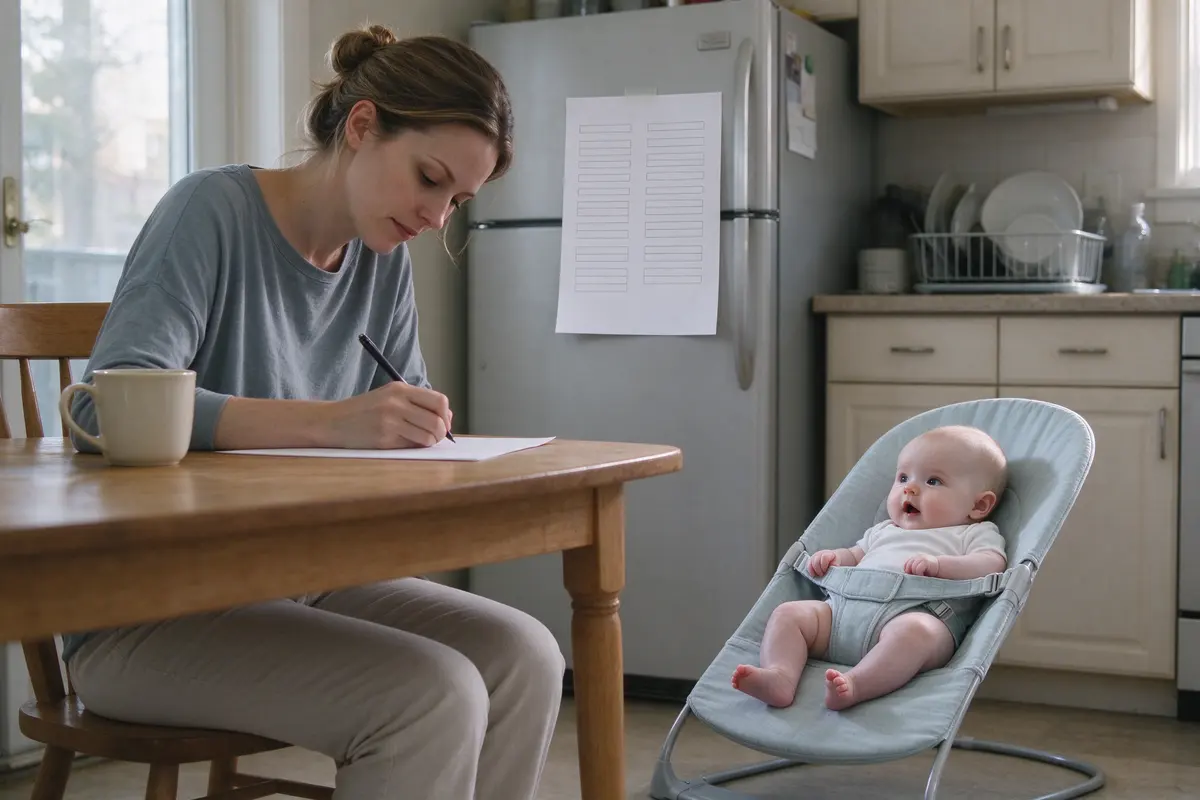
The shift plan, written. Two columns on the fridge: who's on, from when to when, and what "on" means. Written because at 2 a.m. nobody remembers what was agreed at dinner, and a grandparent staying over can read it.
Keep one line for yourself. Overwhelming tiredness is on the CDC's list of urgent maternal warning signs, along with trouble breathing, chest pain, or a fast-beating heart (CDC). Fifteen weeks of broken nights is tired; something beyond that is a call, and you say you were pregnant within the last year.
If you're the partner: your 13 minutes against her 62 is the whole argument. Take the first shift tonight, and take it again tomorrow.
Sources
- Richter D, Krämer MD, Tang NKY, Montgomery-Downs HE, Lemola S. "Long-term effects of pregnancy and childbirth on sleep satisfaction and duration of first-time and experienced mothers and fathers." Sleep, 2019. https://pubmed.ncbi.nlm.nih.gov/30649536/
- Montgomery-Downs HE, Insana SP, Clegg-Kraynok MM, Mancini LM. "Normative longitudinal maternal sleep: the first 4 postpartum months." American Journal of Obstetrics and Gynecology, 2010. https://pubmed.ncbi.nlm.nih.gov/20719289/
- Tikotzky L, Sadeh A, Glickman-Gavrieli T. "Infant sleep and paternal involvement in infant caregiving during the first 6 months of life." Journal of Pediatric Psychology, 2011. https://pubmed.ncbi.nlm.nih.gov/20444853/
- Doan T, Gardiner A, Gay CL, Lee KA. "Breast-feeding increases sleep duration of new parents." Journal of Perinatal and Neonatal Nursing, 2007. https://pubmed.ncbi.nlm.nih.gov/17700096/
- Moon RY. "Safe Sleep Tips for Sleep-Deprived New Parents." HealthyChildren.org, 2026. https://www.healthychildren.org/English/ages-stages/baby/sleep/Pages/safe-sleep-tips-for-sleep-deprived-parents.aspx
- St James-Roberts I, Roberts M, Hovish K, Owen C. "Video Evidence That London Infants Can Resettle Themselves Back to Sleep After Waking in the Night, as well as Sleep for Long Periods, by 3 Months of Age." Journal of Developmental and Behavioral Pediatrics, 2015. https://pubmed.ncbi.nlm.nih.gov/26035139/
- American Academy of Pediatrics. "Fever" (symptom checker). HealthyChildren.org, 2026. https://www.healthychildren.org/English/tips-tools/symptom-checker/Pages/symptomviewer.aspx?symptom=Fever
- American Academy of Pediatrics. "Vomiting Without Diarrhea" (symptom checker). HealthyChildren.org, 2026. https://www.healthychildren.org/English/tips-tools/symptom-checker/Pages/symptomviewer.aspx?symptom=Vomiting+Without+Diarrhea
- Centers for Disease Control and Prevention. "Urgent Maternal Warning Signs and Symptoms." HEAR HER, 2024. https://www.cdc.gov/hearher/maternal-warning-signs/index.html
This guide is general education that summarizes published research and guidance from groups like the American Academy of Pediatrics, the CDC, and the WHO. It isn’t medical advice, and every child develops on their own timeline. Your pediatrician knows your child; if something feels wrong, call them. In an emergency, call 911.
Get each day’s note the morning it applies
Add your baby to a free Chorevia household with their date of birth, and every morning for 120 days the day’s note arrives in the app and by email: what’s developing, one thing to try, what to watch for, and a word for you.
Create your household