Day 91 of 120 · Week 13
Month four
Last reviewed · 4 min read · 11 sources · Plain-text version
A new month and a new list. What the 4-month milestones mean, what's on the 6-month list ahead, corrected age, and a first reach-and-grab on the floor.

Ninety-one days. Month four is the one where many babies turn into playmates: chuckles, grabs, and maybe a first roll. Today is a look at the list that describes it.
Heart
What's coming is fun. Between 3 and 4 months, many babies start to feel like real company, and the skills on the way are the social ones: laughing, raspberries, grabbing on purpose, and rolling tummy to back are all on the 6-month list (CDC). Chuckles, meanwhile, are a 4-month milestone, so the window for a first laugh is wide (CDC). None of it is due today.
Head
The list for this month is the 4-month one, and it works the same way the earlier lists did: CDC's checklists name skills at least 75% of babies show by each age, so a missed milestone is a reason to ask, not to wait and see (Zubler et al., 2022). By 4 months, most babies smile on their own to get your attention, coo and make sounds back when you talk, turn toward your voice, look at their hands with interest, hold their head steady when held, hold a toy you put in their hand, swing an arm at toys, and push up onto elbows or forearms on their tummy (CDC). Born early? Use corrected age for milestones during the first 2 years (AAP).
Body
The body work of the month is reaching. In a study that tested 7 babies repeatedly from 6 to 25 weeks, babies first touched objects at about 12 weeks and first grasped them at 16.0 weeks in the light and 14.7 weeks in the dark, which means reaching is guided by feel as much as sight (Clifton et al., 1993). Babies learn to reach by reaching, so the floor matters: WHO advises at least 30 minutes of tummy time a day, spread out, and no more than 1 hour at a time strapped into a seat or carrier (WHO).
Try today
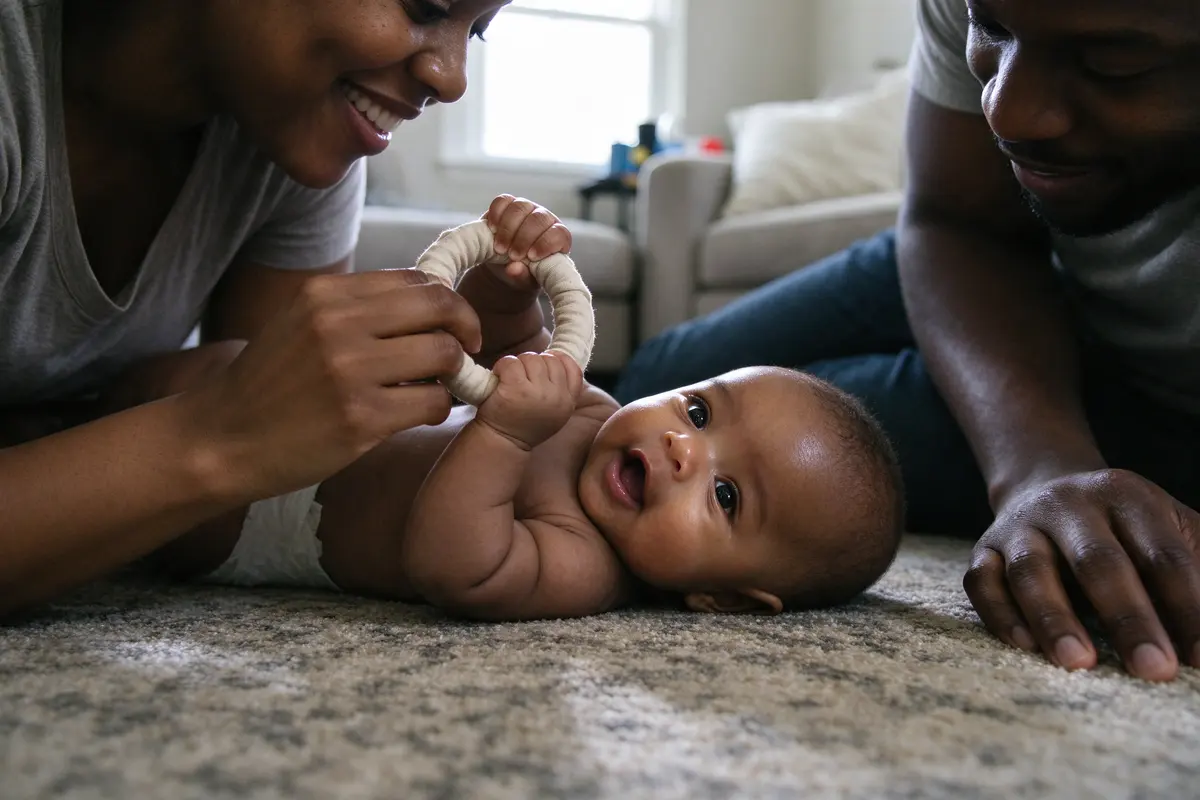
Reach-and-grab
Time: 3 to 5 minutes, once or twice a day · Reach-and-grab in the guide
Lay your baby on their back on a floor blanket and hold a light, easy-to-grip toy over their chest, within arm's reach.
Wait for a swipe. Don't put the toy in their hand; let them close their fingers around it.
Offer it from the left, the right, and the middle, and cheer every catch: "Reach, reach. You got it!"
Make it work:Choose toys too big to choke on, like a rattle or a cloth book (CDC). Whether extra practice speeds reaching hasn't been tested at this age.
Watch for
Normal
a 4-month list with gaps today; it describes the whole month (Zubler et al., 2022).
Normal
a baby who turns toward your voice some of the time (CDC).
Ask now
if your baby didn't pass the newborn hearing screen and follow-up testing hasn't happened; it should be done by 3 months (Hecht, AAP).
Normal
skills arriving in a different order than the list.
Call your pediatrician right away
if your baby has had any head injury, such as a fall from a bed, even if they seem fine (AAP).
For you
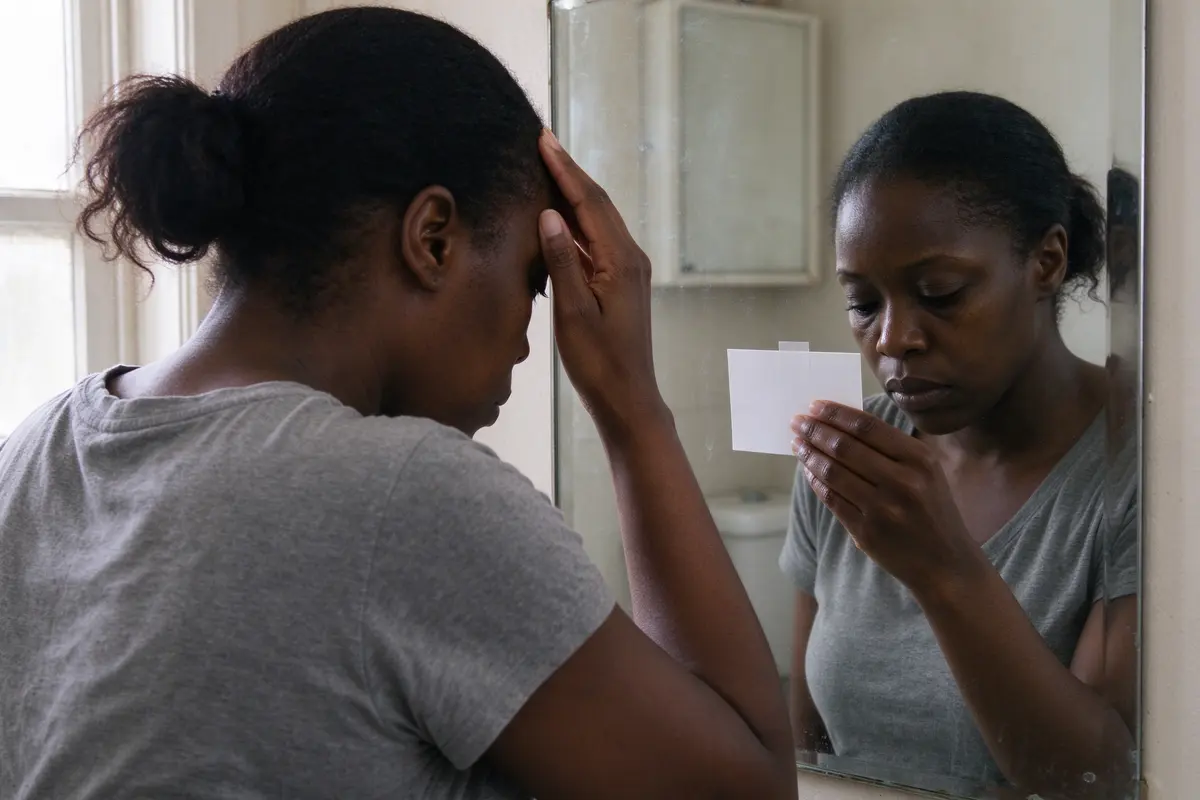
A new month, the same warning signs for you, briefly. Thirteen weeks out, the CDC's urgent maternal warning signs still count: a headache that won't go away or gets worse, dizziness or fainting, changes in vision, a fever of 100.4°F or higher, trouble breathing, chest pain or a fast-beating heart, heavy bleeding, and overwhelming tiredness. Seek care immediately, and tell any provider you see that you were pregnant within the last year (CDC).
Their own sentence is the one to keep: "If you feel like something just isn't right, or you aren't sure if it's serious, talk to your health care provider" (CDC).
If you're the partner: the list applies for a year. Know where it's written down.
Sources
- Centers for Disease Control and Prevention. "Milestones by 6 Months." Learn the Signs. Act Early., 2026. https://www.cdc.gov/act-early/milestones/6-months.html
- Centers for Disease Control and Prevention. "Milestones by 4 Months." Learn the Signs. Act Early., 2026. https://www.cdc.gov/act-early/milestones/4-months.html
- Zubler JM, Wiggins LD, Macias MM, et al. "Evidence-Informed Milestones for Developmental Surveillance Tools." Pediatrics, 2022. https://pubmed.ncbi.nlm.nih.gov/35132439/
- American Academy of Pediatrics. "Corrected Age For Preemies." HealthyChildren.org, 2018. https://www.healthychildren.org/English/ages-stages/baby/preemie/Pages/Corrected-Age-For-Preemies.aspx
- Clifton RK, Muir DW, Ashmead DH, Clarkson MG. "Is visually guided reaching in early infancy a myth?" Child Development, 1993. https://pubmed.ncbi.nlm.nih.gov/8404258/
- World Health Organization. "To grow up healthy, children need to sit less and play more." 2019. https://www.who.int/news/item/24-04-2019-to-grow-up-healthy-children-need-to-sit-less-and-play-more
- American Academy of Pediatrics. "Fever and Your Baby." HealthyChildren.org, 2025. https://www.healthychildren.org/English/health-issues/conditions/fever/Pages/Fever-and-Your-Baby.aspx
- American Academy of Pediatrics. "Fever" (symptom checker). HealthyChildren.org, 2026. https://www.healthychildren.org/English/tips-tools/symptom-checker/Pages/symptomviewer.aspx?symptom=Fever
- Hecht JL. "Hearing Screening for Newborns, Children & Adolescents: AAP Policy Explained." HealthyChildren.org, 2023. https://www.healthychildren.org/English/ages-stages/baby/Pages/Purpose-of-Newborn-Hearing-Screening.aspx
- American Academy of Pediatrics. "Head Injury" (symptom checker). HealthyChildren.org, 2026. https://www.healthychildren.org/English/tips-tools/symptom-checker/Pages/symptomviewer.aspx?symptom=Head+Injury
- Centers for Disease Control and Prevention. "Urgent Maternal Warning Signs and Symptoms." HEAR HER. https://www.cdc.gov/hearher/maternal-warning-signs/index.html
This guide is general education that summarizes published research and guidance from groups like the American Academy of Pediatrics, the CDC, and the WHO. It isn’t medical advice, and every child develops on their own timeline. Your pediatrician knows your child; if something feels wrong, call them. In an emergency, call 911.
Get each day’s note the morning it applies
Add your baby to a free Chorevia household with their date of birth, and every morning for 120 days the day’s note arrives in the app and by email: what’s developing, one thing to try, what to watch for, and a word for you.
Create your household