Day 130 of 300 · Week 18
Doubling
Last reviewed · 3 min read · 13 sources · Plain-text version
Many babies double their birth weight at about 4 months. Milk is still the only food and drink, cereal in the bottle is a choking risk, and a bathroom scale makes a keepsake.
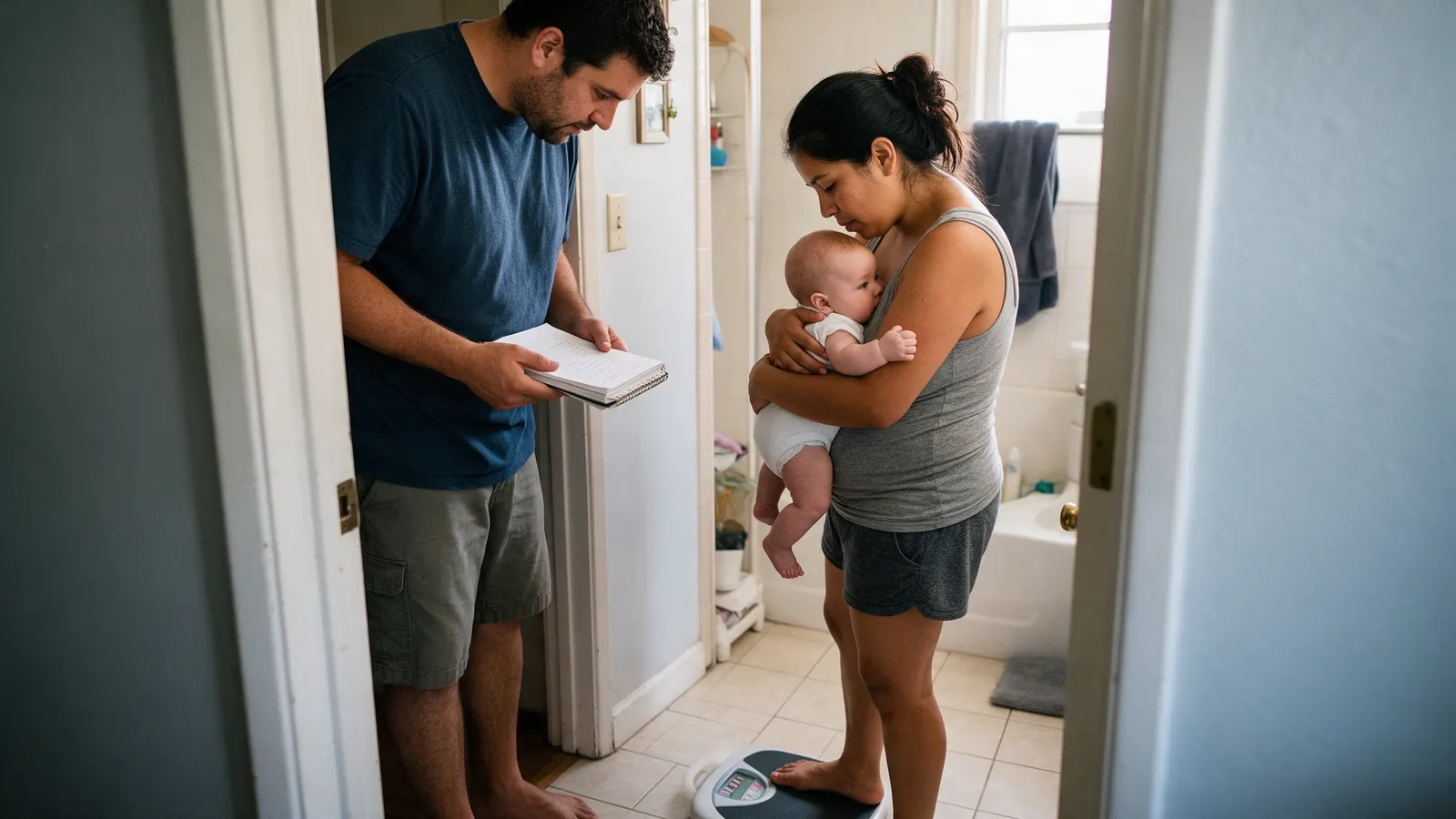
Somewhere around now, a lot of babies weigh twice what they did on day one. Today is for marking it, not measuring it.
Heart
Many babies double their birth weight at about 4 months (AAP). Breast milk or formula is still the only food and drink your baby needs; CDC says babies aren't ready for other foods, water, or other drinks for about the first 6 months (CDC). Solids can start at about 6 months, and starting before 4 months isn't recommended (CDC); WHO's guidance also starts other foods at about 6 months (WHO, 2023).
Head
Cereal in the bottle is the shortcut to skip. The AAP says it can cause choking and too much weight gain, though a doctor may suggest it for reflux (AAP). It doesn't buy sleep either: in a trial of 106 babies, rice cereal in a bedtime bottle didn't change how many slept through the night (Macknin et al., 1989). If someone older than you swears by it, that trial is your answer.
Body
Feeds are shorter and easier to interrupt now; babies get far more aware of the world around 4 to 6 months, and a phone, a pet, or a voice can pull them off mid-feed (Australian Breastfeeding Association). How you know they're getting enough anyway: plenty of wet diapers and steady growth on the chart (Jain & Bunik, AAP). The chart lives at the clinic, which is why today's scale is a keepsake, not a check. If your baby gets breast milk, the AAP recommends 400 IU of vitamin D a day, and ask about iron, since the AAP's advice on when to start it has shifted (Porto & Abu-Alreesh, AAP; AAP).
Try today
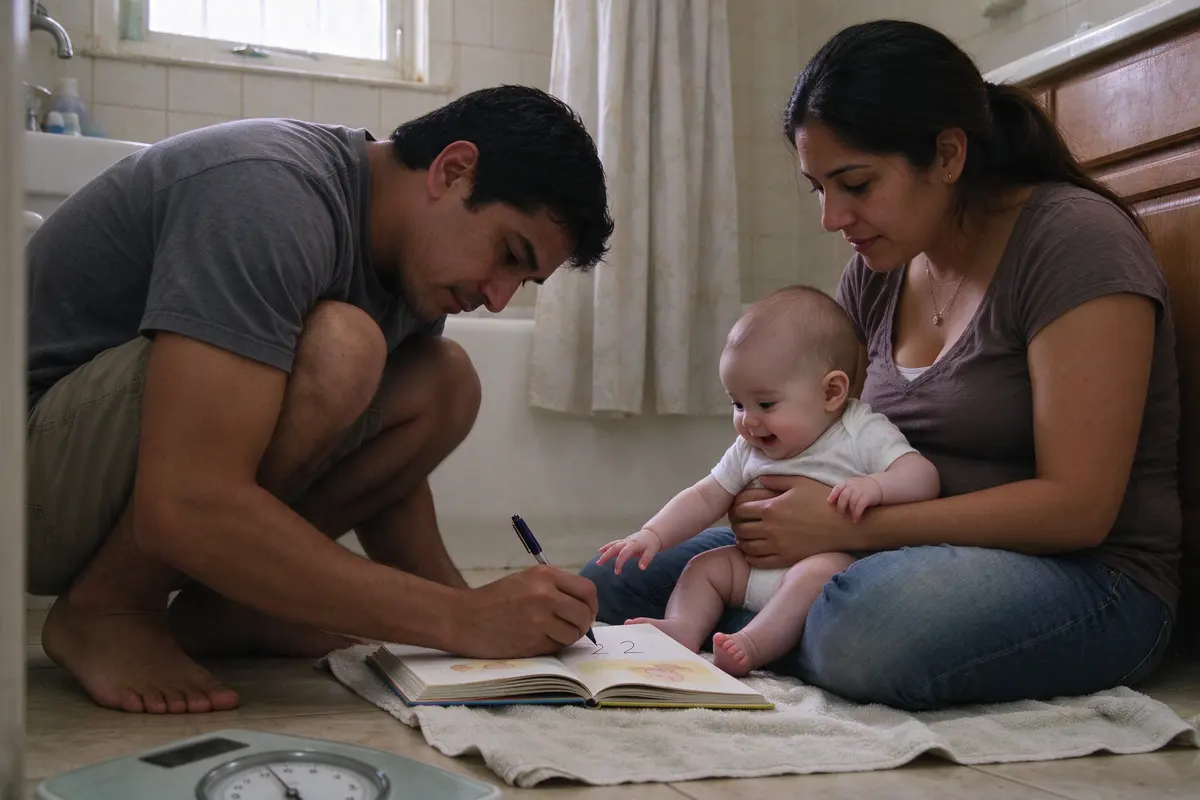
The weigh-in at home
Time: Two minutes after a diaper change · Growth and feeding in the guide
Step on the bathroom scale alone and note the number.
Step on again holding your baby firmly against your chest with both arms, and note that number.
Subtract. Write the result next to the birth weight in the baby book, with the date.
If you have the 4-month checkup's weight, write that beside it too; the clinic's number is the one that counts.
Make it work:A bathroom scale is for the baby book, not for worry. Wet diapers and the clinic's chart tell you your baby is getting enough (Jain & Bunik, AAP).
Watch for
- Normal: a baby who hasn't doubled on the dot; it's many babies at about 4 months, not all (AAP). Call your pediatrician if your baby seems unwell, has fewer wet diapers, or isn't growing as expected (Jain & Bunik, AAP).
- Normal: eyes on your plate and a grab at your fork. Readiness for solids means sitting up with support, steady head control, opening the mouth when food comes, and swallowing rather than pushing it out, and the timing is a conversation with your pediatrician, not a date (CDC). Call your pediatrician right away for signs of dehydration: no wet diaper in more than 8 hours, a very dry mouth, or no tears (AAP).
- Go to the ER now if your baby vomits green (bile) or blood (AAP).
- Normal: not being sure whether something is wrong. Call anyway if your baby just doesn't seem right to you. Trust your instincts (Lurie Children's).
For you
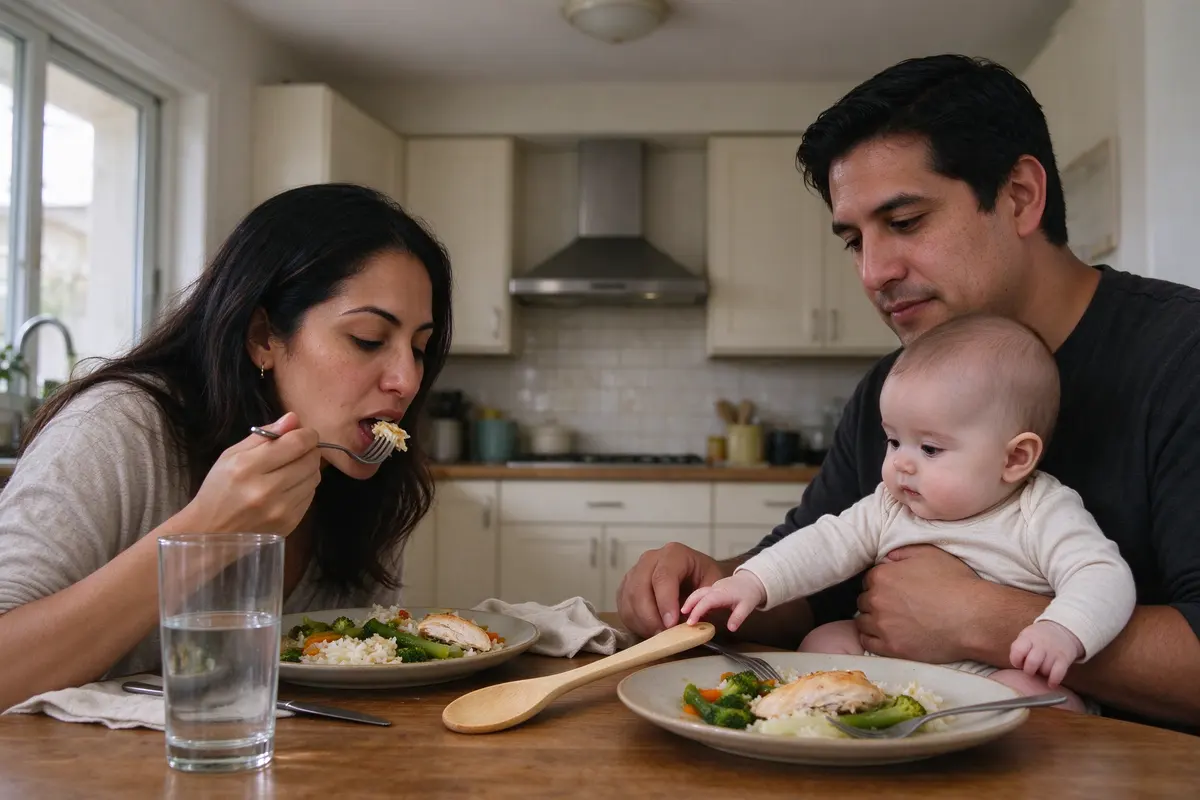
Feeding yourself. Your baby has doubled on milk you made or mixed, and you've been eating standing up over the sink for four months. The Office on Women's Health's advice to new mothers (it's about constipation, but it holds) is plenty of water and fresh fruits and vegetables (OWH), and it's easier to follow sitting down. Today: one meal at the table, plate full, water poured, before the feed rather than after it.
If you're the partner: the plate goes in front of her before she sits down to feed, not after. That's the whole job.
Sources
- American Academy of Pediatrics. "When Can Babies Start Solid Foods? Readiness & Feeding Tips." HealthyChildren.org, 2026. https://www.healthychildren.org/English/ages-stages/baby/feeding-nutrition/Pages/Starting-Solid-Foods.aspx
- Centers for Disease Control and Prevention. "Milestones by 4 Months." Learn the Signs. Act Early., 2026. https://www.cdc.gov/act-early/milestones/4-months.html
- Centers for Disease Control and Prevention. "When, What, and How to Introduce Solid Foods." 2026. https://www.cdc.gov/infant-toddler-nutrition/foods-and-drinks/when-what-and-how-to-introduce-solid-foods.html
- World Health Organization. "WHO Guideline for complementary feeding of infants and young children 6–23 months of age." 2023. https://www.who.int/publications/i/item/9789240081864
- Macknin ML, Medendorp SV, Maier MC. "Infant sleep and bedtime cereal." American Journal of Diseases of Children, 1989. https://pubmed.ncbi.nlm.nih.gov/2672785/
- Australian Breastfeeding Association. "Feeding your distractible baby." 2025. https://www.breastfeeding.asn.au/resources/distractible-baby
- Jain S, Bunik M. "How Often and How Much Should Your Baby Eat?" HealthyChildren.org, 2024. https://www.healthychildren.org/English/ages-stages/baby/feeding-nutrition/Pages/How-Often-and-How-Much-Should-Your-Baby-Eat.aspx
- Porto A, Abu-Alreesh S. "Vitamin D for Babies, Children & Adolescents." HealthyChildren.org, 2022. https://www.healthychildren.org/English/healthy-living/nutrition/Pages/vitamin-d-on-the-double.aspx
- American Academy of Pediatrics. "Checkup Checklist: 4 Months Old." HealthyChildren.org, 2023. https://www.healthychildren.org/English/ages-stages/Your-Childs-Checkups/Pages/Your-Checkup-Checklist-4-Months-Old.aspx
- American Academy of Pediatrics. "Fever" (symptom checker). HealthyChildren.org, 2026. https://www.healthychildren.org/English/tips-tools/symptom-checker/Pages/symptomviewer.aspx?symptom=Fever
- American Academy of Pediatrics. "Vomiting Without Diarrhea" (symptom checker). HealthyChildren.org, 2026. https://www.healthychildren.org/English/tips-tools/symptom-checker/Pages/symptomviewer.aspx?symptom=Vomiting+Without+Diarrhea
- Latimer T. "When to Call the Pediatrician for Your Newborn." Lurie Children's Hospital of Chicago, 2022. https://www.luriechildrens.org/en/blog/when-to-call-the-pediatrician-for-your-newborn/
- Office on Women's Health. "Recovering from birth." US Department of Health and Human Services, 2021. https://womenshealth.gov/pregnancy/childbirth-and-beyond/recovering-birth
This guide is general education that summarizes published research and guidance from groups like the American Academy of Pediatrics, the CDC, and the WHO. It isn’t medical advice, and every child develops on their own timeline. Your pediatrician knows your child; if something feels wrong, call them. In an emergency, call 911.
Get each day’s note the morning it applies
Add your baby to a free Chorevia household with their date of birth, and every morning for 300 days the day’s note arrives in the app and by email: what’s developing, one thing to try, what to watch for, and a word for you.
Create your household