Day 134 of 300 · Week 18
Nineteen weeks: temperament
Last reviewed · 4 min read · 8 sources · Plain-text version
Easygoing, intense, or slow to warm up: your baby's style is showing. What calms each kind, the script for a visiting relative, and a slow-approach game to try.

Nineteen weeks, and you could describe this baby to a stranger. Takes a while with new faces, or goes to anyone. Loud about everything, or watches first. That's temperament.
Heart
Some babies are easygoing; others are intense or slow to warm up. Cuddling, talking, and distraction can calm an intense baby. A quiet, sensitive baby needs extra time to warm up and people who approach slowly, and may need your attention more than they show (AAP). Remember that last line: the baby who doesn't demand may still need. None of these is a better baby. Each is a baby you're learning to read.
Head
Intensity has a mechanism. For a fed, changed, rested baby who's still fussy, the AAP suggests adding comfort one step at a time, your eyes, then your voice, then a hand on their chest, and only then picking up, giving each step a few minutes, because piling everything on at once can overload them (Ideran & Fishbein, AAP). A visitor who swoops, lifts, and talks loudly at once is the overload version.
Body
The script for a relative, straight from the guide: "She warms up slowly. Talk to her from over here for a few minutes before you pick her up" (AAP). Most relatives want to do it right and don't know how; the sentence tells them. For an intense baby the script changes: "He gets loud fast. If he cries, hand him back and I'll settle him, then try again." By 4 months, most babies smile on their own to get your attention and look, move, or make sounds to get or keep it (CDC); a slow-to-warm baby does all that too, once the room feels safe.
Try today
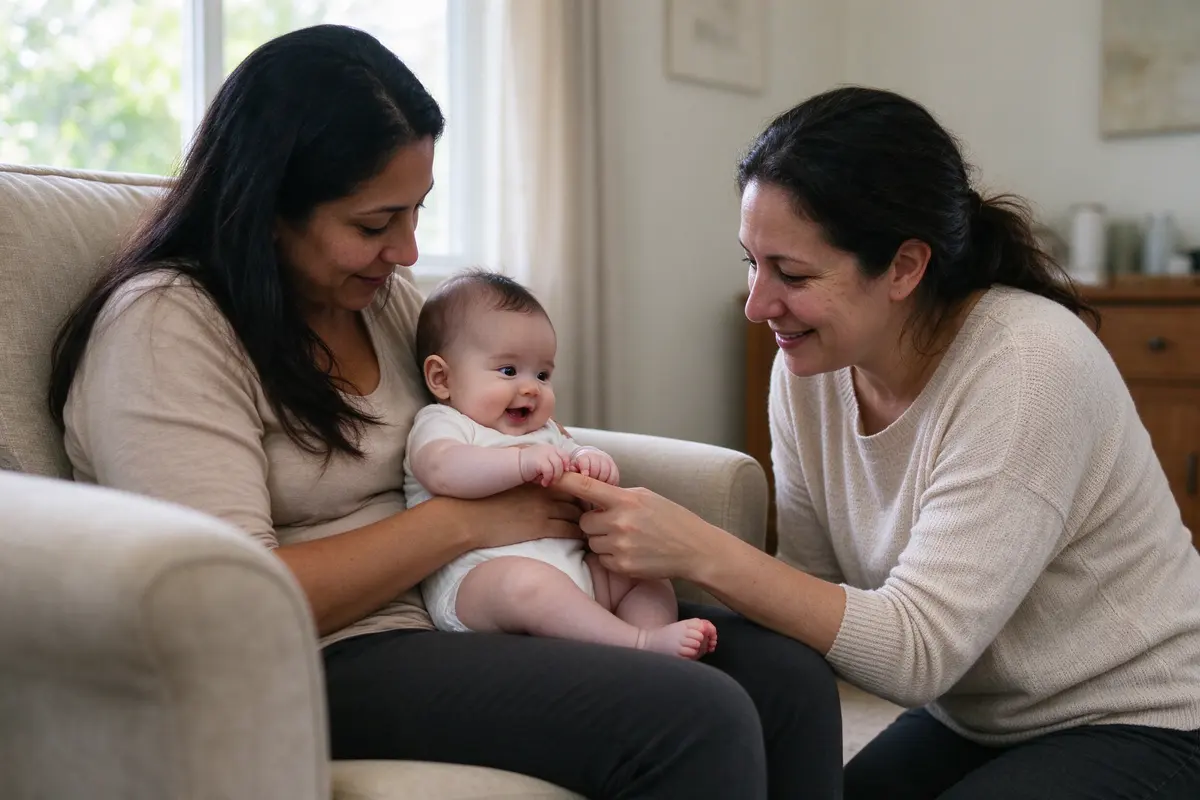
The slow approach
Time: 5 minutes at the start of a visit
Before the visitor is in the door, give them the script: talk first, from across the room, for a few minutes (AAP).
Hold your baby facing out and let the visitor chat, sing, or wave from the sofa while you narrate: "That's Tía Rosa. She's saying hi."
When your baby's body loosens and the stare softens, the visitor comes to arm's length and offers a finger.
If your baby grips, smiles, or stays easy, the pick-up happens next; if they stiffen or fuss, go back a step and give it another minute.
Make it work:The baby's face sets the pace, not the visitor's drive time. Some days the pick-up never happens; that's still a good visit.
Watch for
Normal
crying at a new face and settling the moment you take them back.
Call your pediatrician right away
if your baby cries nonstop, or cries when touched or moved (AAP).
Normal
a quiet baby who watches a full room without a sound.
Go to the ER now
if your baby isn't alert when awake, is hard to wake, or has a bulging soft spot (AAP).
Normal
saving the big smiles for you and one or two others.
For you

Your temperament counts too. If a houseful of visitors drains you, you're allowed to pace them the way you pace them for your baby: one at a time, short, with a stop time said out loud. If you're the intense one, say the hard thing to an adult who can hear it. And if you're the quiet one, the line about sensitive babies applies to you: you may need attention more than you show (AAP). Ask for it anyway.
The quiet partner is on that list too. About 10% of fathers had depression around a birth in one meta-analysis, rising to about 26% at 3 to 6 months after birth; a larger, later one found about 8% (Paulson & Bazemore, 2010; Cameron et al., 2016). Help is 1-833-TLC-MAMA or 988, for either of you (CDC).
If you're the partner: you give the relatives the script today. She shouldn't have to be the one who says no.
Sources
- American Academy of Pediatrics. "Emotional and Social Development: 4 to 7 Months." HealthyChildren.org, updated 2009. https://www.healthychildren.org/English/ages-stages/baby/Pages/Emotional-and-Social-Development-4-7-Months.aspx
- Ideran P, Fishbein M. "Self-Soothing: Help Your Baby Learn This Life Skill." HealthyChildren.org, updated 2024. https://www.healthychildren.org/English/ages-stages/baby/crying-colic/Pages/Self-Soothing-Helping-Your-Baby-Learn-This-Life-Skill.aspx
- Centers for Disease Control and Prevention. "Milestones by 4 Months." Learn the Signs. Act Early., updated 2026. https://www.cdc.gov/act-early/milestones/4-months.html
- American Academy of Pediatrics. "Fever" (symptom checker). HealthyChildren.org, accessed 2026. https://www.healthychildren.org/English/tips-tools/symptom-checker/Pages/symptomviewer.aspx?symptom=Fever
- American Academy of Pediatrics. "Developmental Milestones: 7 Months." HealthyChildren.org, updated 2009. https://www.healthychildren.org/English/ages-stages/baby/Pages/Developmental-Milestones-7-Months.aspx
- Paulson JF, Bazemore SD. "Prenatal and postpartum depression in fathers and its association with maternal depression: a meta-analysis." JAMA, 2010. https://pubmed.ncbi.nlm.nih.gov/20483973/
- Cameron EE, Sedov ID, Tomfohr-Madsen LM. "Prevalence of paternal depression in pregnancy and the postpartum: An updated meta-analysis." Journal of Affective Disorders, 2016. https://pubmed.ncbi.nlm.nih.gov/27475890/
- Centers for Disease Control and Prevention. "Symptoms of Depression Among Women." 2024. https://www.cdc.gov/reproductive-health/depression/index.html
This guide is general education that summarizes published research and guidance from groups like the American Academy of Pediatrics, the CDC, and the WHO. It isn’t medical advice, and every child develops on their own timeline. Your pediatrician knows your child; if something feels wrong, call them. In an emergency, call 911.
Get each day’s note the morning it applies
Add your baby to a free Chorevia household with their date of birth, and every morning for 300 days the day’s note arrives in the app and by email: what’s developing, one thing to try, what to watch for, and a word for you.
Create your household