Day 141 of 300 · Week 19
Falls happen fast now
Last reviewed · 4 min read · 9 sources · Plain-text version
Rolling can start the moment you look away, and babies this age don't fear edges. One hand on the baby on any raised surface, every time, and what to do if a fall already happened.

One hand. That's the whole lesson, because the baby who has never rolled will roll one day, probably when you've turned to get the wipes.
Heart
Rocking on the tummy, kicking, and "swimming" with the arms usually appear at about 5 months and lead to rolling; most babies roll tummy to back first (AAP), and the AAP's safe sleep guidance notes that rolling often begins around 3 to 4 months and can start earlier (Moon, AAP). Babies with little or no crawling experience show no wariness of heights; that comes from moving around on their own (Dahl et al., 2013). The first roll and the first fall are often the same movement, in different places.
Head
The places, then. Never leave your baby alone on a changing table, even for a moment, even strapped in (AAP), and never alone on a bed or couch, since they may be rolling soon, if not already (AAP). Among young children hospitalized for furniture falls in one study, a third fell from beds (Pomerantz et al., 2012). Bouncers go on the floor only, never on a counter, table, or soft surface, and get retired when your baby can sit up alone (CPSC). The full list is in the falls section of the 4-month guide.
Body
The strap isn't the rule; your hand is. Even strapped in, a baby can't be left for a moment (AAP), so the habit to build is physical: whenever the baby is on anything higher than the floor, one of your hands is on them, and if a job needs both hands, the baby comes down to the floor or up into your arms first. It feels slow for a week. Then it's how you move.
Try today
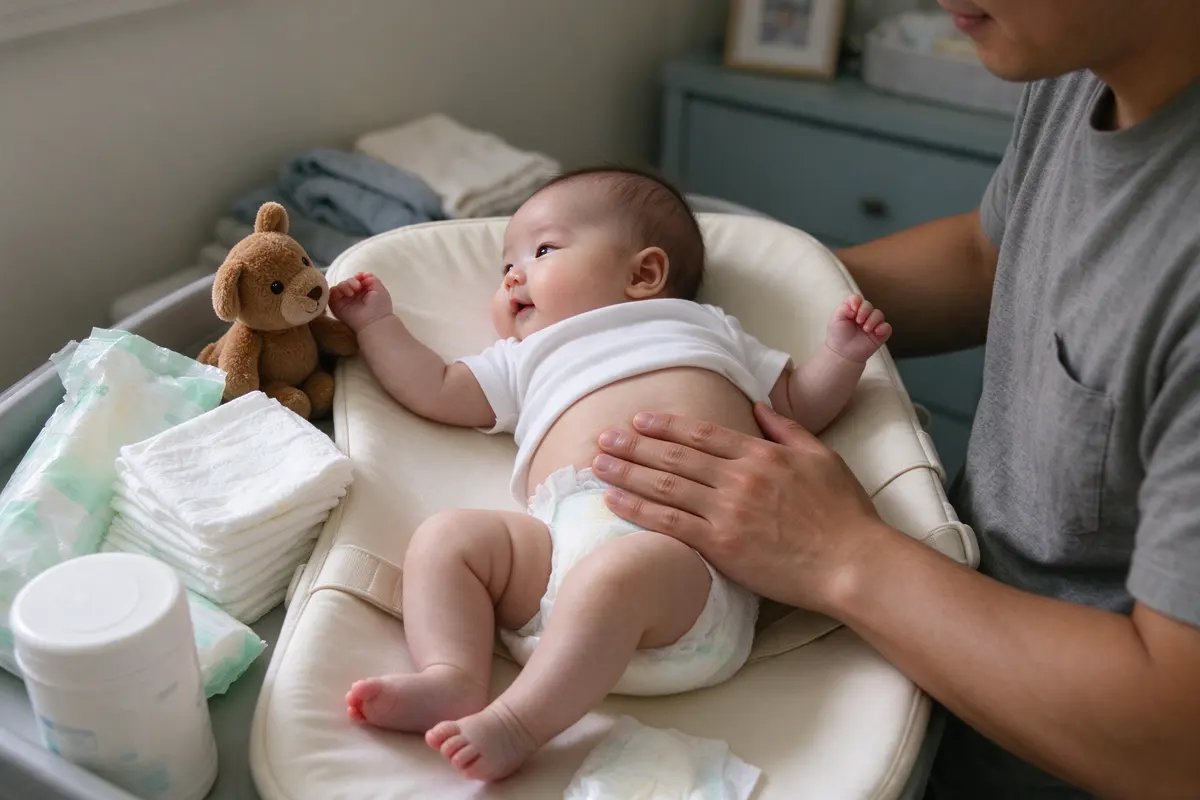
The one-hand rule
Time: Every change today, a minute each · Falls happen fast now in the guide
Before you lift your baby onto the table, lay out the diaper, wipes, cream, and a clean onesie within reach of one hand.
Rest your other hand flat on your baby's chest or belly and keep it there for the whole change; say "one hand" out loud the first few times so it sticks.
If you need both hands, stop, pick your baby up, and finish on the floor, never with the strap alone (AAP).
Practice the interruption once on purpose: pretend the phone rings, scoop the baby, and go.
Make it work:A changing mat on the floor ends the question for good; the floor can't be fallen from.
Watch for
Normal
a half-roll onto the hip during a change, or no roll yet; most babies roll tummy to back first, and many roll both ways by 7 months (AAP).
Call your pediatrician right away
after any head injury in a baby under 1, including a fall from a bed, couch, or changing table, even if your baby seems fine (AAP).
Normal
a baby who fights being held still on the table.
Go to the ER now
if, after a fall, your baby vomits 2 or more times, cries nonstop, or seems "out of it" (AAP).
Normal
a hard nap after a scary moment that turned out fine.
Call 911
if your baby has a seizure after a head injury, was knocked out for more than a minute, is hard to wake, or has bleeding you can't stop (AAP).
For you

The rule is for every pair of hands in the house. Write "one hand on the baby" on a sticky note on the changing table, where a grandparent, a sitter, and a half-asleep partner will see it. It's a reminder for tired people, and everyone who loves this baby is tired.
One more thing about your hands. If you ever feel dizzy or faint while holding your baby, sit down on the floor with them before anything else. Dizziness or fainting is on the CDC's list of urgent maternal warning signs, the kind to seek care for immediately, and it's worth telling any provider that you were pregnant within the last year (CDC). Tired is normal. The room tilting is not.
If you're the partner: the rule is yours too, and so is the sticky note. Put it up tonight.
Sources
- American Academy of Pediatrics. "Movement Milestones: Babies 4 to 7 Months." HealthyChildren.org, 2021. https://www.healthychildren.org/English/ages-stages/baby/Pages/Movement-4-to-7-Months.aspx
- Moon RY. "How to Keep Your Sleeping Baby Safe: AAP Policy Explained." HealthyChildren.org, 2026. https://www.healthychildren.org/English/ages-stages/baby/sleep/Pages/a-parents-guide-to-safe-sleep.aspx
- Dahl A, Campos JJ, Anderson DI, et al. "The epigenesis of wariness of heights." Psychological Science, 2013. https://pubmed.ncbi.nlm.nih.gov/23722981/
- American Academy of Pediatrics. "Changing Table Safety." HealthyChildren.org, 2009. https://www.healthychildren.org/English/safety-prevention/at-home/Pages/Changing-Table-Safety.aspx
- American Academy of Pediatrics. "Checkup Checklist: 2 Months Old." HealthyChildren.org, 2021. https://www.healthychildren.org/English/ages-stages/Your-Childs-Checkups/Pages/Your-Checkup-Checklist-2-Months-Old.aspx
- Pomerantz WJ, Gittelman MA, Hornung R, Husseinzadeh H. "Falls in children birth to 5 years: different mechanisms lead to different injuries." Journal of Trauma and Acute Care Surgery, 2012. https://pubmed.ncbi.nlm.nih.gov/23026963/
- US Consumer Product Safety Commission. "New Federal Standard to Improve Safety of Infant Bouncer Seats Takes Effect." 2018. https://www.cpsc.gov/Newsroom/News-Releases/2018/New-Federal-Standard-to-Improve-Safety-of-Infant-Bouncer-Seats-Takes-Effect
- American Academy of Pediatrics. "Head Injury" (symptom checker). HealthyChildren.org, 2026. https://www.healthychildren.org/English/tips-tools/symptom-checker/Pages/symptomviewer.aspx?symptom=Head+Injury
- Centers for Disease Control and Prevention. "Urgent Maternal Warning Signs and Symptoms." HEAR HER, 2024. https://www.cdc.gov/hearher/maternal-warning-signs/index.html
This guide is general education that summarizes published research and guidance from groups like the American Academy of Pediatrics, the CDC, and the WHO. It isn’t medical advice, and every child develops on their own timeline. Your pediatrician knows your child; if something feels wrong, call them. In an emergency, call 911.
Get each day’s note the morning it applies
Add your baby to a free Chorevia household with their date of birth, and every morning for 300 days the day’s note arrives in the app and by email: what’s developing, one thing to try, what to watch for, and a word for you.
Create your household