Day 143 of 300 · Week 20
The car seat as they grow
Last reviewed · 4 min read · 9 sources · Plain-text version
Rear-facing to the seat's limits, a convertible seat when the infant seat is outgrown, straps at or below the shoulders, chest clip at the armpits, and the pinch test that checks it all in a minute.

The seat that fit on the ride home from the hospital has a baby in it now who is nearly twice the size. Today is a fit check, and a look at what comes after the infant seat.
Heart
Rear-facing in the back seat as long as possible, up to the seat's rear-facing limits; when your baby outgrows the infant seat, the next step is a convertible seat, still rear-facing (AAP). The growth is real: many babies double their birth weight at about 4 months (AAP), and from 1 to 4 months babies typically gain 1.5 to 2 pounds and grow 1 to 1.5 inches a month (AAP). The strap slots that were right in month one may be below the shoulders now, or above them.
Head
The fit rules haven't changed; your baby has. Harness straps go at or below the shoulders for a rear-facing seat, snug enough that you can't pinch any slack, with the chest clip at armpit level and no bulky coat underneath (AAP). And the seat is for travel, not for sleeping or feeding outside the car (AAP): from 2003 to 2007, an estimated 43,562 babies were treated in US ERs for car seat injuries outside the car, mostly from falls (Parikh & Wilson, 2010).
Body
If your baby dozes off on the drive, the nap doesn't continue in the seat at home: move them to their back on a firm, flat surface (Moon, AAP). And the hands that grab mugs grab harness straps now, so expect the chest clip to be pulled at; it goes back to armpit level before you drive (AAP). The car seats section of the 4-month guide has the rules in one paragraph.
Try today
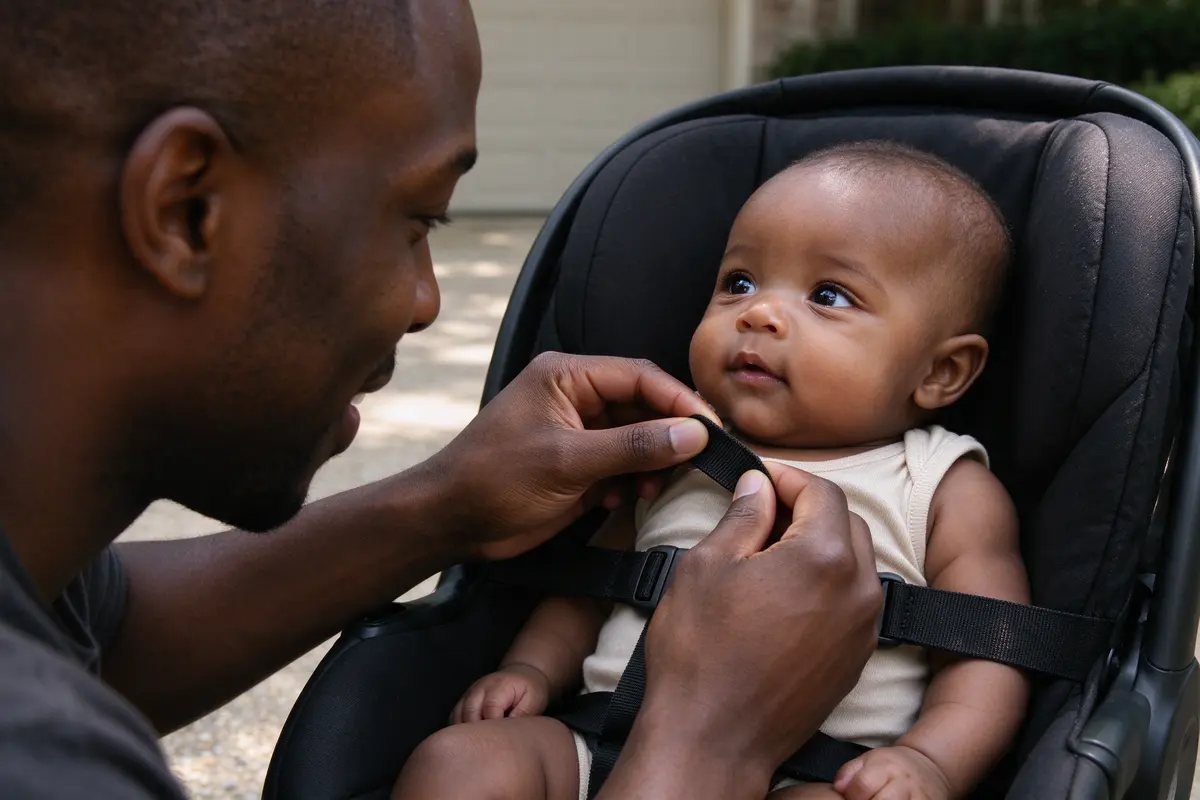
The pinch test
Time: 5 minutes, parked, with the baby in the seat · Car seats in the guide
Buckle your baby in at home: back seat, rear-facing, indoor clothes, no coat (AAP).
Tighten the harness, then pinch the strap at the collarbone between your thumb and finger. If you can pinch a fold of webbing, it's too loose; tighten until you can't (AAP).
Slide the chest clip to armpit level, and check the strap slots are at or below the shoulders; move them if your baby has grown past them (AAP).
Find the seat's label and read the rear-facing height and weight limits out loud, so you both know the number that means "convertible seat next."
Unbuckle and lift your baby out; the seat stays in the car (AAP).
Make it work:Do the pinch every time you buckle for a week, and it becomes the way you buckle.
Watch for
Normal
falling asleep on a drive; at home, move your baby to their back on a firm, flat surface (Moon, AAP).
Call 911
for bluish lips or face, or a baby struggling for each breath (AAP).
Normal
a head that stays steady and turns to look out the window; holding the head steady when held is a 4-month milestone (CDC).
Raise it with your pediatrician
if your baby doesn't hold their head steady when you hold them, and ask about developmental screening rather than waiting (CDC).
Normal
crying through a long drive and stopping the moment the car does.
Call your pediatrician right away
if your baby cries nonstop, or cries when touched or moved (AAP).
For you
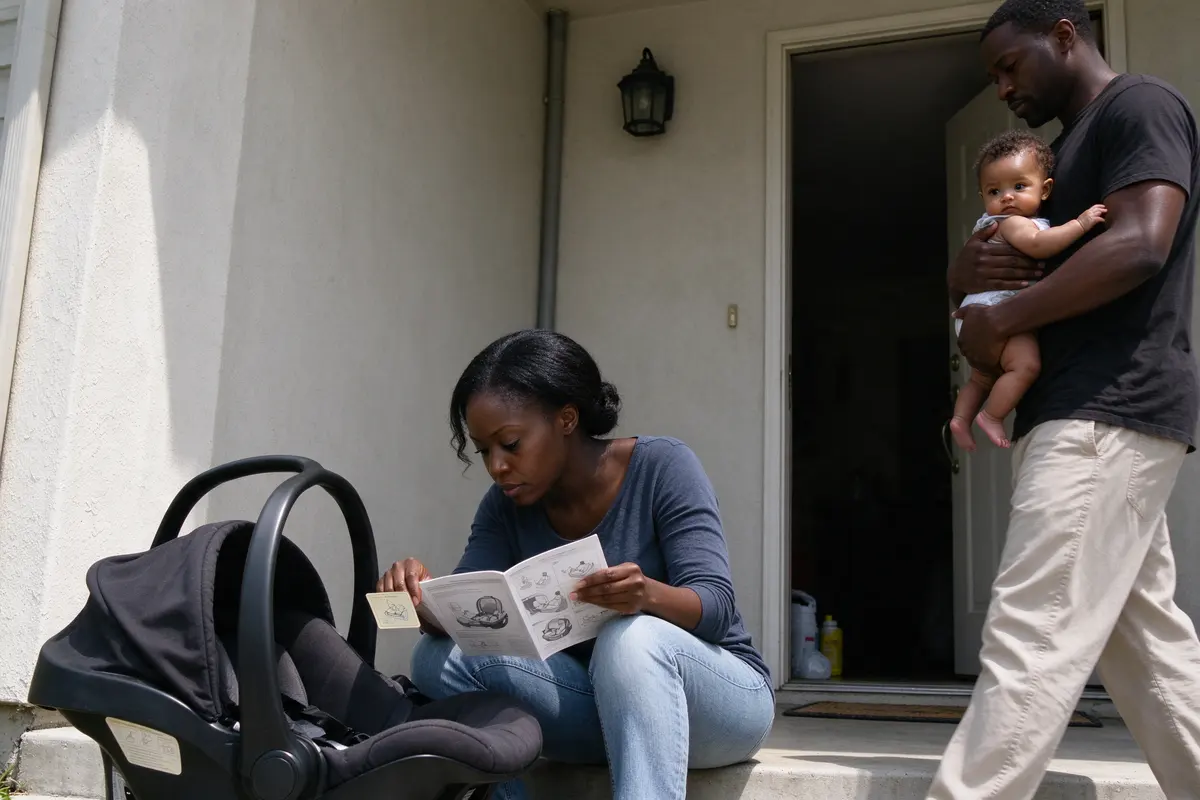
Read the seat's height and weight limits today and write them inside a kitchen cupboard door, with the baby's last measurements beside them. You'll know the month the convertible seat is due instead of discovering it in a parking lot.
You're the one who reads everything, and that habit is worth turning on yourself once in a while. The CDC's line for mothers in the year after birth is simple: "If you feel like something just isn't right, or you aren't sure if it's serious, talk to your health care provider," and tell any provider you were pregnant within the last year (CDC). Twenty weeks out still counts.
If you're the partner: the seat manual is yours tonight, cover to cover, and the installation check is yours this weekend.
Sources
- American Academy of Pediatrics. "Car Seats: Information for Families." HealthyChildren.org, 2026. https://www.healthychildren.org/English/safety-prevention/on-the-go/Pages/Car-Safety-Seats-Information-for-Families.aspx
- American Academy of Pediatrics. "When Can Babies Start Solid Foods? Readiness & Feeding Tips." HealthyChildren.org, 2026. https://www.healthychildren.org/English/ages-stages/baby/feeding-nutrition/Pages/Starting-Solid-Foods.aspx
- American Academy of Pediatrics. "Physical Appearance and Growth: 1 to 3 Months." HealthyChildren.org, 2009. https://www.healthychildren.org/English/ages-stages/baby/Pages/Physical-Appearance-and-Growth-1-To-3-Months.aspx
- Parikh SN, Wilson L. "Hazardous use of car seats outside the car in the United States, 2003-2007." Pediatrics, 2010. https://pubmed.ncbi.nlm.nih.gov/20603257/
- Moon RY. "How to Keep Your Sleeping Baby Safe: AAP Policy Explained." HealthyChildren.org, 2026. https://www.healthychildren.org/English/ages-stages/baby/sleep/Pages/a-parents-guide-to-safe-sleep.aspx
- American Academy of Pediatrics. "Breathing Trouble" (symptom checker). HealthyChildren.org, 2026. https://www.healthychildren.org/English/tips-tools/symptom-checker/Pages/symptomviewer.aspx?symptom=Breathing+Trouble
- Centers for Disease Control and Prevention. "Milestones by 4 Months." Learn the Signs. Act Early., 2026. https://www.cdc.gov/act-early/milestones/4-months.html
- American Academy of Pediatrics. "Fever" (symptom checker). HealthyChildren.org, 2026. https://www.healthychildren.org/English/tips-tools/symptom-checker/Pages/symptomviewer.aspx?symptom=Fever
- Centers for Disease Control and Prevention. "Urgent Maternal Warning Signs and Symptoms." HEAR HER, 2024. https://www.cdc.gov/hearher/maternal-warning-signs/index.html
This guide is general education that summarizes published research and guidance from groups like the American Academy of Pediatrics, the CDC, and the WHO. It isn’t medical advice, and every child develops on their own timeline. Your pediatrician knows your child; if something feels wrong, call them. In an emergency, call 911.
Get each day’s note the morning it applies
Add your baby to a free Chorevia household with their date of birth, and every morning for 300 days the day’s note arrives in the app and by email: what’s developing, one thing to try, what to watch for, and a word for you.
Create your household