Day 148 of 300 · Week 20
Family life is the curriculum
Last reviewed · 4 min read · 14 sources · Plain-text version
No lessons needed. Your baby learns from watching you cook, fold, and water plants while you say what you're doing. Why the chores count as talk time, and a laundry narration to try.
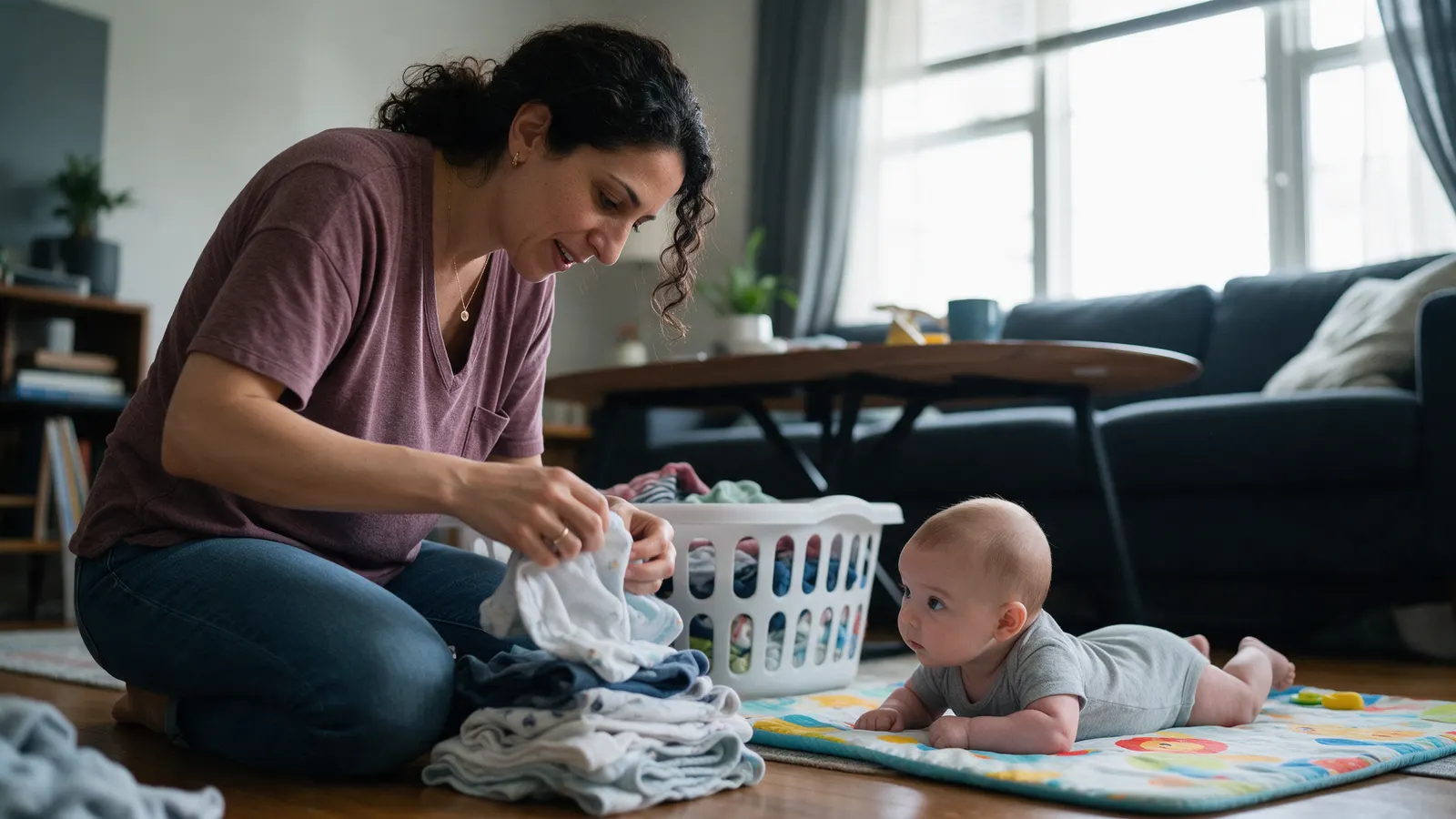
There's a version of this month where you feel you should be doing activities and the laundry is in the way. The laundry is the activity.
Heart
The 4-month guide is plain: no lessons yet. Let your baby watch and listen while you cook, fold laundry, or water plants, and narrate what you're doing; it's talk time for them and real work for you (see the guide). Underneath is serve and return: when your baby babbles or gazes and you answer with eye contact and words, those exchanges help build brain circuits (Harvard Center on the Developing Child). A sock, named and handed over, is a serve returned.
Head
The evidence for talk and play is about ordinary days, not programs. In a randomized trial at a New York public hospital clinic, coaching parents to read and play with children from birth to age 3 led to fewer behavior problems at age 4½ (Mendelsohn et al., 2018), and the AAP recommends shared reading from birth (Klass et al., 2024). Rhythm counts too: steady sleep and feeding routines help babies learn that days have a shape (CDC). Folding at the same time each afternoon, with the same commentary, becomes a routine your baby expects.
Body
Where the baby goes while you work: the floor. WHO advises floor play several times a day, including at least 30 minutes of tummy time spread through the day, and not keeping babies strapped into seats for more than 1 hour at a time (WHO). A mat beside the basket beats a bouncer, which belongs on the floor, never on a table or counter (CPSC). Older children can join, with the AAP's rule that they never pick the baby up without permission (AAP); handing you socks is a fine first job.
Try today

The laundry narration
Time: One basket, 10 to 15 minutes · Family life is the curriculum in the guide
Put your baby on the floor mat beside the basket, on their tummy to start, where they can see your hands (WHO).
Narrate each item in a lively voice and pause after it: "Blue sock. Where's the other blue sock? Here. Pair."
Hand them one safe thing to hold and mouth, like a clean washcloth, nothing with strings, buttons, or loose parts (Bradin, AAP).
When they make a sound, copy it and add a word with that sound in it, then go back to folding (AAP).
Roll them onto their back for the last few items, and finish with a towel-over-your-head peekaboo.
Make it work:The folding doesn't have to be good. The talking is the job; the stack is a bonus.
Watch for
Normal
a baby who'd rather watch you than any toy; looking at you, moving, or making sounds to get or keep your attention is a 4-month milestone (CDC).
Don't wait
if you're concerned about development: ask about screening, or call your state's early intervention program for a free evaluation (CDC).
Normal
a fuss when you turn your back; babies from about 1 month notice and get upset when a parent stops responding (Mesman et al., 2009).
Call your pediatrician right away
if your baby cries nonstop, or cries when touched or moved (AAP).
Normal
the washcloth going straight to the mouth; mouthing safe things is how babies learn (CDC).
Call 911
if your baby choked on a small object that could still be stuck (AAP).
For you

The chores count as talk time, so stop keeping two lists. "Did the laundry" and "didn't do anything with the baby today" are the same afternoon. WHO's floor-play advice (WHO) doesn't say you have to be on the floor too, only that the baby is.
If you had a C-section, the full basket is yours again: the lifting limit, nothing heavier than your baby, covers the first 6 to 8 weeks, and most regular activities are back within 4 to 8 weeks (MedlinePlus). If anything still pulls when you lift, that's a question for your provider, not a thing to fold around.
If you're the partner: narrate your own jobs tonight, in your own words. Dishes count.
Sources
- Center on the Developing Child at Harvard University. "Serve and Return." Accessed 2026. https://developingchild.harvard.edu/key-concept/serve-and-return/
- Mendelsohn AL, Cates CB, Weisleder A, et al. "Reading Aloud, Play, and Social-Emotional Development." Pediatrics, 2018. https://pubmed.ncbi.nlm.nih.gov/29632254/
- Klass P, Miller-Fitzwater A, High PC; AAP Council on Early Childhood. "Literacy Promotion: An Essential Component of Primary Care Pediatric Practice: Policy Statement." Pediatrics, 2024. https://pubmed.ncbi.nlm.nih.gov/39342414/
- Centers for Disease Control and Prevention. "Milestones by 4 Months." Learn the Signs. Act Early., 2026. https://www.cdc.gov/act-early/milestones/4-months.html
- World Health Organization. "To grow up healthy, children need to sit less and play more." 2019. https://www.who.int/news/item/24-04-2019-to-grow-up-healthy-children-need-to-sit-less-and-play-more
- US Consumer Product Safety Commission. "New Federal Standard to Improve Safety of Infant Bouncer Seats Takes Effect." 2018. https://www.cpsc.gov/Newsroom/News-Releases/2018/New-Federal-Standard-to-Improve-Safety-of-Infant-Bouncer-Seats-Takes-Effect
- American Academy of Pediatrics. "Developmental Milestones: 1-4 Months Old." HealthyChildren.org, 2026. https://www.healthychildren.org/English/ages-stages/baby/Pages/Developmental-Milestones-3-Months.aspx
- Bradin S. "Choking Prevention for Babies & Children: What Every Parent Needs to Know." HealthyChildren.org, 2026. https://www.healthychildren.org/English/health-issues/injuries-emergencies/Pages/Choking-Prevention.aspx
- American Academy of Pediatrics. "Language Development: 4 to 7 Months." HealthyChildren.org, 2009. https://www.healthychildren.org/English/ages-stages/baby/Pages/Language-Development-4-to-7-Months.aspx
- Centers for Disease Control and Prevention. "Concerned About Your Child's Development?" 2026. https://www.cdc.gov/act-early/families/concerned.html
- Mesman J, van IJzendoorn MH, Bakermans-Kranenburg MJ. "The many faces of the Still-Face Paradigm: A review and meta-analysis." Developmental Review, 2009. https://doi.org/10.1016/j.dr.2009.02.001
- American Academy of Pediatrics. "Fever" (symptom checker). HealthyChildren.org, 2026. https://www.healthychildren.org/English/tips-tools/symptom-checker/Pages/symptomviewer.aspx?symptom=Fever
- American Academy of Pediatrics. "Breathing Trouble" (symptom checker). HealthyChildren.org, 2026. https://www.healthychildren.org/English/tips-tools/symptom-checker/Pages/symptomviewer.aspx?symptom=Breathing+Trouble
- MedlinePlus. "Going home after a C-section." National Library of Medicine, 2024. https://medlineplus.gov/ency/patientinstructions/000624.htm
This guide is general education that summarizes published research and guidance from groups like the American Academy of Pediatrics, the CDC, and the WHO. It isn’t medical advice, and every child develops on their own timeline. Your pediatrician knows your child; if something feels wrong, call them. In an emergency, call 911.
Get each day’s note the morning it applies
Add your baby to a free Chorevia household with their date of birth, and every morning for 300 days the day’s note arrives in the app and by email: what’s developing, one thing to try, what to watch for, and a word for you.
Create your household