Day 243 of 300 · Week 33
Lifts arms to be picked up
Last reviewed · 4 min read · 9 sources · Plain-text version
Lifting their arms to be picked up is on the 9-month list, and it's the first gesture most babies use on purpose. Wait for the arms before you lift, and lift with your legs when you do.
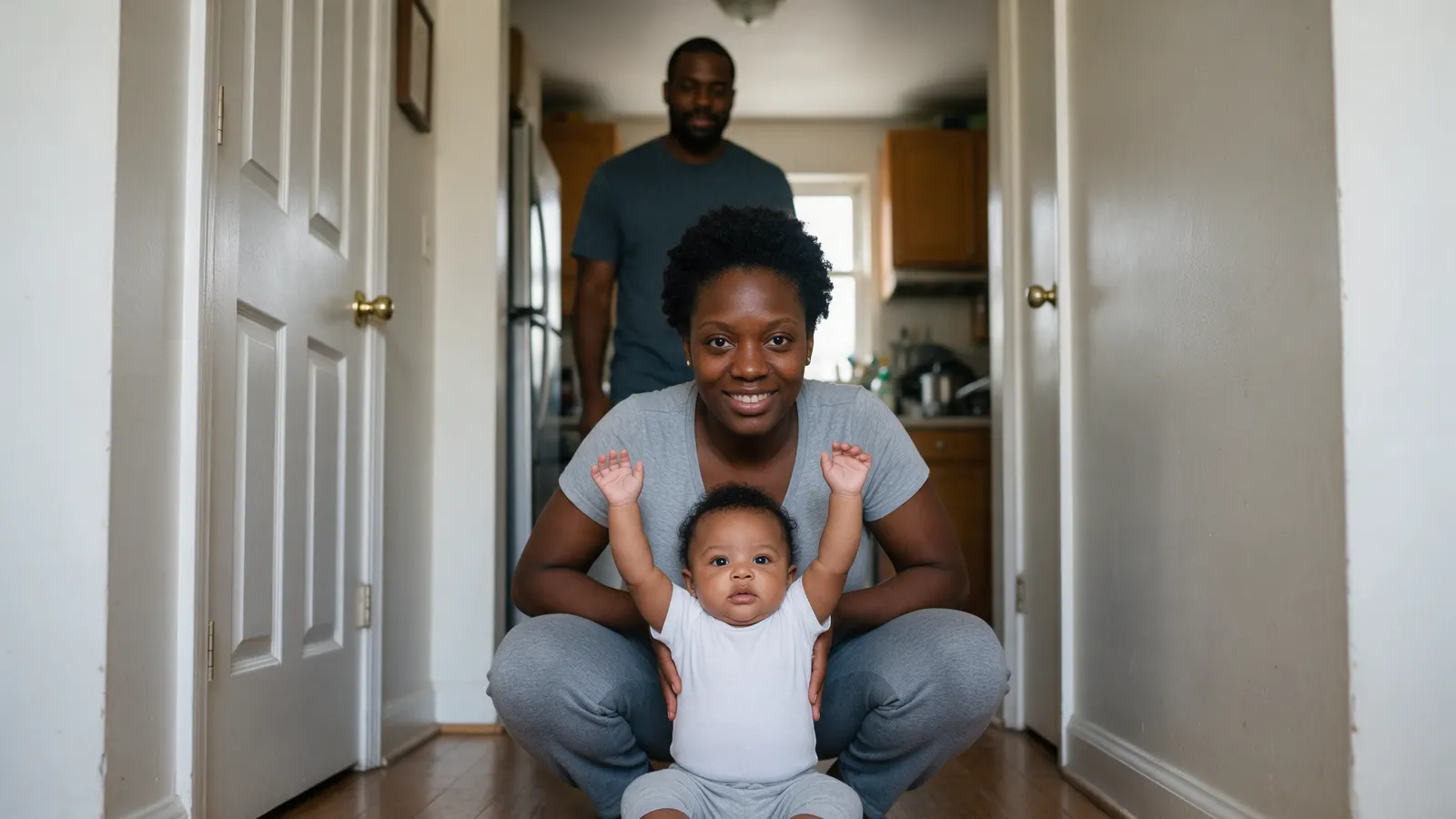
A baby who wants to be held used to cry for it. Around now, many start to ask with their arms instead. Today is that gesture, what to do with it, and what it does to your back.
Heart
By 9 months, most babies lift their arms to be picked up (CDC). It's the first of a family of gestures that do the work of words: the CDC's suggestion for this age is to teach them on purpose, waving bye-bye, shaking your head for "no," and lifting your arms to say "up" (CDC). Toward the end of the first year, babies use pointing and gestures to say what they want, and they copy the gestures they see you use (AAP). The arms come first because they're the gesture you answer fastest.
Head
Why a gesture matters more than it looks: in 24 babies followed monthly from 9 to 15 months, time spent sharing attention with their mothers, and mothers' talk about what the baby was already looking at, predicted the earliest gestures and words (Carpenter et al., 1998). Those are links, not cause, and the study is small. But the direction is the one the CDC's tips already point in: a gesture is a turn in a conversation, and the baby learns that turns get answered (CDC). The arms go up; you say "Up!"; the baby comes up. That's a sentence with three parts, and your baby just said the first one.
Body
The pairing is the whole trick: a word with the gesture, every time. Keep the word the same ("up," not "up" today and "come here" tomorrow), because babies understand more than they can say, and to a baby a word is any sound used the same way each time (AAP). And watch what's coming: the same arms will soon pull on the sofa, since pulling up to stand is a 12-month milestone (CDC), which is why the mattress goes to its lowest setting before your baby learns to stand (AAP).
Try today

Up?
Time: A few seconds, every pickup today
Before you lift your baby, kneel or crouch to their level, raise your own arms, and ask, "Up?" (CDC).
Wait two or three seconds. If the arms come up, say "Up!" and lift. If they don't, lift anyway with the same word; the gesture is a 9-month skill still arriving.
On the way down, do the reverse: "Down," and set them on the floor.
Count how many times the arms came up on their own today. Tomorrow's count is the only one to compare it with.
Make it work:Keep it to real pickups. A baby who learns that arms up gets answered doesn't need drills.
Watch for
Normal
arms up for one parent and a turned head for the other, on the same afternoon; preferences shift all month.
Bring it up
if your baby uses one arm or leg much more than the other (AAP).
Normal
a baby who lifts their arms, then changes their mind and dives for the toy instead.
Talk with your pediatrician
if your baby seems very stiff or very floppy (AAP).
Normal
a sideways topple from sitting when the arms go up too fast.
Call your pediatrician
for any head injury in a baby under 1, even one who seems fine (AAP).
For you
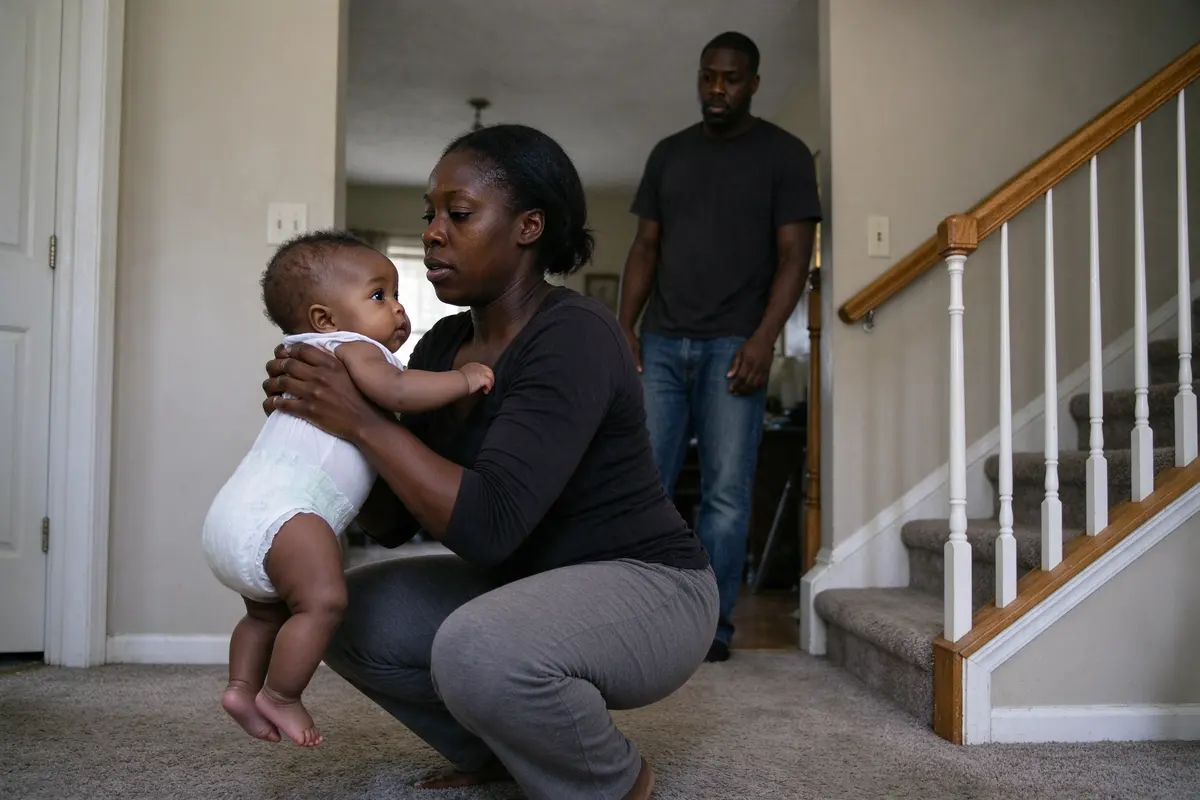
Your back, lifting a bigger baby. The arms-up gesture means dozens of lifts a day, from the floor, which is the deepest lift there is, and the baby weighs more every week. Bend your knees, bring the baby in against your chest before you stand, and stand with your legs, not your back. If you had a C-section, the rule was nothing heavier than your baby for the first 6 to 8 weeks (MedlinePlus); that window closed long ago, and the baby is the heaviest thing you lift now, so the form is what's left to protect you. Crouching to ask "Up?" first is good for your back as well as the baby's words: it puts you at the bottom of the lift before you start it.
If you're the partner: the floor lifts are yours this evening. Every one of them, with your knees.
Sources
- Centers for Disease Control and Prevention. "Milestones by 9 Months." Learn the Signs. Act Early. program, updated 2026. https://www.cdc.gov/act-early/milestones/9-months.html
- American Academy of Pediatrics. "Language Development: 8 to 12 Months." HealthyChildren.org, updated 2009. https://www.healthychildren.org/English/ages-stages/baby/Pages/Language-Development-8-to-12-Months.aspx
- Carpenter M, Nagell K, Tomasello M. "Social cognition, joint attention, and communicative competence from 9 to 15 months of age." Monographs of the Society for Research in Child Development, 1998. https://pubmed.ncbi.nlm.nih.gov/9835078/
- Centers for Disease Control and Prevention. "Milestones by 1 Year." Learn the Signs. Act Early. program, updated 2026. https://www.cdc.gov/act-early/milestones/1-year.html
- American Academy of Pediatrics. "Make Baby's Room Safe: Parent Checklist." HealthyChildren.org, updated 2020. https://www.healthychildren.org/English/safety-prevention/at-home/Pages/Make-Babys-Room-Safe.aspx
- American Academy of Pediatrics. "Movement Milestones in Babies 8 to 12 Months Old." HealthyChildren.org, updated 2021. https://www.healthychildren.org/English/ages-stages/baby/Pages/Movement-8-to-12-Months.aspx
- American Academy of Pediatrics. "Developmental Milestones: 7 Months." HealthyChildren.org, updated 2009. https://www.healthychildren.org/English/ages-stages/baby/Pages/Developmental-Milestones-7-Months.aspx
- American Academy of Pediatrics. "Head Injury" (symptom checker). HealthyChildren.org, accessed 2026. https://www.healthychildren.org/English/tips-tools/symptom-checker/Pages/symptomviewer.aspx?symptom=Head+Injury
- MedlinePlus. "Going home after a C-section." National Library of Medicine, 2024. https://medlineplus.gov/ency/patientinstructions/000624.htm
This guide is general education that summarizes published research and guidance from groups like the American Academy of Pediatrics, the CDC, and the WHO. It isn’t medical advice, and every child develops on their own timeline. Your pediatrician knows your child; if something feels wrong, call them. In an emergency, call 911.
Get each day’s note the morning it applies
Add your baby to a free Chorevia household with their date of birth, and every morning for 300 days the day’s note arrives in the app and by email: what’s developing, one thing to try, what to watch for, and a word for you.
Create your household