Day 255 of 300 · Week 35
Following the point
Last reviewed · 3 min read · 9 sources · Plain-text version
Pointing to ask is a 15-month milestone, but the stare and the reach are here now. Talk about what your baby is already looking at predicted the first gestures and words. Follow the point.

Your baby stares at something, then looks at you, then stares at it again. That three-step look is the beginning of pointing, and it's already a conversation. Today is how to answer it.
Heart
Toward the end of the first year, babies start using pointing and gestures to say what they want, and they copy the gestures they see you use (AAP). The milestones sit later than you'd guess: most babies wave bye-bye by 12 months, and most point to ask for something or get help by 15 months (CDC; CDC). Your baby is 8 months old. What's here now is the stare, the whole-arm reach, and the glance back to check that you saw it. That glance is the part that matters.
Head
In 24 babies followed monthly from 9 to 15 months, time spent sharing attention with their mothers, and mothers' talk about what the baby was already looking at, predicted the earliest gestures and words (Carpenter et al., 1998). In a study of 10 toddlers, many things children first pointed at later became words (Iverson & Goldin-Meadow, 2005). These studies show links, not cause, and they're small. But the direction is useful: the words come from where the baby is looking, not from where you'd like them to look.
Body
So when your baby points, or stares, answer with words (CDC). The guide's script, for a baby fixed on a dog: "Dog! A big dog. The dog says woof," then a pause for the baby's turn. Keep names consistent, "cat" today and not "kitty" tomorrow, ask questions, and wait for an answer (AAP). And point yourself, at the thing they're looking at and then at the next thing, because the gesture gets copied before it gets invented (AAP).
Try today
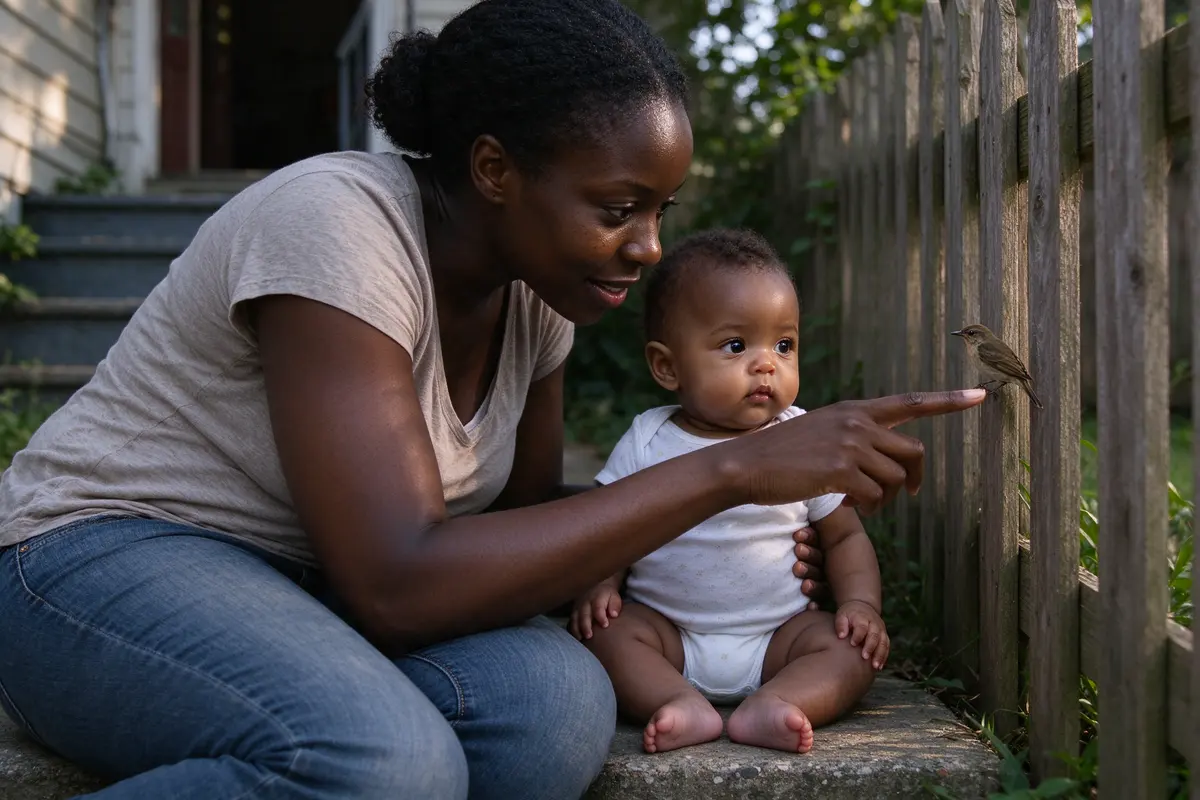
Follow the point
Time: Anytime, all day · Follow the point in the guide
When your baby stares at something or reaches toward it, look where they're looking (Carpenter et al., 1998).
Name it, short and clear: "A bird!"
Add a little more, like "The bird is flying," then pause for your baby's turn (CDC).
Point at it yourself with one finger, then point at the next thing and name that too. Ten rounds on a walk is plenty.
Make it work:Follow their eyes, not your plan. The talk that predicted words was about what the baby was already looking at (Carpenter et al., 1998).
Watch for
Normal
no pointing at all at 8 months; pointing to ask is a 15-month milestone (CDC).
Bring it up
if your baby doesn't look when you call their name by 9 months (CDC).
Normal
a reach with the whole arm and a grunt, aimed at the thing on the top shelf.
Talk with your pediatrician
if your baby seems not to see or hear well (AAP).
Normal
a new fear of the vacuum or the dark, pointed at with a wail, and wariness of a stranger who points back (AAP).
Mention it at the checkup
if your baby's fear of strangers is very intense; in 1,285 twins, stranger fear that was high and steady from the start, or rose sharply, went with more inhibition at age 3 (Brooker et al., 2013).
For you
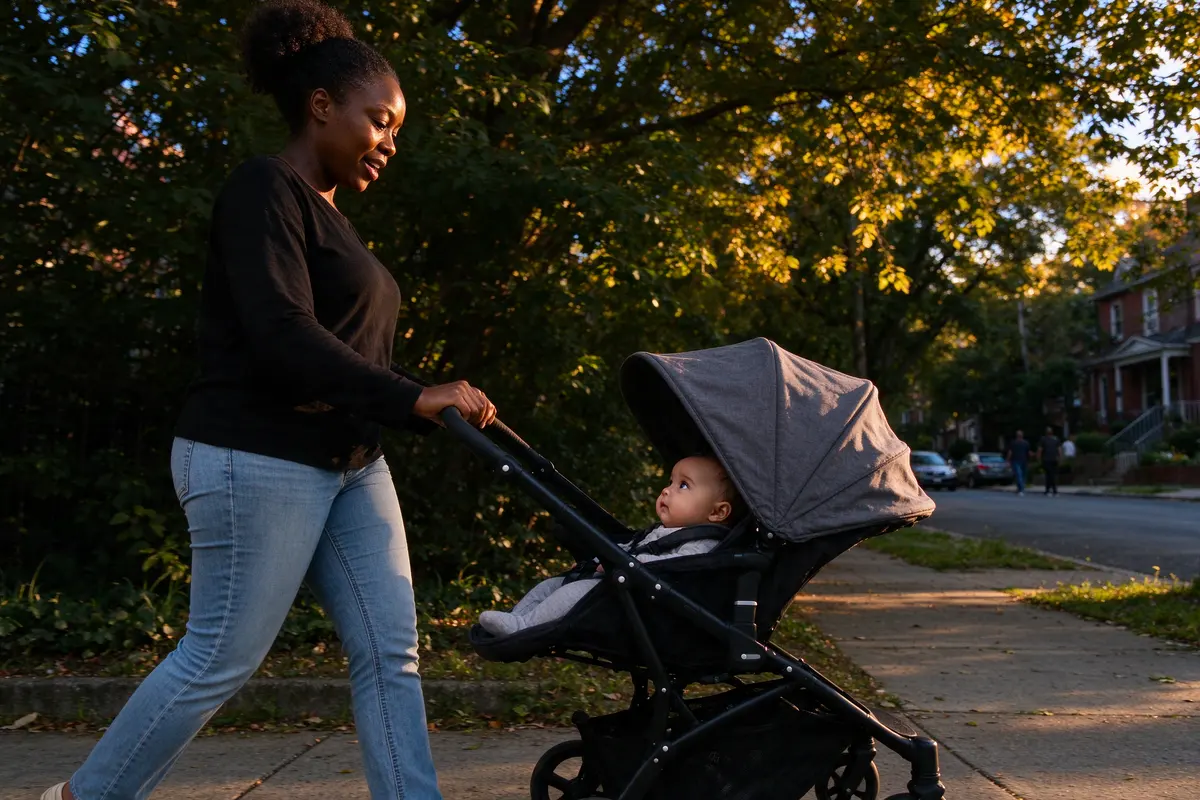
The walk is a vocabulary lesson for both of you. You don't need flashcards; you need to notice where the baby is looking and say the word. In the study, what predicted the first words was the mother talking about the thing the baby had already chosen (Carpenter et al., 1998). That's the easiest kind of talking there is: the baby picks the topic. Twenty minutes around the block with the stroller turned so you can see each other, and you'll have named a dozen things without planning any of them.
If you're the partner: take the evening walk and do the ten rounds. Report back which thing got the longest stare. That's probably a word in the making.
Sources
- American Academy of Pediatrics. "Language Development: 8 to 12 Months." HealthyChildren.org, updated 2009. https://www.healthychildren.org/English/ages-stages/baby/Pages/Language-Development-8-to-12-Months.aspx
- Centers for Disease Control and Prevention. "Milestones by 1 Year." Learn the Signs. Act Early. program, updated 2026. https://www.cdc.gov/act-early/milestones/1-year.html
- Centers for Disease Control and Prevention. "Milestones by 15 Months." Learn the Signs. Act Early. program, accessed 2026. https://www.cdc.gov/act-early/milestones/15-months.html
- Carpenter M, Nagell K, Tomasello M. "Social cognition, joint attention, and communicative competence from 9 to 15 months of age." Monographs of the Society for Research in Child Development, 1998. https://pubmed.ncbi.nlm.nih.gov/9835078/
- Iverson JM, Goldin-Meadow S. "Gesture paves the way for language development." Psychological Science, 2005. https://pubmed.ncbi.nlm.nih.gov/15869695/
- Centers for Disease Control and Prevention. "Milestones by 9 Months." Learn the Signs. Act Early. program, updated 2026. https://www.cdc.gov/act-early/milestones/9-months.html
- American Academy of Pediatrics. "Checkup Checklist: 9 Months Old." HealthyChildren.org, updated 2021. https://www.healthychildren.org/English/ages-stages/Your-Childs-Checkups/Pages/Your-Checkup-Checklist-9-Months-Old.aspx
- American Academy of Pediatrics. "Emotional and Social Development: 8 to 12 Months." HealthyChildren.org, updated 2009. https://www.healthychildren.org/English/ages-stages/baby/Pages/Emotional-and-Social-Development-8-12-Months.aspx
- Brooker RJ, Buss KA, Lemery-Chalfant K, et al. "The development of stranger fear in infancy and toddlerhood: normative development, individual differences, antecedents, and outcomes." Developmental Science, 2013. https://pubmed.ncbi.nlm.nih.gov/24118713/
This guide is general education that summarizes published research and guidance from groups like the American Academy of Pediatrics, the CDC, and the WHO. It isn’t medical advice, and every child develops on their own timeline. Your pediatrician knows your child; if something feels wrong, call them. In an emergency, call 911.
Get each day’s note the morning it applies
Add your baby to a free Chorevia household with their date of birth, and every morning for 300 days the day’s note arrives in the app and by email: what’s developing, one thing to try, what to watch for, and a word for you.
Create your household