Day 253 of 300 · Week 34
Walkers, once more
Last reviewed · 3 min read · 11 sources · Plain-text version
Baby walkers sent an estimated 230,676 US children to emergency rooms from 1990 to 2014, mostly down stairs, and they delay walking. New walkers take 2,368 steps an hour on the floor. The floor hour.
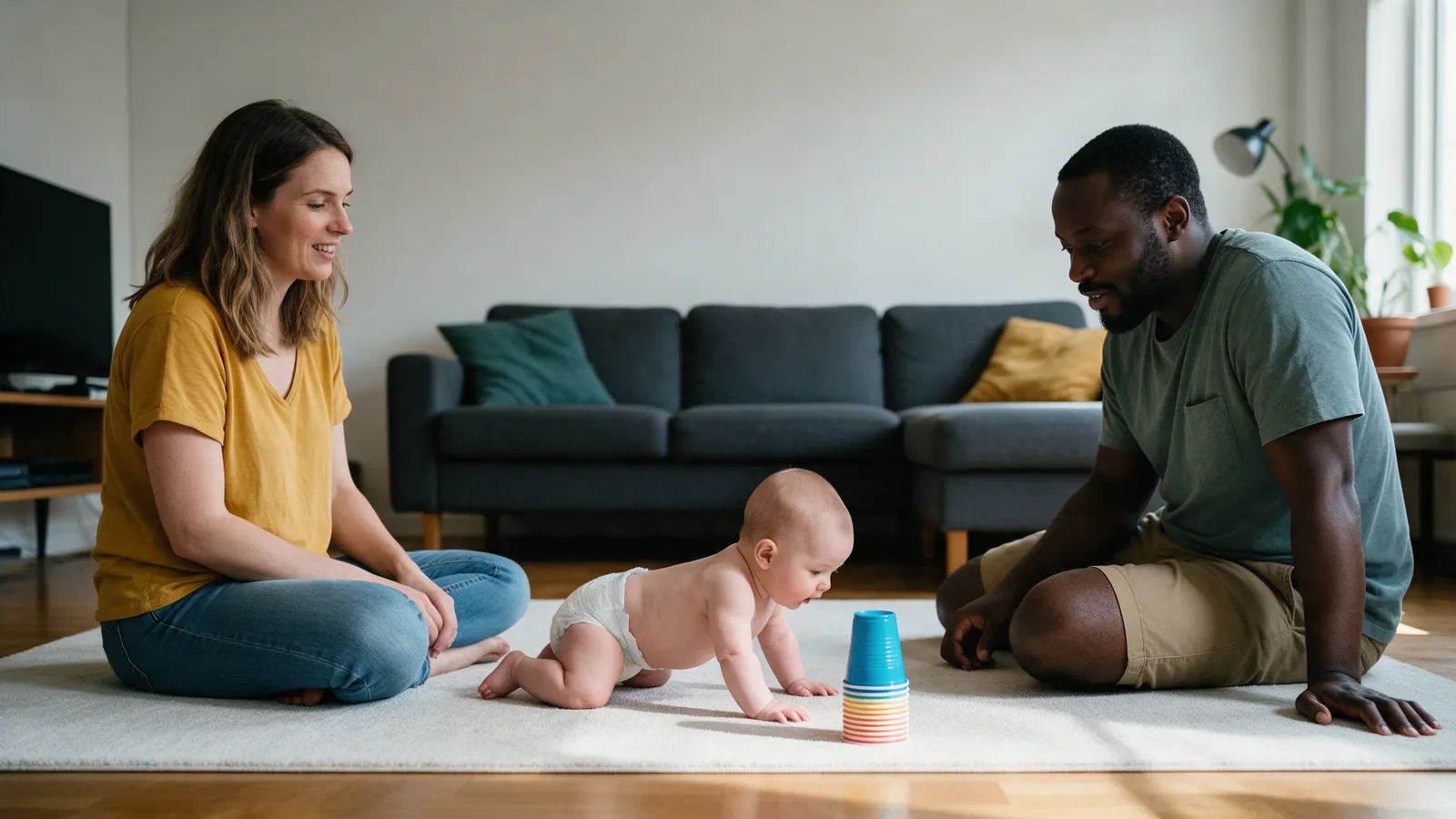
Someone, this month, will offer you a walker. A hand-me-down, a gift, a "we had one and she was fine." Today is the answer, and what to put the baby in instead, which is nothing.
Heart
Baby walkers don't help children learn to walk and can delay it, and they send thousands of children to hospitals each year, mostly from falls down stairs (AAP). From 1990 to 2014, an estimated 230,676 US children under 15 months were treated in emergency rooms for walker injuries, 74.1% from falls down stairs (Sims et al., 2018). Among 109 babies, walker users sat, crawled, and walked later and scored lower on developmental tests (Siegel & Burton, 1999). The AAP has long called for a ban on their sale (AAP, 2001), and walkers are banned in Canada (AAP).
Head
What teaches walking is the floor. Filmed during free play, 12- to 19-month-olds averaged 2,368 steps and 17 falls per hour (Adolph et al., 2012). Those falls are the curriculum: a baby in a walker is rolling, not balancing, and a baby in a walker can move more than 3 feet in a second, faster than an adult can react (AAP). Safe floor space beats any gadget. The WHO's version is interactive floor play several times a day and no more than 1 hour at a time strapped into a stroller, high chair, or carrier (WHO).
Body
If you want something that stands your baby up, CDC's suggestion is letting them push things around, such as empty boxes, and it says walkers aren't recommended (CDC). A stationary activity center with no wheels is safer than a walker (AAP); keep those sessions short, inside the WHO's hour (WHO). The cheapest, best equipment is a childproofed rug with the small things picked up (AAP).
Try today
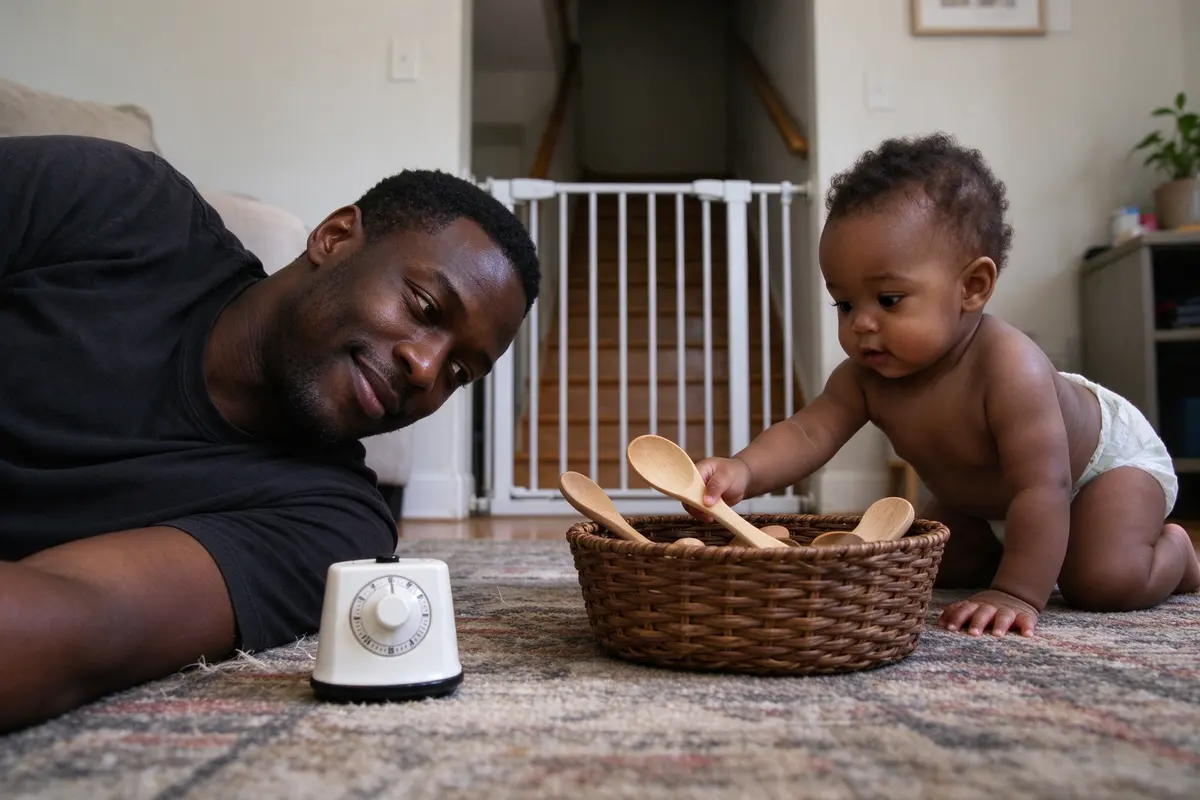
The floor hour
Time: 60 minutes, in pieces, with a timer · Crawling, cruising, and first steps in the guide
Pick one childproofed room. Check the floor and between the cushions for coins, toy parts, and pen caps (AAP).
Put your baby down with three things to reach for, placed just out of reach in three directions, and start a timer.
Get down there yourself for part of it; the rest, you're nearby and they're working.
Add up the pieces across the day until they reach an hour of free floor time, and count the strapped-in minutes against the WHO's 1-hour limit (WHO).
Make it work:Falls onto a rug are the point, not a problem; new walkers average 17 an hour (Adolph et al., 2012).
Watch for
Normal
a baby who stiffens their legs and bounces hard whenever you hold them upright, and wants nothing else.
Talk with your pediatrician
if your baby uses one arm or leg much more than the other (AAP).
Normal
a topple sideways from sitting onto the rug, and a short cry.
Go to the ER now
if after a head injury your baby vomits 2 or more times, cries and won't stop, or is awake but not alert (AAP).
Normal
a day of refusing the floor and wanting to be held.
Call your pediatrician right away
if your baby cries nonstop, cries when touched or moved, or won't move an arm or leg normally (AAP).
For you

Say no to the walker, kindly, again. You said it in month six, and the offer comes back because walkers look like help. The script is short: "Thank you, we're skipping walkers; the pediatricians' group has asked for a ban and they're illegal in Canada" (AAP). If a relative already bought one, the AAP's safer alternatives are a play yard or a stationary activity center with no wheels (AAP); offer the exchange, and keep the receipt conversation light.
If you're the partner: the relative who keeps offering is often yours. Take that call. One sentence, no debate, and then ask them to come sit on the floor for the hour instead.
Sources
- American Academy of Pediatrics. "Baby Walkers: A Dangerous Choice." HealthyChildren.org, updated 2022. https://www.healthychildren.org/English/safety-prevention/at-home/Pages/Baby-Walkers-A-Dangerous-Choice.aspx
- Sims A, Chounthirath T, Yang J, Hodges NL, Smith GA. "Infant Walker-Related Injuries in the United States." Pediatrics, 2018. https://pubmed.ncbi.nlm.nih.gov/30224365/
- Siegel AC, Burton RV. "Effects of baby walkers on motor and mental development in human infants." Journal of Developmental and Behavioral Pediatrics, 1999. https://pubmed.ncbi.nlm.nih.gov/10533994/
- American Academy of Pediatrics Committee on Injury and Poison Prevention. "Injuries associated with infant walkers." Pediatrics, 2001. https://pubmed.ncbi.nlm.nih.gov/11533353/
- Adolph KE, Cole WG, Komati M, et al. "How do you learn to walk? Thousands of steps and dozens of falls per day." Psychological Science, 2012. https://pubmed.ncbi.nlm.nih.gov/23085640/
- World Health Organization. "To grow up healthy, children need to sit less and play more." 2019. https://www.who.int/news/item/24-04-2019-to-grow-up-healthy-children-need-to-sit-less-and-play-more
- Centers for Disease Control and Prevention. "Milestones by 1 Year." Learn the Signs. Act Early. program, updated 2026. https://www.cdc.gov/act-early/milestones/1-year.html
- Bradin S. "Choking Prevention for Babies & Children: What Every Parent Needs to Know." HealthyChildren.org, updated 2026. https://www.healthychildren.org/English/health-issues/injuries-emergencies/Pages/Choking-Prevention.aspx
- American Academy of Pediatrics. "Movement Milestones in Babies 8 to 12 Months Old." HealthyChildren.org, updated 2021. https://www.healthychildren.org/English/ages-stages/baby/Pages/Movement-8-to-12-Months.aspx
- American Academy of Pediatrics. "Head Injury" (symptom checker). HealthyChildren.org, accessed 2026. https://www.healthychildren.org/English/tips-tools/symptom-checker/Pages/symptomviewer.aspx?symptom=Head+Injury
- American Academy of Pediatrics. "Fever" (symptom checker). HealthyChildren.org, accessed 2026. https://www.healthychildren.org/English/tips-tools/symptom-checker/Pages/symptomviewer.aspx?symptom=Fever
This guide is general education that summarizes published research and guidance from groups like the American Academy of Pediatrics, the CDC, and the WHO. It isn’t medical advice, and every child develops on their own timeline. Your pediatrician knows your child; if something feels wrong, call them. In an emergency, call 911.
Get each day’s note the morning it applies
Add your baby to a free Chorevia household with their date of birth, and every morning for 300 days the day’s note arrives in the app and by email: what’s developing, one thing to try, what to watch for, and a word for you.
Create your household