Day 268 of 300 · Week 36
Thirty-six weeks: before the 9-month visit
Last reviewed · 4 min read · 12 sources · Plain-text version
The 9-month checkup brings a developmental screening questionnaire, a full exam, sleep and pulling-up questions, and fluoride varnish once teeth are in. The nine-month list: five questions in writing.
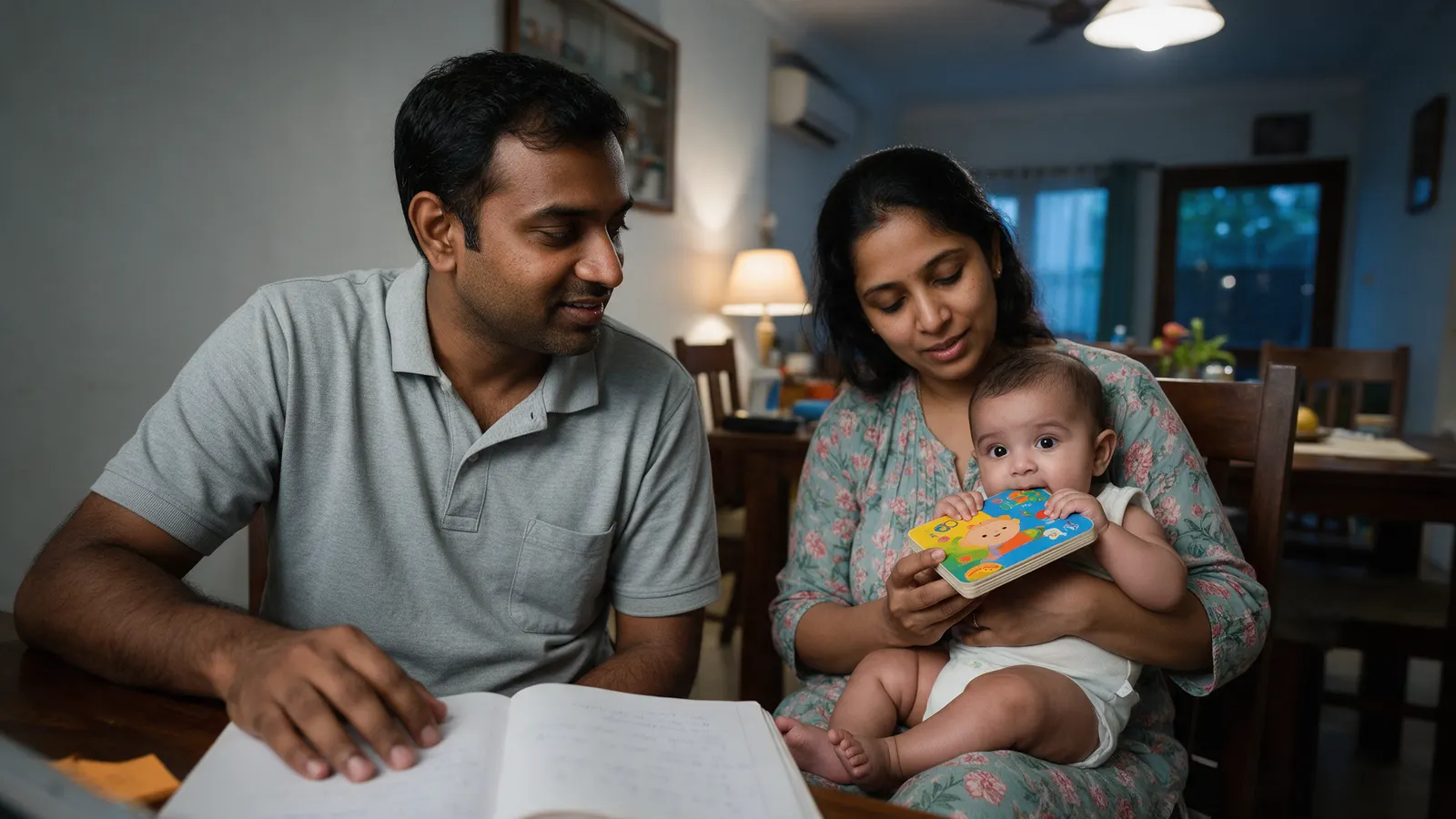
Thirty-six weeks, and the 9-month visit is around now. Today is what happens at it, the questionnaire you'll be handed, and the five things worth having in writing before you walk in.
Heart
The AAP recommends a standardized developmental screening at the 9-month visit (Lipkin & Macias, 2020; AAP, 2025), often a parent questionnaire like the Ages & Stages Questionnaires (ASQ) (ASQ). It's a form you fill in about what your baby does, not a test your baby takes, and the right answers are the true ones. Expect a full exam, questions about sleep and pulling to stand, and fluoride varnish once teeth are in (AAP). If your baby has teeth, the varnish is brushed on at the visit; if none yet, it waits.
Head
The pediatrician will ask about eating, so the food diary earns its keep: at 9 months, the AAP suggests 3 meals and 2 to 3 snacks a day (AAP), and a week of what actually went in is more useful than a guess. They'll ask about sleep, which is where the night-feed question goes: many babies this age don't need to eat at night, some still do, and the AAP's advice is to check with your pediatrician first if your baby isn't growing and gaining weight steadily (AAP). And they'll be glad to hear your yesterday's vaccine question before they reach for the tray.
Body
The exam also checks the things you can't see at home. Bring it up if your baby seems not to see or hear well (AAP), uses one arm or leg much more than the other (AAP), or has lost skills they used to have (CDC). The guide's section is The 9-month and 12-month checkups. One more thing to know before you go: if the screening raises a worry, your state's early intervention program does a free evaluation and you don't need a referral (CDC).
Try today

The nine-month list
Time: 15 minutes, both adults, the food diary open
Write question one about food: what's in the diary, what's refused, and whether the amounts look right for 3 meals and 2 to 3 snacks (AAP).
Write question two about nights: the night-feed question, with how many wakings and how long each one lasts (AAP).
Write question three about moving: sitting, scooting or crawling, pulling up, and anything one-sided you've noticed.
Write question four about vaccines, copied from yesterday's card, and question five about the one thing that's been nagging at you, however small.
Put the list, the food diary, and the vaccine record in the bag tonight, not tomorrow morning.
Make it work:Five is the limit. A list of fifteen gets three answered; a list of five gets five.
Watch for
Normal
a baby who sits alone but hasn't pulled up; pulling up to stand is a 12-month milestone (CDC).
Bring it up at the visit
if by 9 months your baby doesn't sit without support, look when you call their name, or babble lots of different sounds (CDC).
Normal
a week of fewer words from a baby who's busy learning to crawl.
Bring it up
if your baby has lost skills they used to have (CDC).
Normal
a rash of small red bumps from a drooly chin, gone by morning.
Call 911
if your baby has purple or blood-colored spots or dots on the skin (AAP).
For you

The visit can ask about you too, but only if you bring it. The 6-month visit was the last of the checkups at which the AAP recommends screening the birthing parent for depression (Earls et al., 2019), so there may be no form this time, and no one may ask. Write a sixth line at the bottom of the list, for yourself: how the nights are, how the days are, whether the flat feeling has lasted more than two weeks. If it has, say it in the room, and if the room isn't the place, your own doctor is, without waiting for a visit that isn't scheduled (Office on Women's Health).
If you're the partner: ask her tonight what the sixth line says, and whether she wants you to be the one who says it out loud at the visit. Then do whichever she picks.
Sources
- Lipkin PH, Macias MM; AAP Council on Children With Disabilities, Section on Developmental and Behavioral Pediatrics. "Promoting Optimal Development: Identifying Infants and Young Children With Developmental Disorders Through Developmental Surveillance and Screening." Pediatrics, 2020. https://pubmed.ncbi.nlm.nih.gov/31843861/
- American Academy of Pediatrics and Bright Futures. "Recommendations for Preventive Pediatric Health Care" (Periodicity Schedule). 2025. https://downloads.aap.org/AAP/PDF/periodicity_schedule.pdf
- Brookes Publishing. "About ASQ." Ages & Stages Questionnaires, accessed 2026. https://agesandstages.com/about-asq/
- American Academy of Pediatrics. "Checkup Checklist: 9 Months Old." HealthyChildren.org, updated 2021. https://www.healthychildren.org/English/ages-stages/Your-Childs-Checkups/Pages/Your-Checkup-Checklist-9-Months-Old.aspx
- American Academy of Pediatrics. "Sleeping Through the Night." HealthyChildren.org, updated 2013. https://www.healthychildren.org/English/ages-stages/baby/sleep/Pages/Sleeping-Through-the-Night.aspx
- American Academy of Pediatrics. "Movement Milestones in Babies 8 to 12 Months Old." HealthyChildren.org, updated 2021. https://www.healthychildren.org/English/ages-stages/baby/Pages/Movement-8-to-12-Months.aspx
- Centers for Disease Control and Prevention. "Milestones by 9 Months." Learn the Signs. Act Early. program, updated 2026. https://www.cdc.gov/act-early/milestones/9-months.html
- Centers for Disease Control and Prevention. "Concerned About Your Child's Development?" Updated 2026. https://www.cdc.gov/act-early/families/concerned.html
- Centers for Disease Control and Prevention. "Milestones by 1 Year." Learn the Signs. Act Early. program, updated 2026. https://www.cdc.gov/act-early/milestones/1-year.html
- American Academy of Pediatrics. "Fever" (symptom checker). HealthyChildren.org, accessed 2026. https://www.healthychildren.org/English/tips-tools/symptom-checker/Pages/symptomviewer.aspx?symptom=Fever
- Earls MF, Yogman MW, Mattson G, Rafferty J; AAP Committee on Psychosocial Aspects of Child and Family Health. "Incorporating Recognition and Management of Perinatal Depression Into Pediatric Practice." Pediatrics, 2019. https://pubmed.ncbi.nlm.nih.gov/30559120/
- Office on Women's Health. "Recovering from birth." US Department of Health and Human Services, 2021. https://womenshealth.gov/pregnancy/childbirth-and-beyond/recovering-birth
This guide is general education that summarizes published research and guidance from groups like the American Academy of Pediatrics, the CDC, and the WHO. It isn’t medical advice, and every child develops on their own timeline. Your pediatrician knows your child; if something feels wrong, call them. In an emergency, call 911.
Get each day’s note the morning it applies
Add your baby to a free Chorevia household with their date of birth, and every morning for 300 days the day’s note arrives in the app and by email: what’s developing, one thing to try, what to watch for, and a word for you.
Create your household