Day 267 of 300 · Week 36
Vaccines at nine months
Last reviewed · 4 min read · 8 sources · Plain-text version
A third polio dose if it wasn't given earlier, a flu shot every year from 6 months, COVID for 6 through 23 months, and schedules that differed in 2026. The vaccine question, in writing.

The 9-month visit is close, and it may include a needle or two. Today is which ones, why the answer varies this year, and the one question that gets you a straight reply.
Heart
The AAP recommends a third hepatitis B dose between 6 and 18 months, a flu shot every year starting at 6 months (two doses, 4 weeks apart, the first time), and COVID vaccine for babies 6 through 23 months (Bracho-Sánchez, AAP). A third polio dose may also come at the 9-month visit if it wasn't given earlier (AAP). So the honest answer to "what shots at nine months?" is: it depends on what's already in the record. If your baby got the flu shot's first dose at the 6-month visit, the second may be due now; if hepatitis B is already complete, nothing is. The record card answers more than any list.
Head
RSV has its own rule. For 2026-2027, the AAP still recommends RSV protection for babies under 8 months entering their first RSV season, unless they're already protected by an RSV vaccine given in pregnancy (AAP). Your baby is past 8 months now, so whether that line still covers them depends on when the season starts where you live and what your pediatrician does at the edge of it. That's a question, not a guess.
Body
And this year the schedules themselves differ. US guidance is in flux: the AAP and CDC schedules differ in 2026 (AAP), and a federal judge paused many of the federal changes in March 2026, a ruling the government has appealed (STAT, 2026). The guide's advice is to ask your pediatrician which schedule they follow (AAP). The full list for the stretch to the first birthday is in the guide's vaccine question.
Try today

The vaccine question
Time: 10 minutes, with the record card out
Find the vaccine record from the 6-month visit and read what's on it: which doses, which dates (Bracho-Sánchez, AAP).
Write the first question exactly like this: "Which schedule does this practice follow, the AAP's or the CDC's, and what does my baby get today under it?" (AAP)
Write the second: "Is a second flu dose, a third polio dose, or RSV protection due now, given what's on this card?" (AAP)
Clip both questions to the record card and put it in the bag you'll carry to the visit.
Make it work:If you have a worry about any vaccine, write it as a third question in your own words. It will get a better answer written down than blurted out while the baby is on the table.
Watch for
Normal
a clingy evening after a shot, and a thermometer that comes out more often than usual.
Go to the ER now
if your baby had a seizure with a fever, has a stiff neck, or has a bulging soft spot (AAP).
Normal
a fever that reads differently on two thermometers; use one, and don't go by the forehead (AAP).
Call your pediatrician right away
for a fever over 104°F (40°C), or shaking chills lasting more than 30 minutes (AAP).
Normal
worrying about febrile seizures, which affect 3 or 4 of every 100 children between 6 months and 5 years.
For you
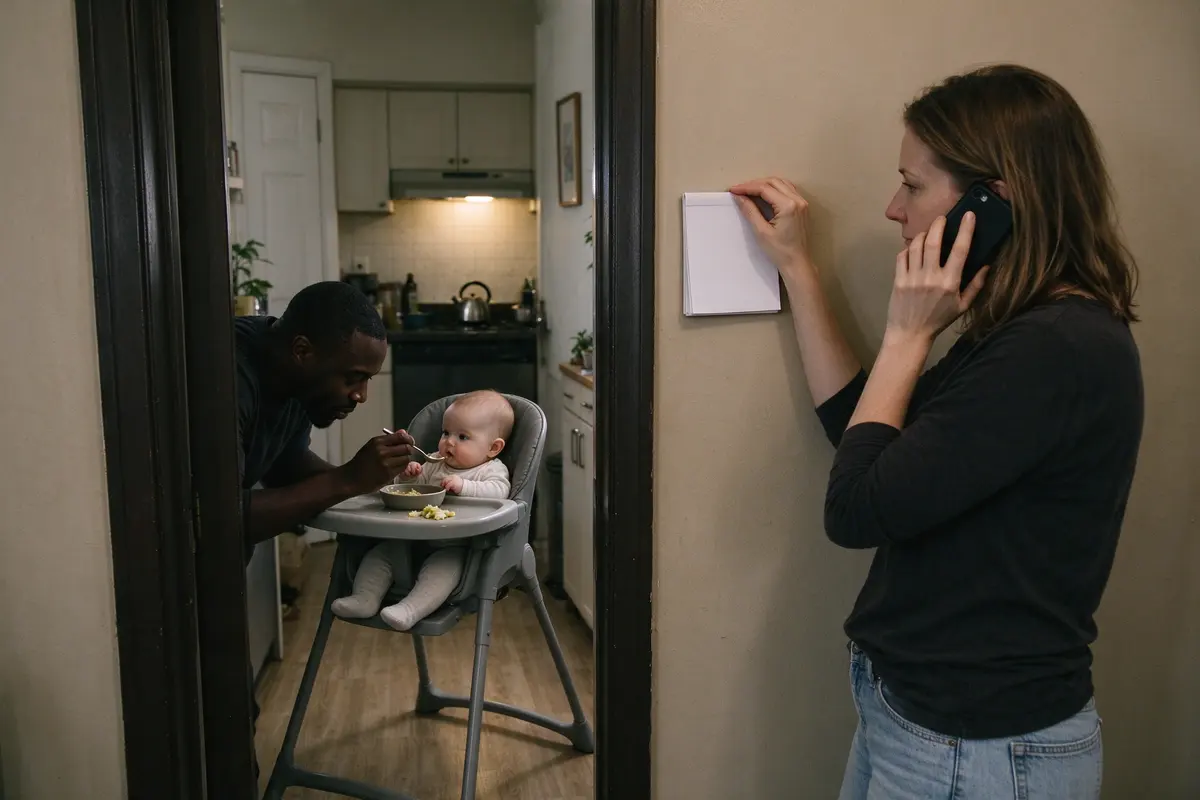
A question is not a confrontation. Asking which schedule the practice follows isn't a challenge to your pediatrician; it's the question the AAP itself says to ask, because its schedule and the CDC's differ this year (AAP). A good pediatrician will have been asked it twenty times this month and will have a clear answer. If the answer is vague or annoyed, that tells you something useful too. You're allowed to want the reasoning, and you're allowed to take notes while they give it.
If you're the partner: you ask question one, she asks question two. Two voices in the room make it a conversation instead of an interrogation, and nobody has to remember both answers alone.
Sources
- Bracho-Sánchez E. "AAP Guide: Vaccines Your Child Needs by Age 6." HealthyChildren.org, updated 2026. https://www.healthychildren.org/English/safety-prevention/immunizations/Pages/Your-Babys-First-Vaccines.aspx
- American Academy of Pediatrics. "Checkup Checklist: 9 Months Old." HealthyChildren.org, updated 2021. https://www.healthychildren.org/English/ages-stages/Your-Childs-Checkups/Pages/Your-Checkup-Checklist-9-Months-Old.aspx
- American Academy of Pediatrics. "AAP Releases RSV Immunization Recommendations for 2026-2027 Season." HealthyChildren.org, 2026. https://www.healthychildren.org/English/news/Pages/aap-updates-rsv-immunization-recommendations-for-2026-2027-season.aspx
- American Academy of Pediatrics. "AAP Releases Recommended Childhood and Adolescent Immunization Schedule for 2026." HealthyChildren.org, 2026. https://www.healthychildren.org/English/news/Pages/AAPs-recommended-childhood-and-adolescent-immunization-schedule-for-2026.aspx
- STAT. "HHS appeals ruling that stalled many of Kennedy's vaccine policy changes." 2026. https://www.statnews.com/2026/04/29/hhs-appealing-acip-vaccine-policy-lawsuit-ruling/
- American Academy of Pediatrics. "Fever" (symptom checker). HealthyChildren.org, accessed 2026. https://www.healthychildren.org/English/tips-tools/symptom-checker/Pages/symptomviewer.aspx?symptom=Fever
- American Academy of Pediatrics. "Fever and Your Baby." HealthyChildren.org, updated 2025. https://www.healthychildren.org/English/health-issues/conditions/fever/Pages/Fever-and-Your-Baby.aspx
- Di Giovine M, Catenaccio E. "Febrile Seizures in Children." HealthyChildren.org, updated 2025. https://www.healthychildren.org/English/health-issues/conditions/fever/Pages/Febrile-Seizures.aspx
This guide is general education that summarizes published research and guidance from groups like the American Academy of Pediatrics, the CDC, and the WHO. It isn’t medical advice, and every child develops on their own timeline. Your pediatrician knows your child; if something feels wrong, call them. In an emergency, call 911.
Get each day’s note the morning it applies
Add your baby to a free Chorevia household with their date of birth, and every morning for 300 days the day’s note arrives in the app and by email: what’s developing, one thing to try, what to watch for, and a word for you.
Create your household