Day 270 of 300 · Nine months
Nine months
Last reviewed · 4 min read · 14 sources · Plain-text version
Nine months. The visit is around now; the screening is a conversation, not a test; early intervention is free and needs no referral. The after-visit note, the hotlines once more, and what's next.

Nine months. The visit is around now, maybe today, maybe next week. Here is what to do with it afterward, and then where the notes go next.
Heart
The screening you'll fill in is a conversation, not a test. The AAP recommends a standardized developmental screening at the 9-month visit (Lipkin & Macias, 2020), often a parent questionnaire like the Ages & Stages Questionnaires (ASQ). It asks you what your baby does, because you're the one who has watched them for nine months. CDC's checklists are set at skills at least 75% of babies show by each age, so a missed one is a reason to check in, not to wait and see (Zubler et al., 2022). By 9 months, most babies sit without support, look when you call their name, and babble lots of different sounds (CDC); if any of those isn't here, say so on the form.
Head
Then the part that takes the fear out. If you're worried, ask your pediatrician about developmental screening, or call your state's early intervention program for a free evaluation; you don't need a referral (CDC; CDC). Free, no referral, and you can call it yourself tomorrow, whatever was said in the room. The "don't wait" list is short: by 9 months, doesn't sit without support, look when you call their name, or babble lots of different sounds (CDC); uses one arm or leg much more than the other (AAP); seems not to see or hear well (AAP); or has lost skills they used to have (CDC).
Body
Try today

The after-visit note
Time: 5 minutes, in the car before you drive, or at the kitchen table if the visit is still ahead
On the back of whatever the clinic handed you, write the answers to your five questions in one line each, in the pediatrician's words as near as you can remember them.
Write what the screening showed, including "nothing to follow up" if that's what was said, and the name of anything you were told to watch.
Write what was given today, shots or varnish, and the date of the next visit.
If anything was referred, write the phone number and the words "free evaluation, no referral needed" next to it, so you remember you can also call early intervention yourself (CDC).
Photograph the page and send it to the other parent before you start the car.
Make it work:If the visit hasn't happened yet, put the blank page in the bag with the list, so the writing happens before the forgetting.
Watch for
Normal
a baby who sat up, babbled, and smiled at the mirror for a week and then did none of it in the exam room.
Don't wait
if you're worried: the free evaluation is yours to request (CDC).
Normal
a clingy, tearful afternoon after a visit with shots.
Call your pediatrician right away
if your baby looks or acts very sick, or you think they need to be seen urgently (AAP).
Normal
a crawl that's still a scoot, or still nothing; 4.3% of healthy children never crawl on hands and knees at all (WHO Multicentre Growth Reference Study Group, 2006).
Talk with your pediatrician
if your baby favors one side or doesn't seem to be moving normally (AAP).
Normal
knowing this baby better than anyone alive, including the person who examined them today.
Call anyway
if your baby just doesn't seem right to you. Trust your instincts; two hundred and seventy days have built them (Lurie Children's).
For you
Nine months of you. Once more, lightly: the National Maternal Mental Health Hotline is 1-833-TLC-MAMA (1-833-852-6262), call or text; 988 is for anyone; in an emergency, 911 (CDC). The 6-month visit was the last of the checkups at which the AAP recommends screening the birthing parent for depression (Earls et al., 2019), so the question is yours to ask yourself and each other. Partners too: about 10% of fathers have depression around a birth, with higher rates reported at 3 to 6 months after (Paulson & Bazemore, 2010), and the months after that aren't exempt.
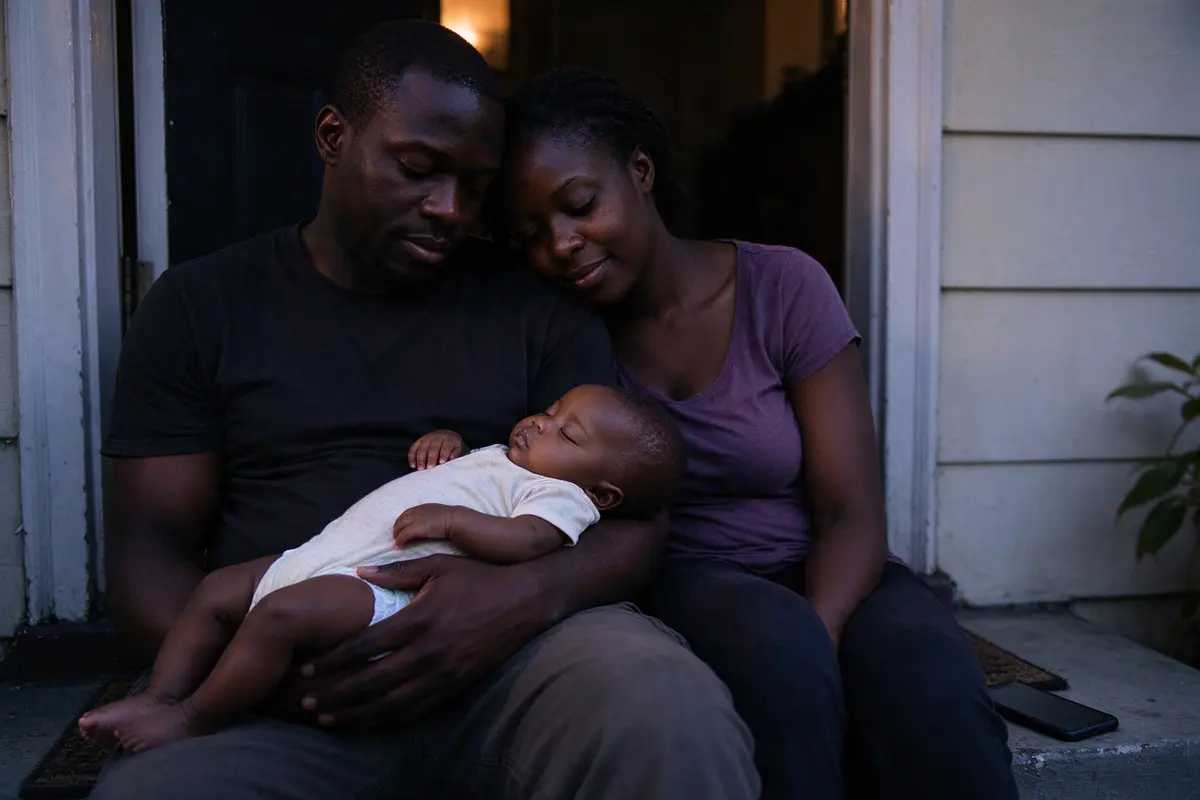
If you're the partner: say the thing she did this month that you'll remember, out loud, on the step. Then keep reading together: the 7-to-12-month guide has the whole stretch to the first birthday, and the notes continue tomorrow at your tenth month.
Sources
- Lipkin PH, Macias MM; AAP Council on Children With Disabilities, Section on Developmental and Behavioral Pediatrics. "Promoting Optimal Development: Identifying Infants and Young Children With Developmental Disorders Through Developmental Surveillance and Screening." Pediatrics, 2020. https://pubmed.ncbi.nlm.nih.gov/31843861/
- Brookes Publishing. "About ASQ." Ages & Stages Questionnaires, accessed 2026. https://agesandstages.com/about-asq/
- Zubler JM, Wiggins LD, Macias MM, et al. "Evidence-Informed Milestones for Developmental Surveillance Tools." Pediatrics, 2022. https://pubmed.ncbi.nlm.nih.gov/35132439/
- Centers for Disease Control and Prevention. "Milestones by 9 Months." Learn the Signs. Act Early. program, updated 2026. https://www.cdc.gov/act-early/milestones/9-months.html
- Centers for Disease Control and Prevention. "Concerned About Your Child's Development?" Updated 2026. https://www.cdc.gov/act-early/families/concerned.html
- American Academy of Pediatrics. "Movement Milestones in Babies 8 to 12 Months Old." HealthyChildren.org, updated 2021. https://www.healthychildren.org/English/ages-stages/baby/Pages/Movement-8-to-12-Months.aspx
- American Academy of Pediatrics. "Checkup Checklist: 9 Months Old." HealthyChildren.org, updated 2021. https://www.healthychildren.org/English/ages-stages/Your-Childs-Checkups/Pages/Your-Checkup-Checklist-9-Months-Old.aspx
- American Academy of Pediatrics. "AAP Releases Recommended Childhood and Adolescent Immunization Schedule for 2026." HealthyChildren.org, 2026. https://www.healthychildren.org/English/news/Pages/AAPs-recommended-childhood-and-adolescent-immunization-schedule-for-2026.aspx
- American Academy of Pediatrics. "Fever" (symptom checker). HealthyChildren.org, accessed 2026. https://www.healthychildren.org/English/tips-tools/symptom-checker/Pages/symptomviewer.aspx?symptom=Fever
- WHO Multicentre Growth Reference Study Group. "WHO Motor Development Study: windows of achievement for six gross motor development milestones." Acta Paediatrica Supplement, 2006. https://pubmed.ncbi.nlm.nih.gov/16817682/
- Latimer T. "When to Call the Pediatrician for Your Newborn." Lurie Children's Hospital of Chicago, 2022. https://www.luriechildrens.org/en/blog/when-to-call-the-pediatrician-for-your-newborn/
- Centers for Disease Control and Prevention. "Symptoms of Depression Among Women." 2024. https://www.cdc.gov/reproductive-health/depression/index.html
- Earls MF, Yogman MW, Mattson G, Rafferty J; AAP Committee on Psychosocial Aspects of Child and Family Health. "Incorporating Recognition and Management of Perinatal Depression Into Pediatric Practice." Pediatrics, 2019. https://pubmed.ncbi.nlm.nih.gov/30559120/
- Paulson JF, Bazemore SD. "Prenatal and postpartum depression in fathers and its association with maternal depression: a meta-analysis." JAMA, 2010. https://pubmed.ncbi.nlm.nih.gov/20483973/
This guide is general education that summarizes published research and guidance from groups like the American Academy of Pediatrics, the CDC, and the WHO. It isn’t medical advice, and every child develops on their own timeline. Your pediatrician knows your child; if something feels wrong, call them. In an emergency, call 911.
Get each day’s note the morning it applies
Add your baby to a free Chorevia household with their date of birth, and every morning for 300 days the day’s note arrives in the app and by email: what’s developing, one thing to try, what to watch for, and a word for you.
Create your household