Day 245 of 300 · Week 33
Peekaboo, month nine
Last reviewed · 4 min read · 6 sources · Plain-text version
Smiling or laughing at peekaboo is a 9-month skill, built on a baby who now knows you're still there behind the door. Peekaboo behind the door, and why the laugh is the whole reward.

The game that got a stare at three months gets a shriek now. Today is why, and the version of peekaboo that fits a baby who can lean, turn, and look for you.
Heart
By 9 months, most babies smile or laugh at peekaboo (CDC). What changed is underneath the laugh. By about 8 months, your baby will lift a scarf to find a hidden toy, and by 10 months they'll keep searching, because they now know objects exist out of sight (AAP). Peekaboo at 8 months is a baby testing that idea on the most important object they have, which is your face. The laugh is the sound of the test passing.
Head
The memory behind it is still short, which is why the game works. In a classic lab study, babies 7.5 to 9 months old searched in the old hiding spot after delays of just 2 to 5 seconds, while 12-month-olds made the same mistake only after delays of more than 10 seconds (Diamond & Goldman-Rakic, 1989). So a pause of two seconds behind the door is real suspense to an 8-month-old; five seconds is a long time; ten is long enough to lose you. Looking for a toy they saw you hide is a 12-month milestone, and the CDC and the AAP both suggest hiding games now as practice (CDC; AAP).
Body
The same idea runs through the rest of the day. Dropping and banging are experiments in how things work, and everything still goes in the mouth, so check the floor often (AAP). Looking for objects dropped out of sight is on the 9-month list too (CDC); the spoon over the high-chair edge and you behind the door are the same lesson, with you as the better punchline.
Try today
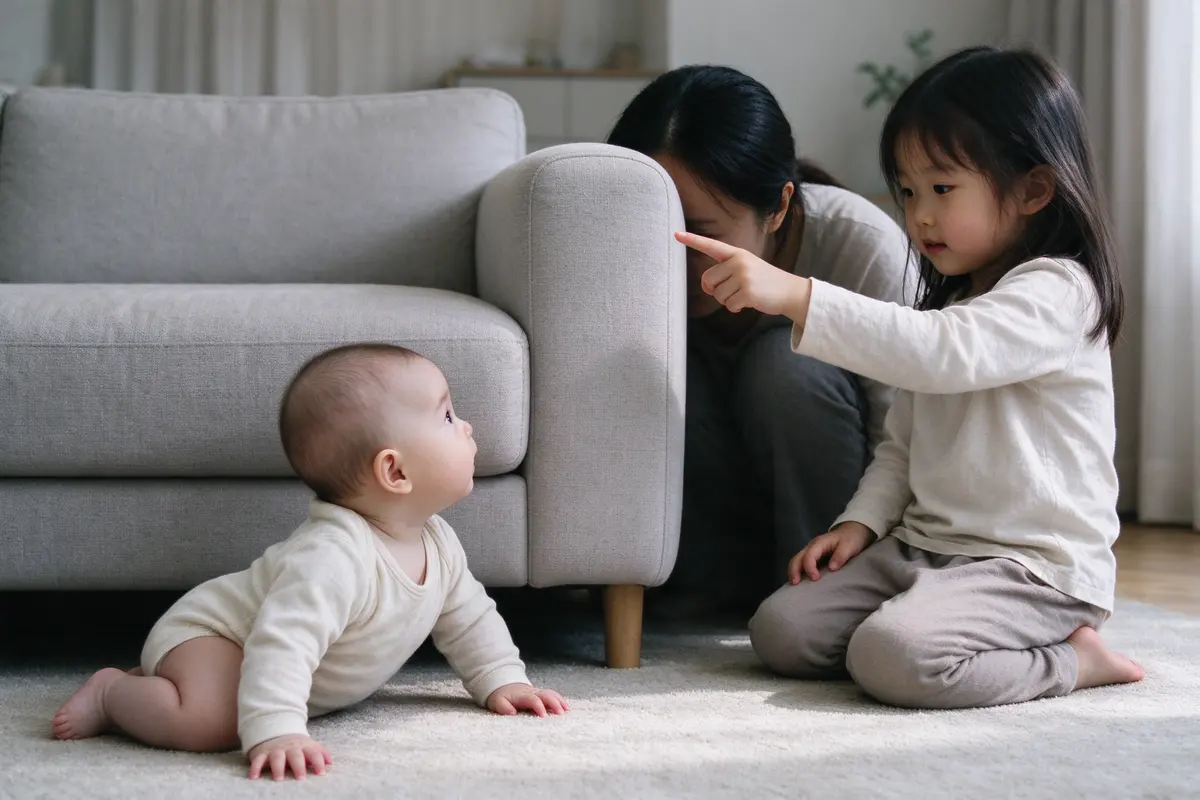
Peekaboo behind the door
Time: 2 to 5 minutes · Where did it go? in the guide
Sit your baby on the floor facing a half-open door, with another adult or a safe cleared rug around them.
Step behind the door edge and say, "Where's Mama?" Count two in your head; that's a long pause for this age (Diamond & Goldman-Rakic, 1989).
Lean out: "Peekaboo!" Then do it again, from the same edge, three or four times.
Change the spot: the sofa arm, the kitchen doorway, behind a towel held up at your face. Cheer when they look toward where you'll appear (AAP).
Let them hide you: drape a light cloth over your own face and let them pull it off. Never over theirs.
Make it work:Stop while they're still laughing. The game ends on a high or it turns into tears.
Watch for
Normal
a frown on the first disappearance and a laugh on the fourth; the pause is suspense to a baby with a memory of a few seconds (Diamond & Goldman-Rakic, 1989).
Bring it up
if by 12 months your baby doesn't look for a toy they saw you hide (CDC).
Normal
the cloth from your face straight into their mouth (AAP).
Call 911
if your baby is choking and can't breathe, cry, or make noise, turns bluish, or goes limp, and start back blows and chest thrusts while someone calls (AAP).
Normal
a baby who is done after three rounds and turns to a toy.
Go to the ER now
if your baby is hard to wake, isn't alert when awake, or seems confused (AAP).
For you

The laugh is the reward. Nothing in today's game builds a skill faster than it would build itself; the AAP suggests hiding games, and the milestone they point at has until 12 months regardless (AAP; CDC). So the point of peekaboo isn't the milestone. It's four minutes in which a person who thinks you're the most interesting object in the world loses you and gets you back, on purpose, and shrieks about it. Take the four minutes for yourself. Lie on the rug afterward and let them climb on you.
If you're the partner: your face behind the door is a different face, and the laugh is different for it. Take a turn.
Sources
- Centers for Disease Control and Prevention. "Milestones by 9 Months." Learn the Signs. Act Early. program, updated 2026. https://www.cdc.gov/act-early/milestones/9-months.html
- American Academy of Pediatrics. "Cognitive Development in Infants: 8 to 12 Months." HealthyChildren.org, updated 2023. https://www.healthychildren.org/English/ages-stages/baby/Pages/Cognitive-Development-8-to-12-Months.aspx
- Diamond A, Goldman-Rakic PS. "Comparison of human infants and rhesus monkeys on Piaget's AB task: evidence for dependence on dorsolateral prefrontal cortex." Experimental Brain Research, 1989. https://pubmed.ncbi.nlm.nih.gov/2924839/
- Centers for Disease Control and Prevention. "Milestones by 1 Year." Learn the Signs. Act Early. program, updated 2026. https://www.cdc.gov/act-early/milestones/1-year.html
- Bradin S. "Choking Prevention for Babies & Children: What Every Parent Needs to Know." HealthyChildren.org, updated 2026. https://www.healthychildren.org/English/health-issues/injuries-emergencies/Pages/Choking-Prevention.aspx
- American Academy of Pediatrics. "Fever" (symptom checker). HealthyChildren.org, accessed 2026. https://www.healthychildren.org/English/tips-tools/symptom-checker/Pages/symptomviewer.aspx?symptom=Fever
This guide is general education that summarizes published research and guidance from groups like the American Academy of Pediatrics, the CDC, and the WHO. It isn’t medical advice, and every child develops on their own timeline. Your pediatrician knows your child; if something feels wrong, call them. In an emergency, call 911.
Get each day’s note the morning it applies
Add your baby to a free Chorevia household with their date of birth, and every morning for 300 days the day’s note arrives in the app and by email: what’s developing, one thing to try, what to watch for, and a word for you.
Create your household