Day 244 of 300 · Week 33
Reacts when you leave
Last reviewed · 3 min read · 8 sources · Plain-text version
Looking, reaching, or crying when you leave is a 9-month milestone. Separation anxiety usually strengthens around 9 months and peaks between 10 and 18. The guide's practice goodbyes, today.

Leaving the room used to be free. Around now, it starts to cost something, and the cost is a sign that the last eight months worked.
Heart
By 9 months, most babies react when you leave by looking, reaching for you, or crying (CDC). Separation anxiety usually gets stronger around 9 months (Swanson, AAP) and peaks between 10 and 18 months, and the AAP calls it a sign of attachment, not of spoiling (AAP). Your baby now knows you exist when you're gone and has little sense of time, so they don't know when you'll be back. The tears at the door are the proof that you're the person they're measuring everything against.
Head
The AAP's advice is short. Never sneak away; say a quick, cheerful goodbye, even if your baby cries (CDC), use the same short ritual every time, and come back when you said you would (Swanson, AAP). Separations are harder when babies are tired, hungry, or sick, and tears usually stop within minutes of your leaving (AAP). The guide's version is Ease goodbyes and new faces. None of these tips has been tested in a trial; they're the AAP's best advice, and the ritual is the part parents say helps them most.
Body
Two places this shows up beyond the front door. If you can, avoid starting child care during this stage, or ease in slowly and take a little extra time at drop-off (AAP). And nights: separation anxiety can bring back night waking (AAP); when it does, reassure your baby quietly, then leave (Nemours KidsHealth). The leaving is the same skill in both places, practiced in daylight first.
Try today
Practice goodbyes
Time: A minute or two, a few times today · Practice goodbyes in the guide
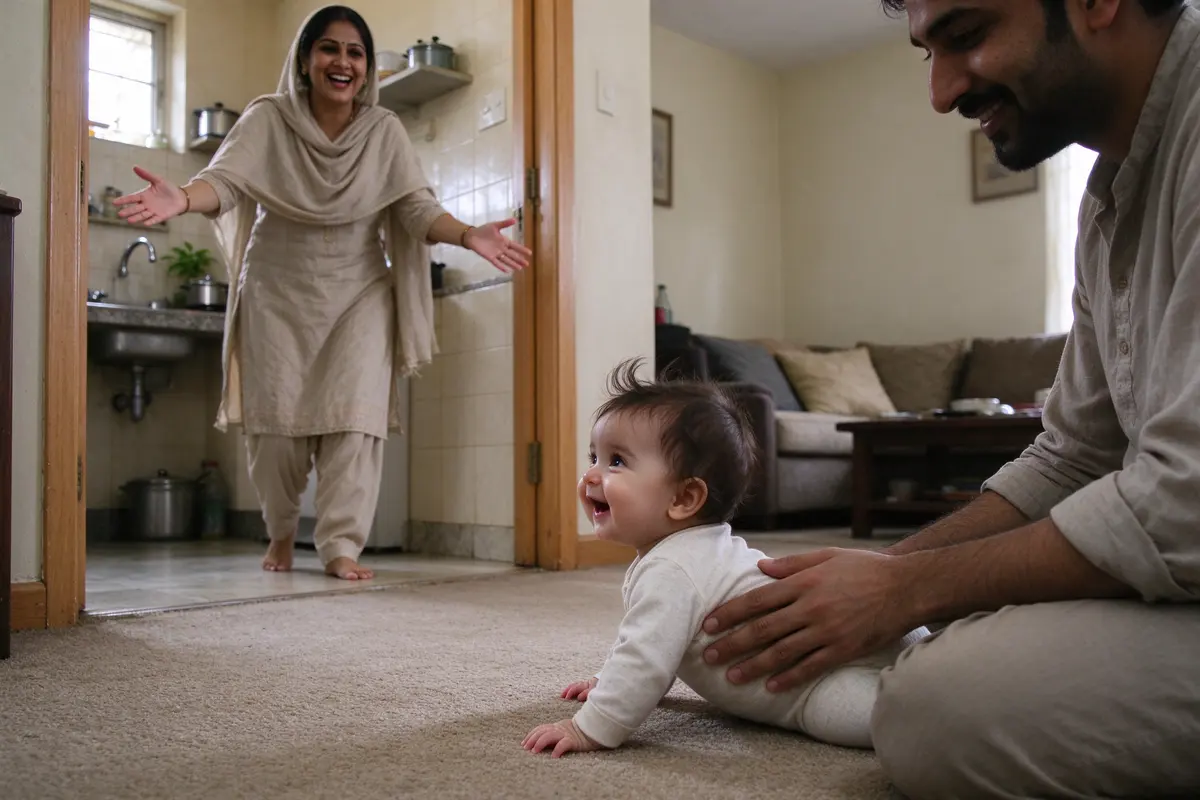
When you step into the next room, say, "I'll be right back," the same words each time (Swanson, AAP).
If your baby fusses, call out to them from the other room instead of rushing back.
Come back when you said you would, with a big hello.
When your baby crawls or scoots off into a safe room on their own, wait a minute or two before following; that's a goodbye they chose (AAP).
Make it work:Pick a rested, fed hour. Separations are harder when a baby is tired, hungry, or sick (AAP).
Watch for
Normal
a wail when you go and quiet within a few minutes; tears usually stop soon after you leave (AAP).
Call your pediatrician right away
if your baby cries nonstop, or cries when touched or moved (AAP).
Normal
clinging harder in a week with a cold; being sick makes goodbyes worse (AAP).
Call your pediatrician right away
for signs of dehydration: no urine in more than 8 hours, dark urine, a very dry mouth, and no tears (AAP).
Normal
no reaction at all when you leave some days, and a big one on others; reacting when you leave has until 9 months (CDC).
Don't wait
if you're worried about development: ask about screening, or call your state's early intervention program for a free evaluation (CDC).
For you

It's attachment, and it ends. The peak the AAP describes is 10 to 18 months (AAP), which means the hardest goodbyes are still ahead and also that they have an end date. The crying through the door isn't a judgment of your leaving; it's the measure of your coming back, and a baby who didn't care would be the worrying one. Go when you said you'd go. Sit on the step for a minute if you need to. Then do the thing you left to do, because a goodbye that's actually a goodbye is what teaches the coming-back.
If you're the partner: you're the one on the floor when she leaves. Call out to the baby, hold the toy up, and don't carry them to the window to watch her go. Then text her when it stops, with the time. It'll be sooner than she thinks.
Sources
- Centers for Disease Control and Prevention. "Milestones by 9 Months." Learn the Signs. Act Early. program, updated 2026. https://www.cdc.gov/act-early/milestones/9-months.html
- Swanson WS. "How to Ease Your Child's Separation Anxiety." HealthyChildren.org, updated 2026. https://www.healthychildren.org/English/ages-stages/toddler/Pages/Soothing-Your-Childs-Separation-Anxiety.aspx
- American Academy of Pediatrics. "Emotional and Social Development: 8 to 12 Months." HealthyChildren.org, updated 2009. https://www.healthychildren.org/English/ages-stages/baby/Pages/Emotional-and-Social-Development-8-12-Months.aspx
- American Academy of Pediatrics. "Making Baby Drop Off at Child Care Easier." HealthyChildren.org, updated 2022. https://www.healthychildren.org/English/family-life/work-and-child-care/Pages/making-baby-drop-off-at-child-care-easier.aspx
- American Academy of Pediatrics. "Separation Anxiety & Sleeping Trouble in Young Children." HealthyChildren.org, updated 2022. https://www.healthychildren.org/English/healthy-living/sleep/Pages/separation-anxiety-and-sleeping.aspx
- Nemours KidsHealth. "Baby Sleep: 8- to 12-Month-Olds." Reviewed 2025. https://kidshealth.org/en/parents/sleep812m.html
- American Academy of Pediatrics. "Fever" (symptom checker). HealthyChildren.org, accessed 2026. https://www.healthychildren.org/English/tips-tools/symptom-checker/Pages/symptomviewer.aspx?symptom=Fever
- Centers for Disease Control and Prevention. "Concerned About Your Child's Development?" Updated 2026. https://www.cdc.gov/act-early/families/concerned.html
This guide is general education that summarizes published research and guidance from groups like the American Academy of Pediatrics, the CDC, and the WHO. It isn’t medical advice, and every child develops on their own timeline. Your pediatrician knows your child; if something feels wrong, call them. In an emergency, call 911.
Get each day’s note the morning it applies
Add your baby to a free Chorevia household with their date of birth, and every morning for 300 days the day’s note arrives in the app and by email: what’s developing, one thing to try, what to watch for, and a word for you.
Create your household