Day 257 of 300 · Week 35
Night waking, month nine
Last reviewed · 3 min read · 10 sources · Plain-text version
Separation anxiety usually gets stronger around 9 months and can bring back night waking. Reassure quietly, then leave; ask before cutting night feeds. The two-minute check.
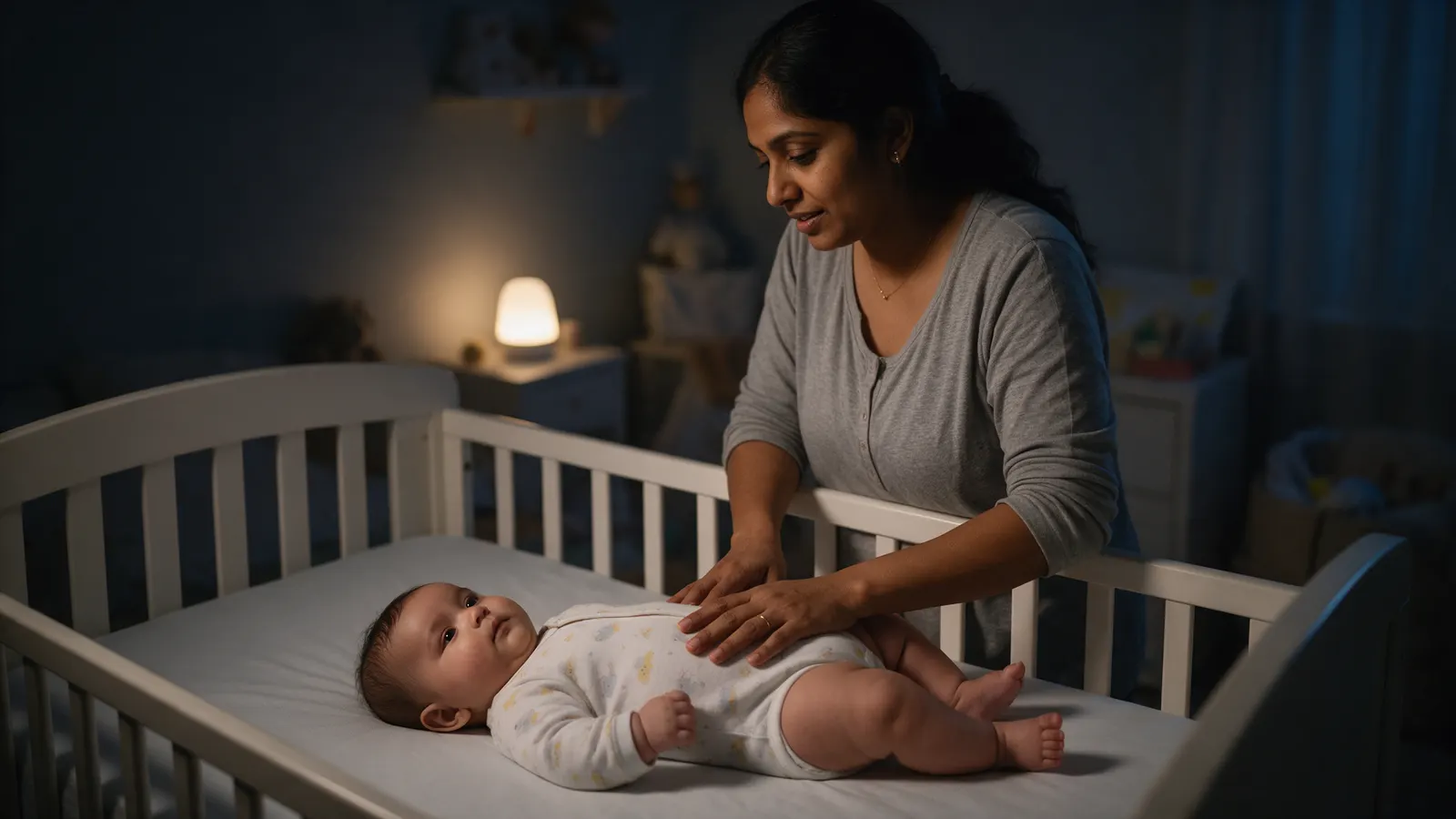
A baby who slept until morning last month is up at 1 a.m. this week, crying as if you'd left the country. You haven't. Today is why this is happening, and the shortest kind way through it.
Heart
Babies 4 to 12 months need 12 to 16 hours of sleep a day, naps included (CDC; WHO), usually 9 to 12 hours at night plus two naps (Nemours KidsHealth). Separation anxiety usually gets stronger around 9 months (Swanson, AAP), and it can bring back night waking (AAP). The 1 a.m. cry is your baby discovering that you exist when you're not in the room, and objecting. It's attachment, with bad timing.
Head
The advice is short and hard to follow at 1 a.m. Reassure your baby quietly, then leave (Nemours KidsHealth). Cuddling, feeding, or talking at every waking can prompt your baby to wake for that attention (Nemours KidsHealth). When separation anxiety brings new night waking, reassure calmly and consistently (AAP). The point isn't to ignore the cry. It's to answer it the same way every time, briefly, so the answer itself becomes something your baby can predict and relax into.
Body
Keep the bedtime routine short and the same, like a bath, then stories or songs, and put your baby down drowsy but awake (Nemours KidsHealth). On night feeds: many babies this age don't need to eat at night, but some still do, so ask your pediatrician before cutting them (AAP). Most formula-fed babies no longer need a middle-of-the-night feeding after 2 to 4 months (AAP), but check with your pediatrician first if your baby isn't growing and gaining weight steadily (AAP). Growth first, then the sleep plan.
Try today
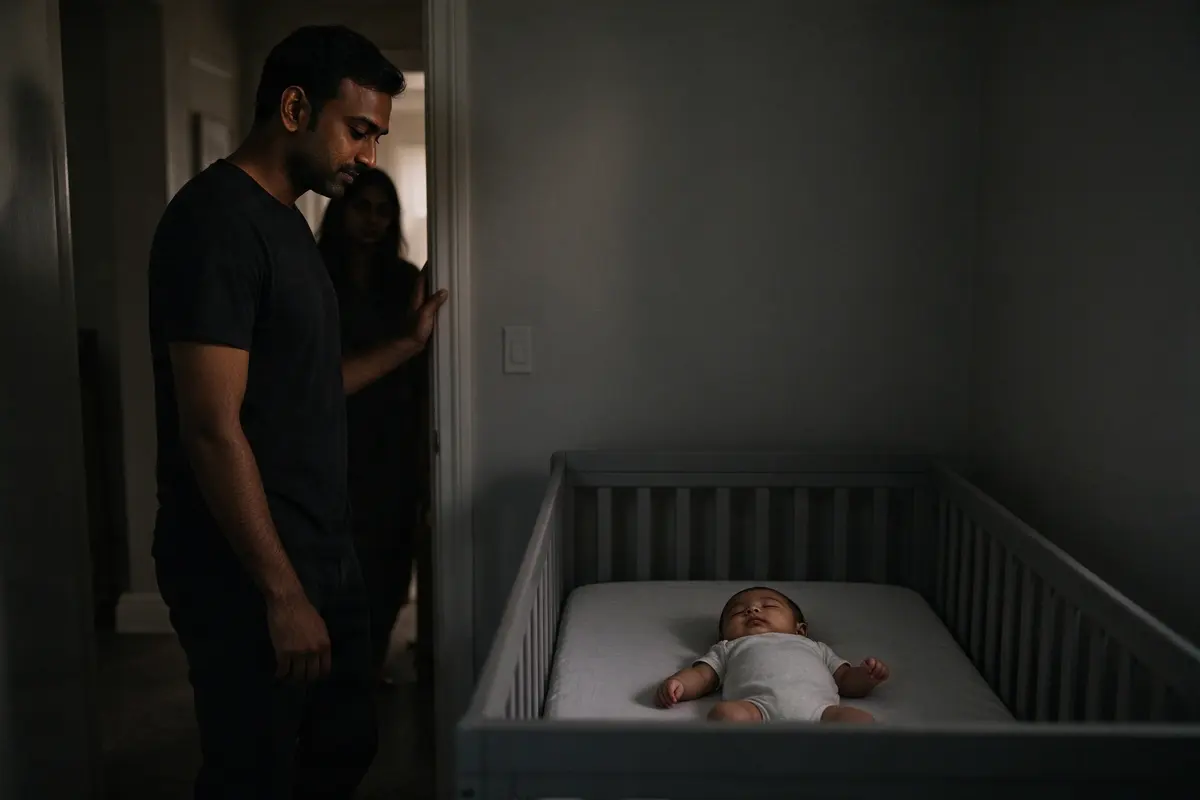
The two-minute check
Time: 2 minutes by the clock, at the next night waking · Naps, nights, and night feeds in the guide
When the cry starts, pause a moment and listen. If it's winding down on its own, stay out.
If it builds, go in with the lights low. Say one calm sentence, the same one every time: "I'm here. It's sleep time." Put a hand on their back (Nemours KidsHealth).
Two minutes, then out, even if they're still grumbling. No feed, no play, no lifting unless something's wrong (Nemours KidsHealth).
If it's hunger, a dirty diaper, or illness, meet it, then back to the sentence. The check is for the separation cry, not the sick one.
Make it work:The same sentence and the same two minutes, from both adults. Consistency is the whole method (AAP).
Watch for
Normal
a new 1 a.m. waking in a baby who slept through last month, that settles with a hand and a sentence (AAP).
Talk with your pediatrician
before dropping a night feed if your baby isn't growing and gaining weight steadily (AAP).
Normal
tears that stop within minutes of your leaving the room (AAP).
Call your pediatrician right away
for a fever over 104°F (40°C), or shaking chills lasting more than 30 minutes (AAP).
Normal
a snuffly wake with the first cold of the season.
Call your pediatrician right away
for trouble breathing that isn't severe; call 911 if your baby is struggling for each breath or can barely cry (AAP).
For you

The nights are a phase. Separation anxiety usually gets stronger around 9 months (Swanson, AAP) and peaks between 10 and 18 months (AAP); it has a shape and an end. If the nights are breaking you rather than tiring you, that's a different thing and it has a number: call or text the National Maternal Mental Health Hotline at 1-833-TLC-MAMA (1-833-852-6262), or call or text 988; in an emergency, call 911 (CDC).
If you're the partner: alternate the checks tonight, one each. Same sentence, same two minutes. The baby shouldn't be able to tell which of you came.
Sources
- Centers for Disease Control and Prevention. "Milestones by 9 Months." Learn the Signs. Act Early. program, updated 2026. https://www.cdc.gov/act-early/milestones/9-months.html
- World Health Organization. "To grow up healthy, children need to sit less and play more." 2019. https://www.who.int/news/item/24-04-2019-to-grow-up-healthy-children-need-to-sit-less-and-play-more
- Nemours KidsHealth. "Baby Sleep: 8- to 12-Month-Olds." Reviewed 2025. https://kidshealth.org/en/parents/sleep812m.html
- Swanson WS. "How to Ease Your Child's Separation Anxiety." HealthyChildren.org, updated 2026. https://www.healthychildren.org/English/ages-stages/toddler/Pages/Soothing-Your-Childs-Separation-Anxiety.aspx
- American Academy of Pediatrics. "Separation Anxiety & Sleeping Trouble in Young Children." HealthyChildren.org, updated 2022. https://www.healthychildren.org/English/healthy-living/sleep/Pages/separation-anxiety-and-sleeping.aspx
- American Academy of Pediatrics. "Sleeping Through the Night." HealthyChildren.org, updated 2013. https://www.healthychildren.org/English/ages-stages/baby/sleep/Pages/Sleeping-Through-the-Night.aspx
- American Academy of Pediatrics. "Amount and Schedule of Baby Formula Feedings." HealthyChildren.org, updated 2022. https://www.healthychildren.org/English/ages-stages/baby/formula-feeding/Pages/amount-and-schedule-of-formula-feedings.aspx
- American Academy of Pediatrics. "Emotional and Social Development: 8 to 12 Months." HealthyChildren.org, updated 2009. https://www.healthychildren.org/English/ages-stages/baby/Pages/Emotional-and-Social-Development-8-12-Months.aspx
- American Academy of Pediatrics. "Fever" (symptom checker). HealthyChildren.org, accessed 2026. https://www.healthychildren.org/English/tips-tools/symptom-checker/Pages/symptomviewer.aspx?symptom=Fever
- Centers for Disease Control and Prevention. "Symptoms of Depression Among Women." 2024. https://www.cdc.gov/reproductive-health/depression/index.html
This guide is general education that summarizes published research and guidance from groups like the American Academy of Pediatrics, the CDC, and the WHO. It isn’t medical advice, and every child develops on their own timeline. Your pediatrician knows your child; if something feels wrong, call them. In an emergency, call 911.
Get each day’s note the morning it applies
Add your baby to a free Chorevia household with their date of birth, and every morning for 300 days the day’s note arrives in the app and by email: what’s developing, one thing to try, what to watch for, and a word for you.
Create your household