Day 247 of 300 · Week 33
Thirty-three weeks: words that aren't words yet
Last reviewed · 4 min read · 7 sources · Plain-text version
Syllables like 'ba,' 'da,' and 'ma,' a baby who understands more than they say, and the rule that 'mog' for milk counts as a word. Talk back with words, and the pause that's hard for you.
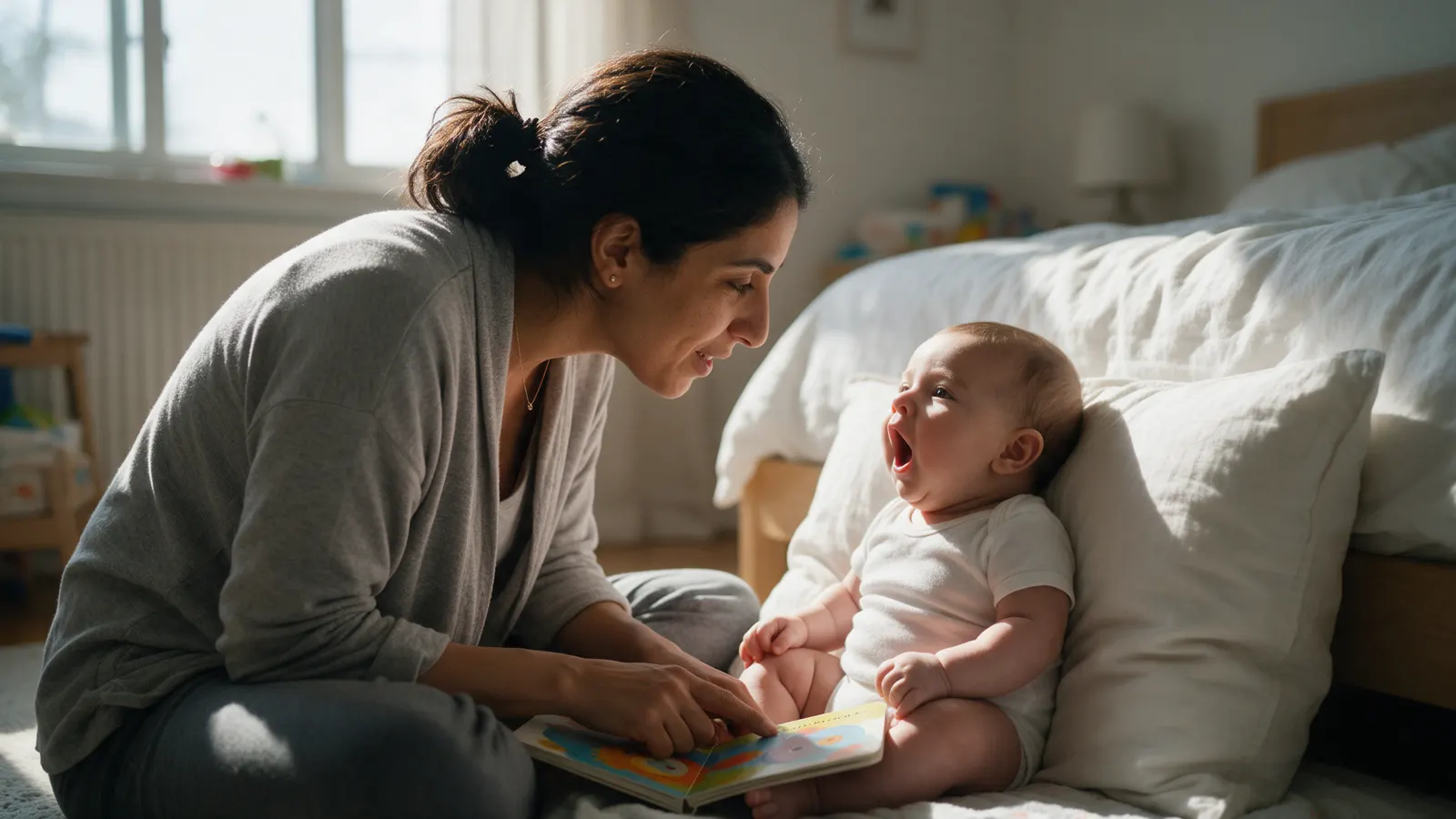
Thirty-three weeks. The sounds in the house have changed from vowels to syllables, and some of them are starting to mean something. Today is how a word gets built out of babble, and the one thing that research says speeds it up.
Heart
Coos turn into syllables like "ba," "da," and "ma," and babies understand more than they can say (AAP). Lots of different sounds like "mamamama" and "bababababa" is the 9-month skill (CDC). Calling a parent "mama" or "dada" or another special name is a 12-month milestone (CDC), so "mama" this week is a syllable, not yet you. But the AAP's definition of a word is generous: any sound used the same way each time, so "mog" for milk counts (AAP). Listen for a sound that always goes with the same thing. That's the first word, whatever it sounds like.
Head
What you do with the babble is the part that's been tested. In a lab experiment, 9.5-month-olds whose mothers answered their babble right away quickly reshaped it using sounds from their mothers' speech; babies answered at random times didn't (Goldstein & Schwade, 2008). The how is short: repeat their sounds, add simple words, and describe what they see (CDC); keep names consistent ("cat" today, not "kitty" tomorrow), ask questions, and wait for an answer (AAP). The guide's activity for all of this is Talk back with words, and it's today's.
Body
The one line that isn't a wait: the AAP advises telling your pediatrician if your baby doesn't babble or imitate any sounds by 7 months, since that can signal a hearing problem (AAP). At 8 months, silence is a call this week. Babble with a few sounds in it, repeated for days at a time, is the normal version, and the 9-month visit will ask whether your baby seems to hear well (AAP).
Try today
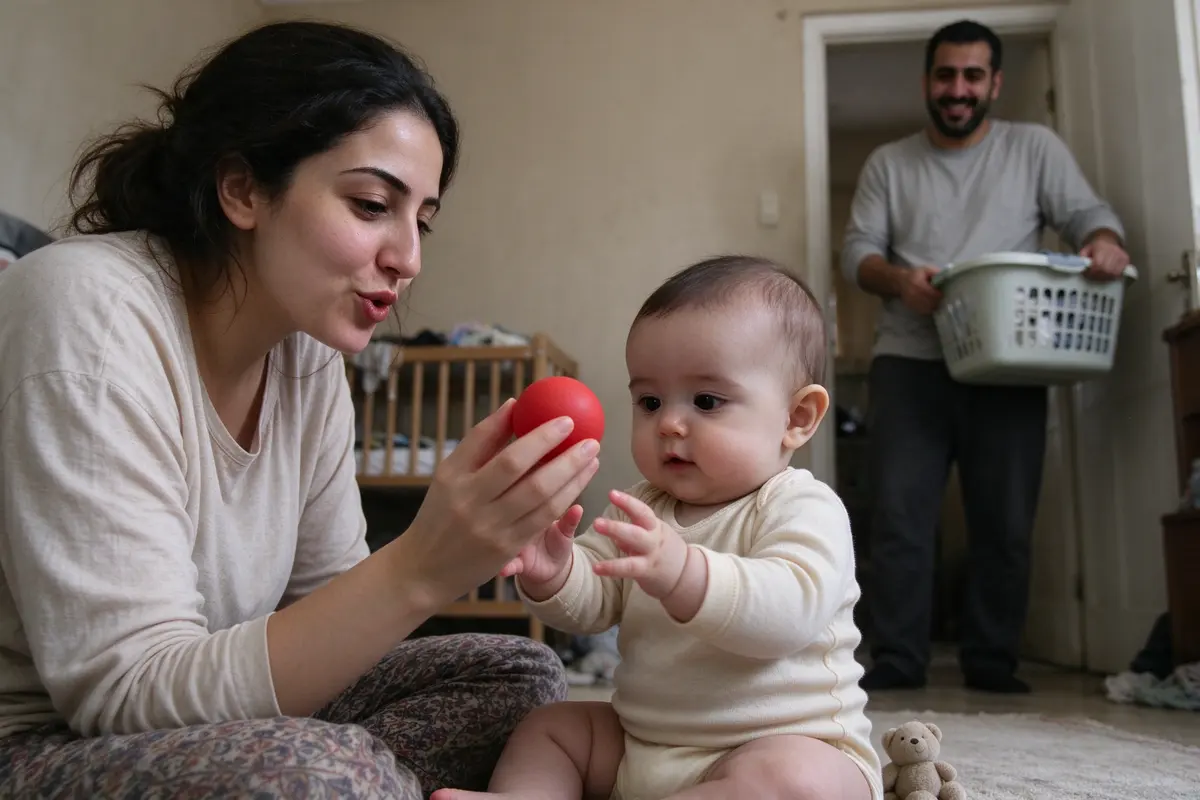
Talk back with words
Time: A few minutes, many times a day · Talk back with words in the guide
When your baby babbles, look at them and answer right away (Goldstein & Schwade, 2008).
Turn their sound into a word: "Ba-ba? Ball! Here's your ball." Hand over the thing you named if you can.
Use a warm, sing-song voice, then wait for a reply. Count to five if you need to.
Whatever comes back, do it again. Then notice one sound today that your baby uses the same way twice; write it down with what it seemed to mean.
Make it work:Right away is the point. The babies answered at random times didn't change their babble (Goldstein & Schwade, 2008).
Watch for
Normal
one favorite syllable for days, then a new one.
Talk with your pediatrician
if your baby doesn't babble or imitate any sounds by 7 months (AAP).
Normal
a baby who babbles to the dog, the ceiling fan, and the spoon, and goes quiet when a stranger talks to them (CDC).
Bring it up
if your baby seems not to see or hear well (AAP).
Normal
a rash of small pink spots on the chest during a cold that fades under your finger.
Call 911
if your baby has purple or blood-colored spots or dots on the skin (AAP).
For you
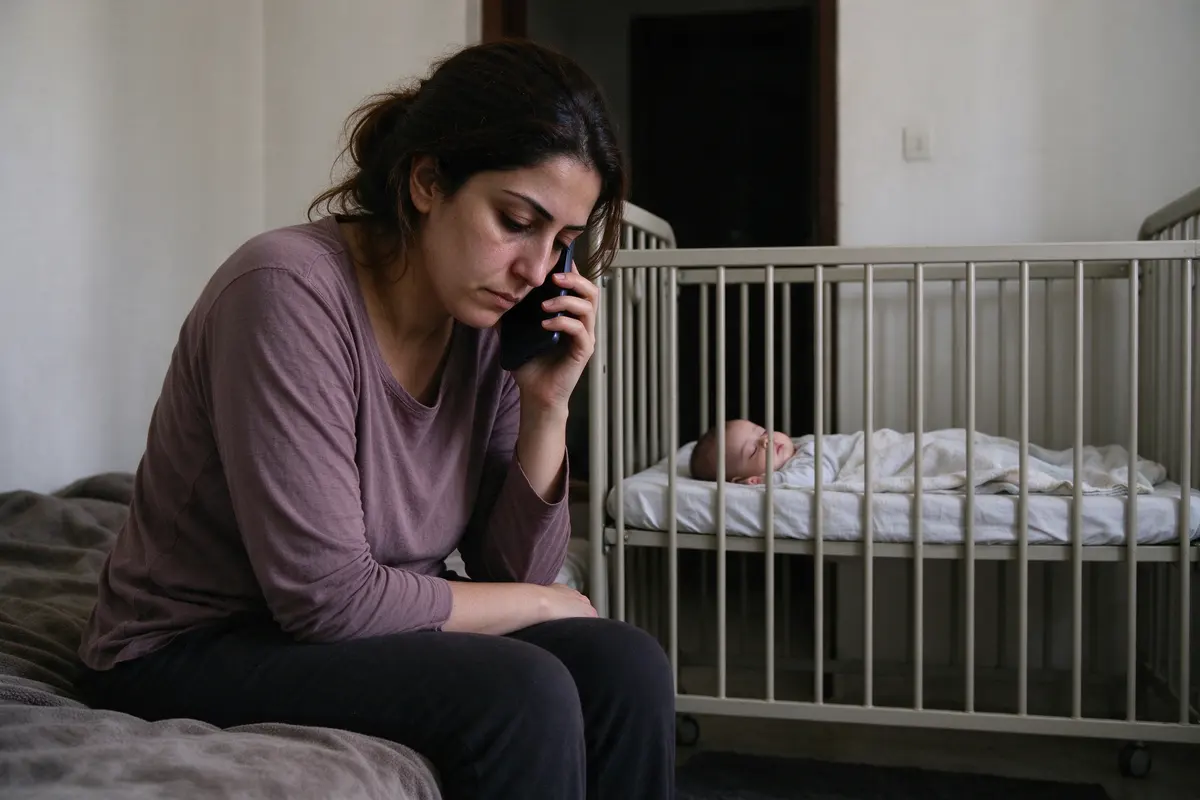
The pause is the hard part. Answering is easy; you've been doing it since the first coo. The AAP's instruction is to ask and then wait for an answer (AAP), and five seconds of silence while a baby looks at you and does nothing feels like failure in a way that talking never does. It isn't. The lab babies changed their babble because they got a turn, not because their mothers filled the air (Goldstein & Schwade, 2008). So if the only thing you manage today is one word and a long quiet, that was the whole exercise.
The same pause works on adults. Call someone, say the true thing, and don't rescue them from the silence after it. Let them have the turn.
If you're the partner: your turn at bath time. One sound back, one word, then shut up and wait.
Sources
- American Academy of Pediatrics. "Language Development: 8 to 12 Months." HealthyChildren.org, updated 2009. https://www.healthychildren.org/English/ages-stages/baby/Pages/Language-Development-8-to-12-Months.aspx
- Centers for Disease Control and Prevention. "Milestones by 9 Months." Learn the Signs. Act Early. program, updated 2026. https://www.cdc.gov/act-early/milestones/9-months.html
- Centers for Disease Control and Prevention. "Milestones by 1 Year." Learn the Signs. Act Early. program, updated 2026. https://www.cdc.gov/act-early/milestones/1-year.html
- Goldstein MH, Schwade JA. "Social feedback to infants' babbling facilitates rapid phonological learning." Psychological Science, 2008. https://pubmed.ncbi.nlm.nih.gov/18466414/
- American Academy of Pediatrics. "Language Development: 4 to 7 Months." HealthyChildren.org, updated 2009. https://www.healthychildren.org/English/ages-stages/baby/Pages/Language-Development-4-to-7-Months.aspx
- American Academy of Pediatrics. "Checkup Checklist: 9 Months Old." HealthyChildren.org, updated 2021. https://www.healthychildren.org/English/ages-stages/Your-Childs-Checkups/Pages/Your-Checkup-Checklist-9-Months-Old.aspx
- American Academy of Pediatrics. "Fever" (symptom checker). HealthyChildren.org, accessed 2026. https://www.healthychildren.org/English/tips-tools/symptom-checker/Pages/symptomviewer.aspx?symptom=Fever
This guide is general education that summarizes published research and guidance from groups like the American Academy of Pediatrics, the CDC, and the WHO. It isn’t medical advice, and every child develops on their own timeline. Your pediatrician knows your child; if something feels wrong, call them. In an emergency, call 911.
Get each day’s note the morning it applies
Add your baby to a free Chorevia household with their date of birth, and every morning for 300 days the day’s note arrives in the app and by email: what’s developing, one thing to try, what to watch for, and a word for you.
Create your household