Day 266 of 300 · Week 36
New people, slowly
Last reviewed · 4 min read · 6 sources · Plain-text version
Shy, clingy, or fearful around strangers is a 9-month milestone, and even favorite relatives can make a baby cry by swooping in. The lap introduction: ten minutes on your lap before anyone holds them.
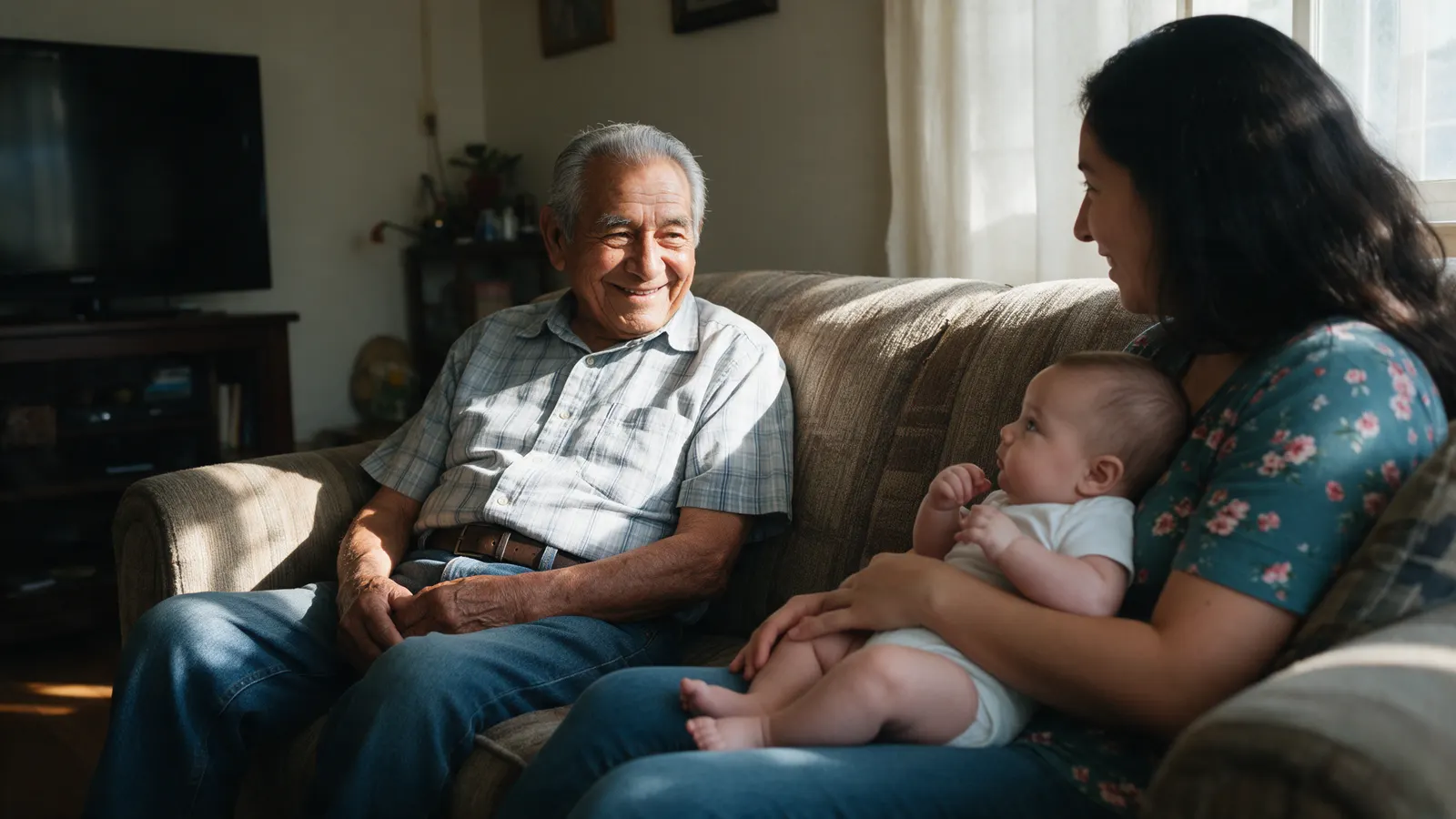
Someone is coming this weekend who hasn't seen the baby since the summer, and they're going to walk in with their arms out. Today is what to say before they get to the door.
Heart
Being shy, clingy, or fearful around strangers is on CDC's list of what most babies do by 9 months (CDC). Wariness of strangers is often one of the first emotional milestones, and it isn't caused by "spoiling"; your baby can now tell familiar from unfamiliar (AAP). It arrives alongside separation anxiety, which usually gets stronger around 9 months (Swanson, AAP) and peaks between 10 and 18 months; the AAP calls it a sign of attachment (AAP). The baby who screams at a beloved aunt is not being rude. They're being accurate: she is, to them, new.
Head
In 1,285 twins followed from 6 to 36 months, the most common patterns started with little fear at 6 months that rose over time; children whose fear was high and steady from the start, or rose sharply, were more inhibited at age 3 (Brooker et al., 2013). So a baby who was passed happily around the room in June and won't leave your lap in October is on the common path, and the rising fear is a stage, not a trait. Some wariness is expected; very intense fear is worth mentioning at the checkup.
Body
The AAP's instruction for the visitor is one word: slowly. Even favorite relatives can make a baby cry if they swoop in fast (AAP). Timing counts too, because separations and new faces are harder when a baby is tired, hungry, or sick (AAP), so the visit lands after the nap and the snack, not at the end of the day. The script for the door, sent by text before they arrive: "She's at the shy stage. Sit down, talk to me first, and let her come to you. It takes about ten minutes." The guide's section is Ease goodbyes and new faces.
Try today
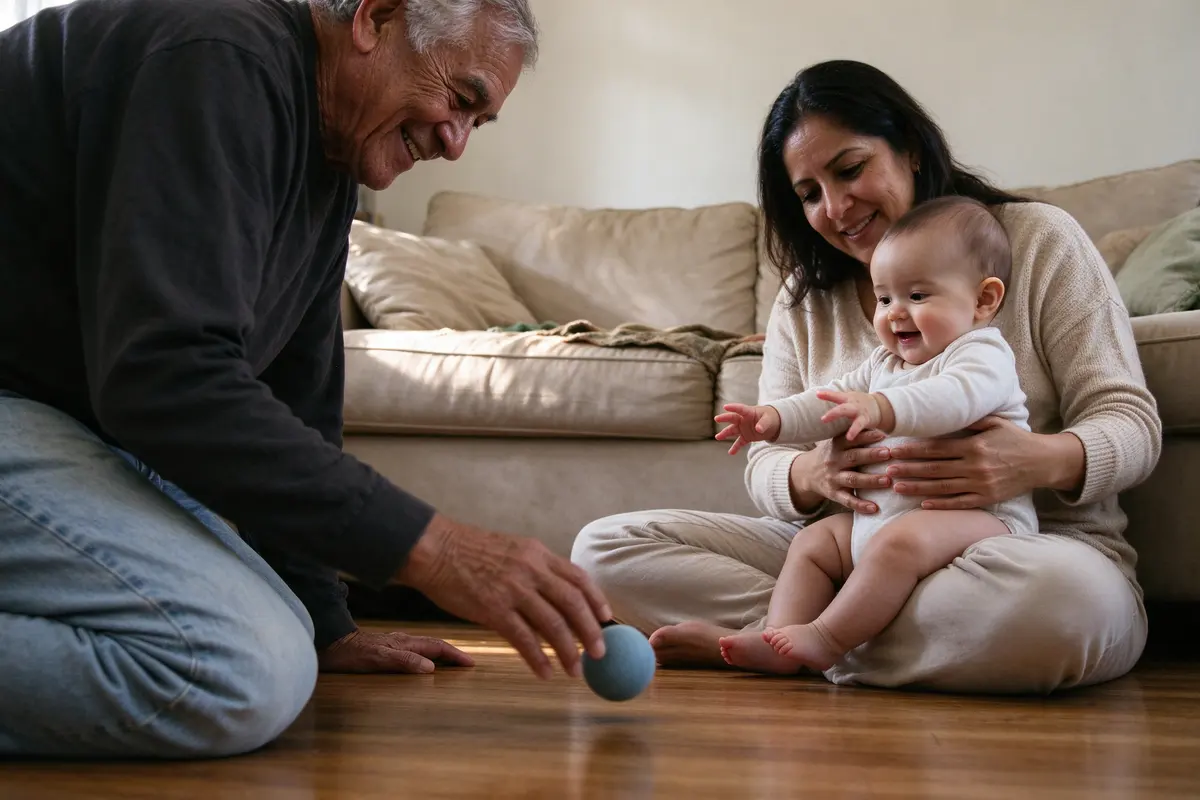
The lap introduction
Time: 10 minutes, after a nap and a snack
Greet the visitor yourself, warmly and at length, with the baby on your lap facing the room. The baby reads your face first (AAP).
The visitor sits at the far end of the sofa or on the floor, a few feet away, hands in their lap, and talks to you, not the baby, for a few minutes.
When the baby starts to look at them, the visitor offers something sideways: a ball rolled across the floor, a toy set down within reach, a game of peekaboo from where they sit.
No hand-off for ten minutes, and then only if the baby leans or reaches toward them. If the baby turns back to you, that's the answer for today.
Make it work:Say the plan out loud at the door so no one feels rejected by it. "We're doing the slow way; it works better." Most relatives are relieved to be told.
Watch for
Normal
a baby who buries their face in your neck for the first five minutes of every visit (AAP).
Mention it at the checkup
if your baby's fear of new people is very intense, or high and steady with everyone (Brooker et al., 2013).
Normal
a long cry after a fast swoop, over within minutes once they're back on your lap.
Call your pediatrician right away
if your baby cries nonstop, or cries when touched or moved (AAP).
Normal
a visitor with a cold who keeps their distance, which is the right call.
Go to the ER now
if your baby has any trouble breathing, including ribs pulling in with each breath or loud wheezing (AAP).
For you
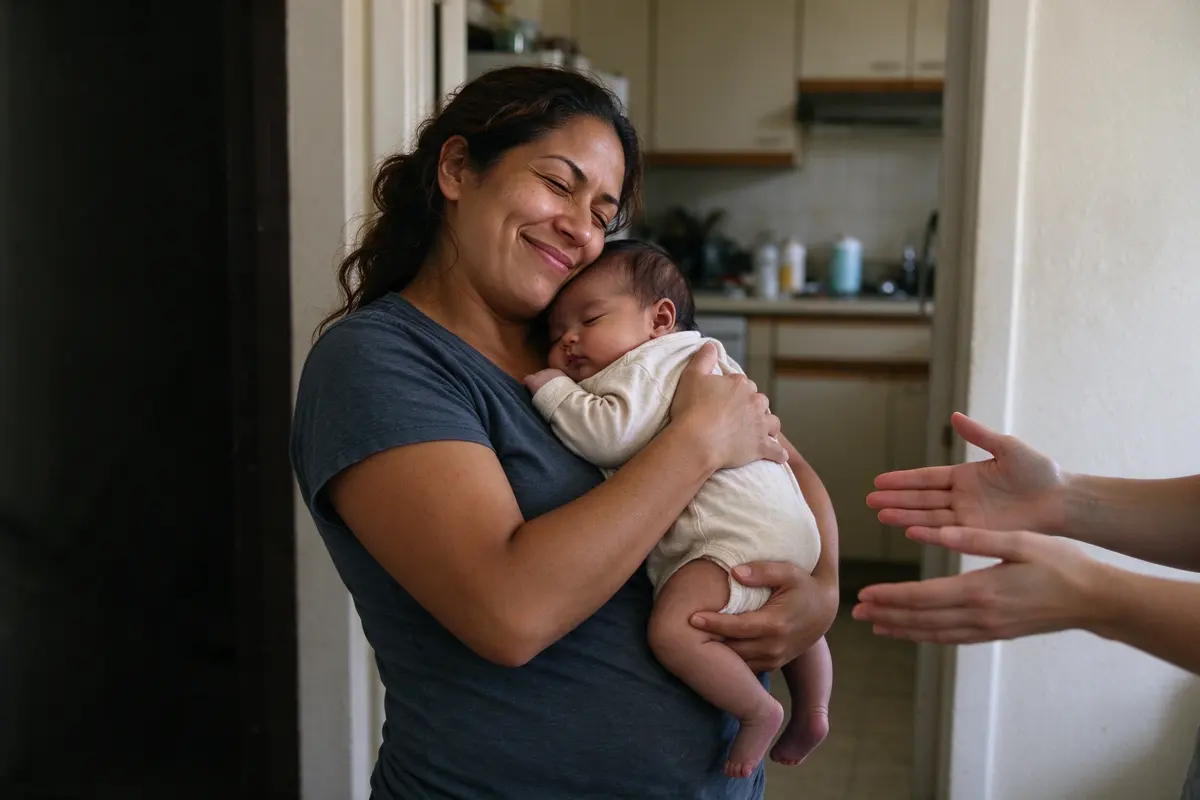
You don't have to hand the baby over. Not to the aunt, not to the neighbor, not to the person at the party who says "give her here." The AAP's advice is that visitors go slowly and that your baby watches from your arms first (AAP), which makes you the gatekeeper by design, not by rudeness. "Not yet, she's shy right now" is a complete sentence. The people who love your baby will take the ten minutes; the ones who are offended were asking for themselves.
If you're the partner: be the one who says it at the door, so she doesn't have to be the unfriendly one twice. And when a relative tries the fast swoop anyway, you're the one who says "slow, remember?" with a smile.
Sources
- Centers for Disease Control and Prevention. "Milestones by 9 Months." Learn the Signs. Act Early. program, updated 2026. https://www.cdc.gov/act-early/milestones/9-months.html
- American Academy of Pediatrics. "Emotional and Social Development: 8 to 12 Months." HealthyChildren.org, updated 2009. https://www.healthychildren.org/English/ages-stages/baby/Pages/Emotional-and-Social-Development-8-12-Months.aspx
- Swanson WS. "How to Ease Your Child's Separation Anxiety." HealthyChildren.org, updated 2026. https://www.healthychildren.org/English/ages-stages/toddler/Pages/Soothing-Your-Childs-Separation-Anxiety.aspx
- Brooker RJ, Buss KA, Lemery-Chalfant K, et al. "The development of stranger fear in infancy and toddlerhood: normative development, individual differences, antecedents, and outcomes." Developmental Science, 2013. https://pubmed.ncbi.nlm.nih.gov/24118713/
- American Academy of Pediatrics. "Fever" (symptom checker). HealthyChildren.org, accessed 2026. https://www.healthychildren.org/English/tips-tools/symptom-checker/Pages/symptomviewer.aspx?symptom=Fever
- American Academy of Pediatrics. "Breathing Trouble" (symptom checker). HealthyChildren.org, accessed 2026. https://www.healthychildren.org/English/tips-tools/symptom-checker/Pages/symptomviewer.aspx?symptom=Breathing+Trouble
This guide is general education that summarizes published research and guidance from groups like the American Academy of Pediatrics, the CDC, and the WHO. It isn’t medical advice, and every child develops on their own timeline. Your pediatrician knows your child; if something feels wrong, call them. In an emergency, call 911.
Get each day’s note the morning it applies
Add your baby to a free Chorevia household with their date of birth, and every morning for 300 days the day’s note arrives in the app and by email: what’s developing, one thing to try, what to watch for, and a word for you.
Create your household