Day 251 of 300 · Week 34
Crawling, the honest version
Last reviewed · 4 min read · 8 sources · Plain-text version
Hands-and-knees crawling started anywhere from 5.2 to 13.5 months in the WHO's study, and 4.3% of babies never did it. Scooting counts, one-sidedness is a call, and the crawl chase.
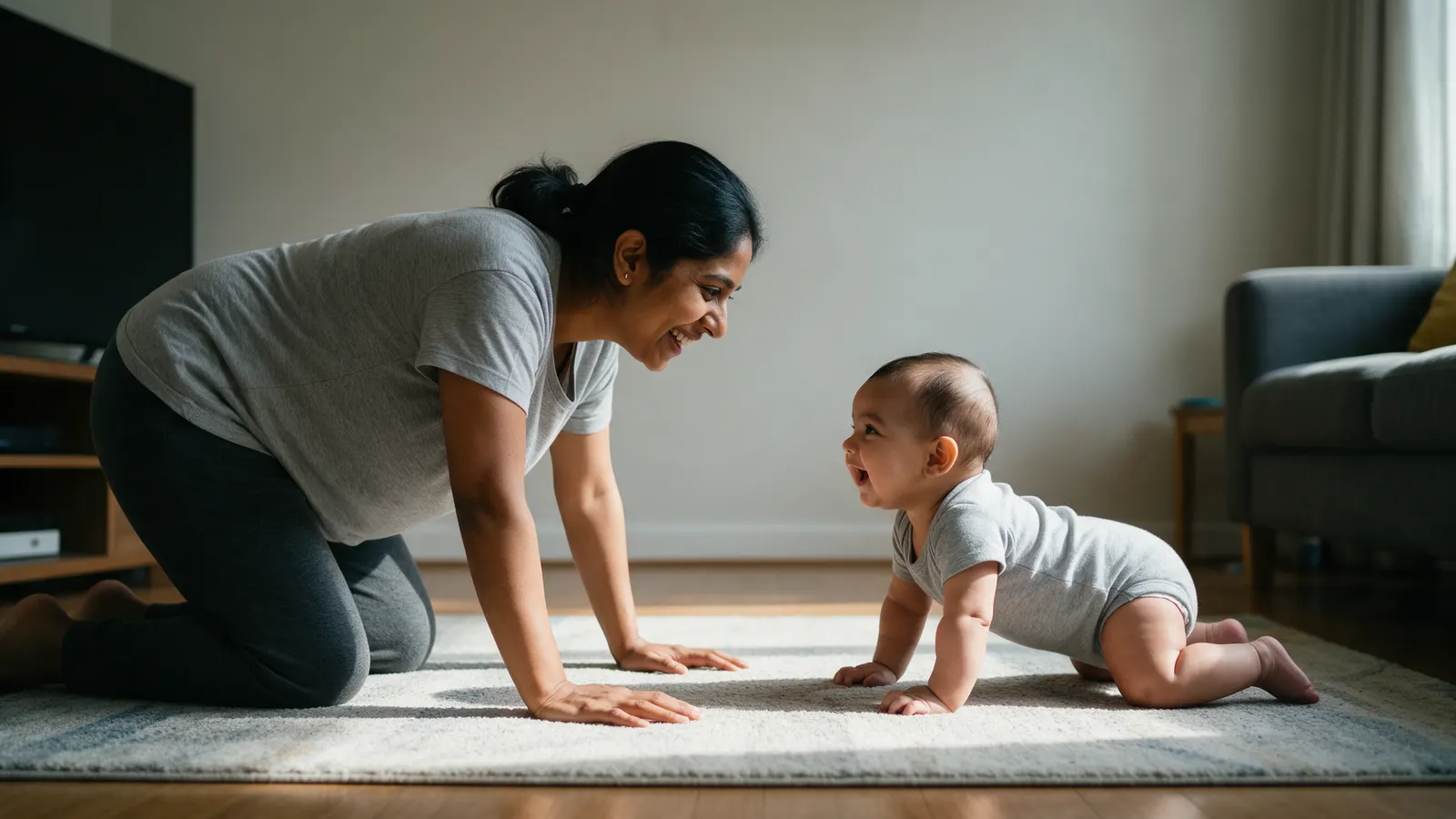
Somebody will ask this week whether your baby is crawling yet. Today is the honest answer, with the numbers, and a game that works whether the answer is yes, no, or sideways.
Heart
Crawling is usually mastered between 7 and 10 months by the babies who crawl, and a few scoot on their bottoms or slither on their bellies instead; the AAP says that's no cause for concern as long as they use each arm and leg equally (AAP). It isn't on any CDC checklist (Kretch et al., 2022). Your baby is 8 months old, so rocking and going nowhere, already across the room, and bottom-scooting by choice are all in the same place today: on schedule.
Head
The WHO followed 816 healthy children in Ghana, India, Norway, Oman, and the US. Hands-and-knees crawling started anywhere from 5.2 to 13.5 months, and 4.3% of the children never crawled on hands and knees at all (WHO Multicentre Growth Reference Study Group, 2006). A review for physical therapists found no good evidence that crawling itself is essential; the benefits linked to it seem to come from moving around independently in any form. The authors found only three studies comparing crawlers with non-crawlers, all of questionable quality, and said plainly that the question isn't settled; many therapists disagree (Kretch et al., 2022). So the useful question isn't "crawling yet?" but "moving, with both sides?"
Body
That second half matters. Talk with your pediatrician if your baby favors one side or doesn't seem to be moving normally (AAP), and if they've lost skills they used to have (CDC). The 9-month visit at the end of this month brings a full exam and questions about pulling to stand (AAP), so what you notice on the rug this week is what you'll report then. Watch for a minute today: does the left knee come forward as often as the right?
Try today
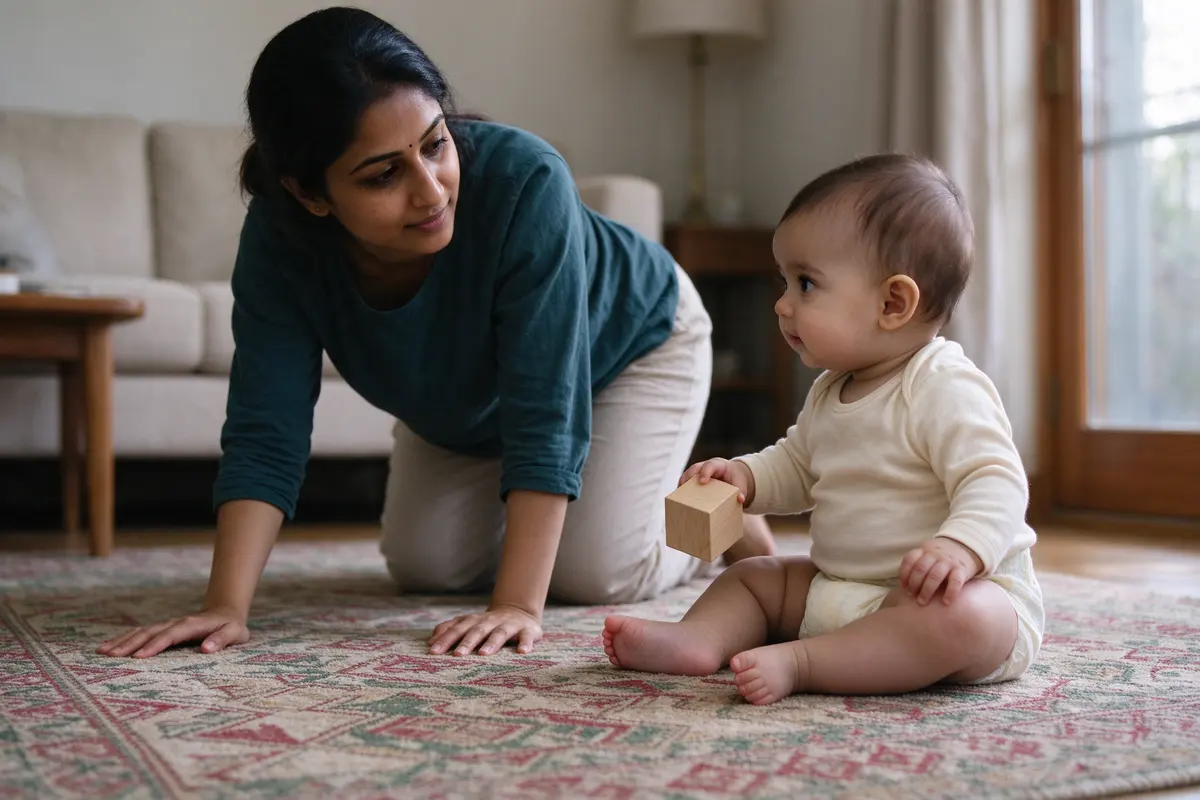
The crawl chase
Time: 5 minutes, on a cleared rug · Cushion crawl course in the guide
Clear the rug of anything small enough to go in a mouth (AAP), then get down on your hands and knees a yard away, facing your baby.
Crawl slowly away, looking back over your shoulder and calling their name. Let them come however they come: crawl, scoot, slither, or roll.
When they reach you, a big hello and a squeeze, then turn and go again.
Three laps, then stop while it's still fun.
Make it work:Babies learn to move through lots of varied practice (Adolph et al., 2012), and the style doesn't matter; 4.3% of healthy children never crawled on hands and knees (WHO Multicentre Growth Reference Study Group, 2006).
Watch for
Normal
a baby who rocks on hands and knees and goes backward, or who scoots on their bottom and never crawls (AAP).
Talk with your pediatrician
if your baby uses one arm or leg much more than the other (AAP).
Normal
a baby who crawled last week and only wants to sit and play this week.
Talk with your pediatrician
if your baby has lost skills they used to have (CDC).
Normal
a chin bumped on the tile during the first army crawl, and tears that stop in your arms.
Call your pediatrician
for any head injury in a baby under 1; go to the ER now if after a head injury your baby vomits 2 or more times, cries and won't stop, or is awake but not alert (AAP).
For you
The range, not the neighbor. The WHO's window for crawling runs from 5.2 to 13.5 months, more than eight months wide, and a slice of healthy babies skip it entirely (WHO Multicentre Growth Reference Study Group, 2006). The baby down the street who crawled at six months and the one who scooted until she walked are both inside it. "Moving, in their own way" is a complete answer.
If you're the partner: you take the next round of the chase, and the next round of the question from relatives. "The pediatrician isn't worried, and neither are we" ends most of them.
Sources
- American Academy of Pediatrics. "Movement Milestones in Babies 8 to 12 Months Old." HealthyChildren.org, updated 2021. https://www.healthychildren.org/English/ages-stages/baby/Pages/Movement-8-to-12-Months.aspx
- Kretch KS, Willett SL, Hsu LY, et al. "'Learn the Signs. Act Early.': Updates and Implications for Physical Therapists." Pediatric Physical Therapy, 2022. https://pubmed.ncbi.nlm.nih.gov/35876833/
- WHO Multicentre Growth Reference Study Group. "WHO Motor Development Study: windows of achievement for six gross motor development milestones." Acta Paediatrica Supplement, 2006. https://pubmed.ncbi.nlm.nih.gov/16817682/
- Centers for Disease Control and Prevention. "Milestones by 9 Months." Learn the Signs. Act Early. program, updated 2026. https://www.cdc.gov/act-early/milestones/9-months.html
- American Academy of Pediatrics. "Checkup Checklist: 9 Months Old." HealthyChildren.org, updated 2021. https://www.healthychildren.org/English/ages-stages/Your-Childs-Checkups/Pages/Your-Checkup-Checklist-9-Months-Old.aspx
- Bradin S. "Choking Prevention for Babies & Children: What Every Parent Needs to Know." HealthyChildren.org, updated 2026. https://www.healthychildren.org/English/health-issues/injuries-emergencies/Pages/Choking-Prevention.aspx
- Adolph KE, Cole WG, Komati M, et al. "How do you learn to walk? Thousands of steps and dozens of falls per day." Psychological Science, 2012. https://pubmed.ncbi.nlm.nih.gov/23085640/
- American Academy of Pediatrics. "Head Injury" (symptom checker). HealthyChildren.org, accessed 2026. https://www.healthychildren.org/English/tips-tools/symptom-checker/Pages/symptomviewer.aspx?symptom=Head+Injury
This guide is general education that summarizes published research and guidance from groups like the American Academy of Pediatrics, the CDC, and the WHO. It isn’t medical advice, and every child develops on their own timeline. Your pediatrician knows your child; if something feels wrong, call them. In an emergency, call 911.
Get each day’s note the morning it applies
Add your baby to a free Chorevia household with their date of birth, and every morning for 300 days the day’s note arrives in the app and by email: what’s developing, one thing to try, what to watch for, and a word for you.
Create your household