Day 256 of 300 · Week 35
Shoes, no
Last reviewed · 3 min read · 7 sources · Plain-text version
Babies don't need shoes until they walk outside, and 'supportive' shoes have no proven benefit. Bare feet on a rug, a cold floor, and grass today, and the fit rules for later.
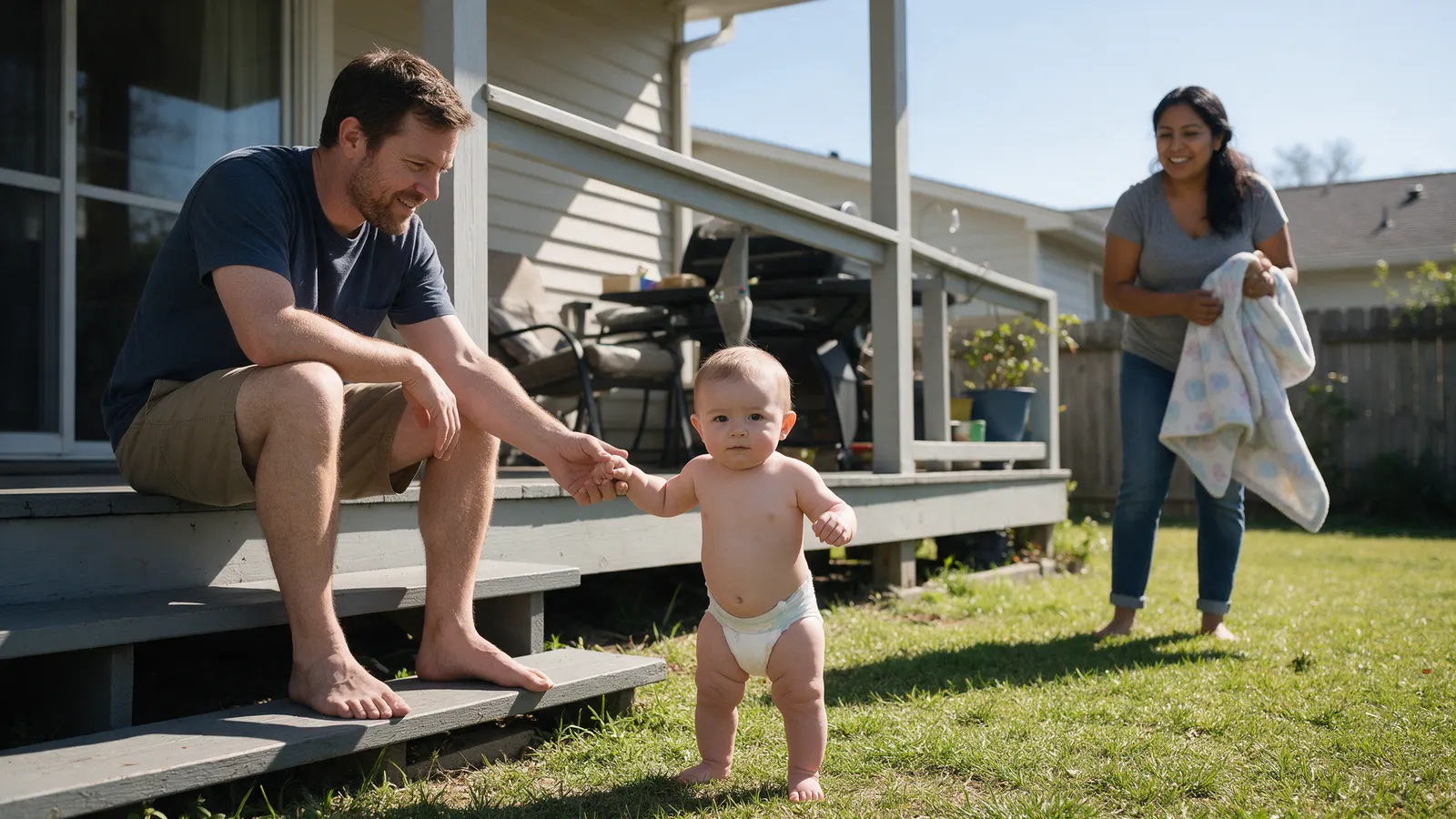
The tiny shoes are irresistible, and the tiny shoes are pointless. Today is why bare feet are the better equipment for a baby who's about to pull up, and what to look for when shoes finally make sense.
Heart
Your baby doesn't need shoes until they start walking outside, and special "supportive" shoes have no proven benefit (AAP). That day is a while off: pulling up to stand and walking while holding on to furniture are 12-month milestones (CDC), and healthy children in the WHO's study started walking alone anywhere from 8.2 to 17.6 months (WHO Multicentre Growth Reference Study Group, 2006). At 8 months, feet are for gripping, pushing, and learning what the floor feels like. Socks with grips or nothing at all.
Head
For later, the AAP's fit rules are plain. Choose closed-toe, comfortable, flexible shoes with nonskid soles and room to grow; sneakers are a great choice. Skip wedges, inserts, high backs, and special arches: they have no proven benefit for most children and may make walking harder. A first pair usually lasts 2 to 3 months, so check the fit monthly (AAP). Write that on the back of your hand before the shoe store, because the store will tell you otherwise.
Body
What a baby's feet need now is practice. Filmed during free play, 12- to 19-month-olds averaged 2,368 steps and 17 falls per hour (Adolph et al., 2012); the months before that are the push-ups and the grip. The WHO's prescription is interactive floor play several times a day (WHO), and the floor has textures: rug, wood, tile, grass. Each one is different information for the soles. Check it first for coins, toy parts, and pen caps (AAP).
Try today
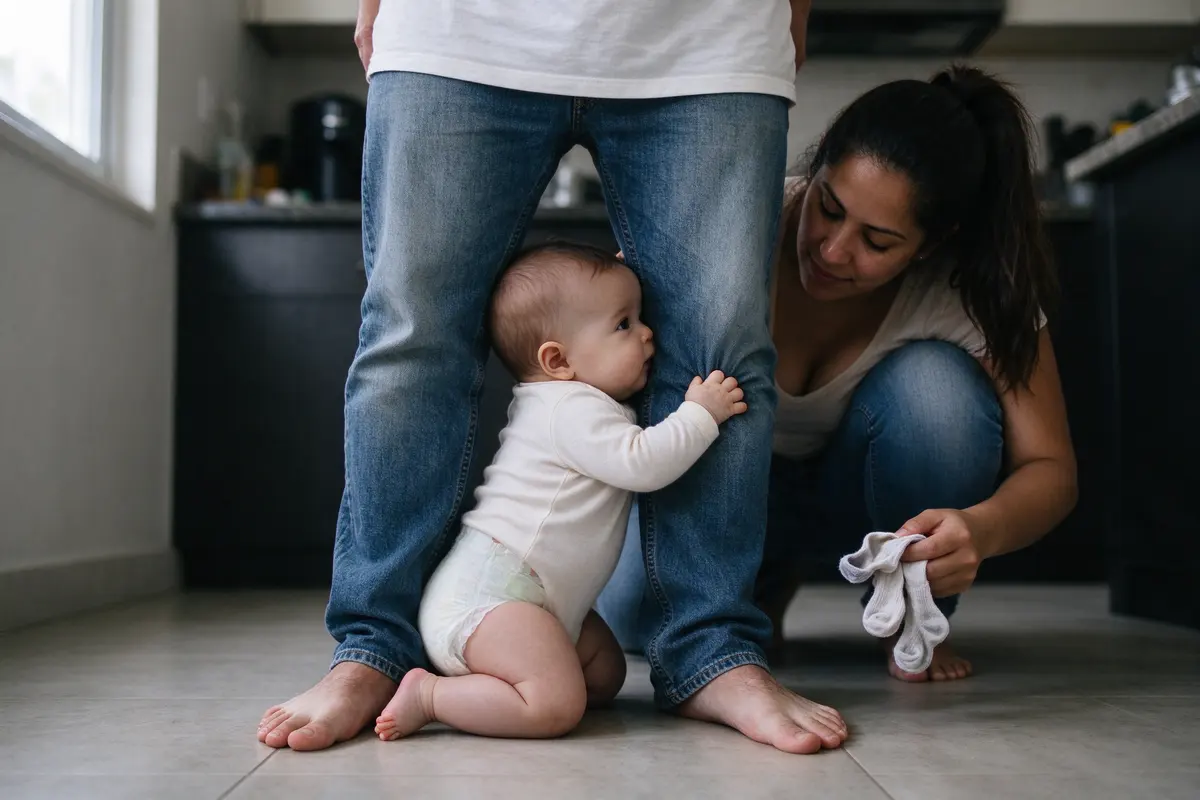
Barefoot on three surfaces
Time: 10 minutes, socks off · Does my baby need shoes to learn to walk? in the guide
Rug first: sit your baby on it barefoot and let them push, kneel, and grab your legs to pull up (AAP). Name it: "Soft."
Then a hard floor, tile or wood: hold both hands and let them stand and stamp. "Cold." "Smooth."
Then outside on grass, after you've looked it over for anything small enough to go in a mouth (AAP). "Tickly."
Watch the toes. They'll curl and grip on each surface differently; that's the lesson.
Make it work:Babies learn to move through huge amounts of varied practice (Adolph et al., 2012). Three surfaces is more variety than one pair of shoes.
Watch for
Normal
toes that curl hard on a cold floor, and a baby who stands on tiptoe when held up.
Talk with your pediatrician
if your baby uses one arm or leg much more than the other, or doesn't seem to be moving normally (AAP).
Normal
a day of wanting to be carried outdoors and refusing the grass entirely.
Call your pediatrician right away
if your baby won't move an arm or leg normally, or cries when touched or moved (AAP).
Normal
the sock you just took off, headed straight for the mouth.
Call 911
if your baby is choking and can't breathe, cry, or make noise, turns bluish, or goes limp, and start back blows and chest thrusts while someone calls (AAP).
For you
Your own feet, flat and comfortable. You carry a bigger baby now than you did in the spring, up and down stairs, often on one hip, and the rules the AAP gives for a baby's first shoes are not a bad standard for yours: flexible, nonskid, comfortable, with room (AAP). If you've been living in the same worn pair since the hospital, today's a fine day to admit it. Shoes for you are not a luxury; they're what you stand in for twelve hours.
If you're the partner: sit on the floor with your own shoes off for the three-surface tour. The baby will study your feet as closely as their own, and it's a good excuse to be down there.
Sources
- American Academy of Pediatrics. "Movement Milestones in Babies 8 to 12 Months Old." HealthyChildren.org, updated 2021. https://www.healthychildren.org/English/ages-stages/baby/Pages/Movement-8-to-12-Months.aspx
- Centers for Disease Control and Prevention. "Milestones by 1 Year." Learn the Signs. Act Early. program, updated 2026. https://www.cdc.gov/act-early/milestones/1-year.html
- WHO Multicentre Growth Reference Study Group. "WHO Motor Development Study: windows of achievement for six gross motor development milestones." Acta Paediatrica Supplement, 2006. https://pubmed.ncbi.nlm.nih.gov/16817682/
- Adolph KE, Cole WG, Komati M, et al. "How do you learn to walk? Thousands of steps and dozens of falls per day." Psychological Science, 2012. https://pubmed.ncbi.nlm.nih.gov/23085640/
- World Health Organization. "To grow up healthy, children need to sit less and play more." 2019. https://www.who.int/news/item/24-04-2019-to-grow-up-healthy-children-need-to-sit-less-and-play-more
- Bradin S. "Choking Prevention for Babies & Children: What Every Parent Needs to Know." HealthyChildren.org, updated 2026. https://www.healthychildren.org/English/health-issues/injuries-emergencies/Pages/Choking-Prevention.aspx
- American Academy of Pediatrics. "Fever" (symptom checker). HealthyChildren.org, accessed 2026. https://www.healthychildren.org/English/tips-tools/symptom-checker/Pages/symptomviewer.aspx?symptom=Fever
This guide is general education that summarizes published research and guidance from groups like the American Academy of Pediatrics, the CDC, and the WHO. It isn’t medical advice, and every child develops on their own timeline. Your pediatrician knows your child; if something feels wrong, call them. In an emergency, call 911.
Get each day’s note the morning it applies
Add your baby to a free Chorevia household with their date of birth, and every morning for 300 days the day’s note arrives in the app and by email: what’s developing, one thing to try, what to watch for, and a word for you.
Create your household