Day 269 of 300 · Nine months
What nine months changed
Last reviewed · 4 min read · 12 sources · Plain-text version
From lying to sitting, from raking to pinching, from coos to syllables, maybe a first wave. The 12-month list as what's next, the tenth-month notes ahead, and the nine-month photo and letter.

Nine months tomorrow. Today is a look back at what the last ninety days did, and a look at the list for the next ninety.
Heart
Put the day-180 photo next to the baby on the floor. At six months, they were lying on the blanket or propped in a tripod; the 9-month list is sitting without support and getting into a sit alone (CDC), and in the WHO's study of 816 healthy children, sitting without support arrived anywhere from 3.8 to 9.2 months (WHO Multicentre Growth Reference Study Group, 2006). The hand that raked the puff into a fist is starting to pinch; by the end of this stage most babies pinch with thumb and finger (AAP). The coos are syllables now, "ba," "da," "ma" (AAP). Some of you have seen the first floppy wave. Born early? Use corrected age for milestones during the first 2 years (AAP).
Head
What's next is the 12-month list, which is three months away and set at skills at least 75% of babies show by then (Zubler et al., 2022). By 1 year, most babies play games like pat-a-cake; wave bye-bye, call a parent "mama," "dada," or another special name, and understand "no"; put something in a container and look for things they saw you hide; and pull up to stand, walk while holding on to furniture, drink from a cup without a lid as you hold it, and pick up small bits of food between thumb and pointer finger (CDC). Read it for the ones you've already seen, not the ones you haven't.
Body
The moving month is the one coming. Pulling up often arrives before a baby knows how to get back down (AAP), and healthy children in the WHO's study stood alone anywhere from 6.9 to 16.9 months and walked alone from 8.2 to 17.6 months (WHO Multicentre Growth Reference Study Group, 2006). That's the range to compare against, not the baby down the street. The notes keep going: the tenth month starts at your tenth month, and the whole stretch to the first birthday is in the 7-to-12-month guide.
Try today
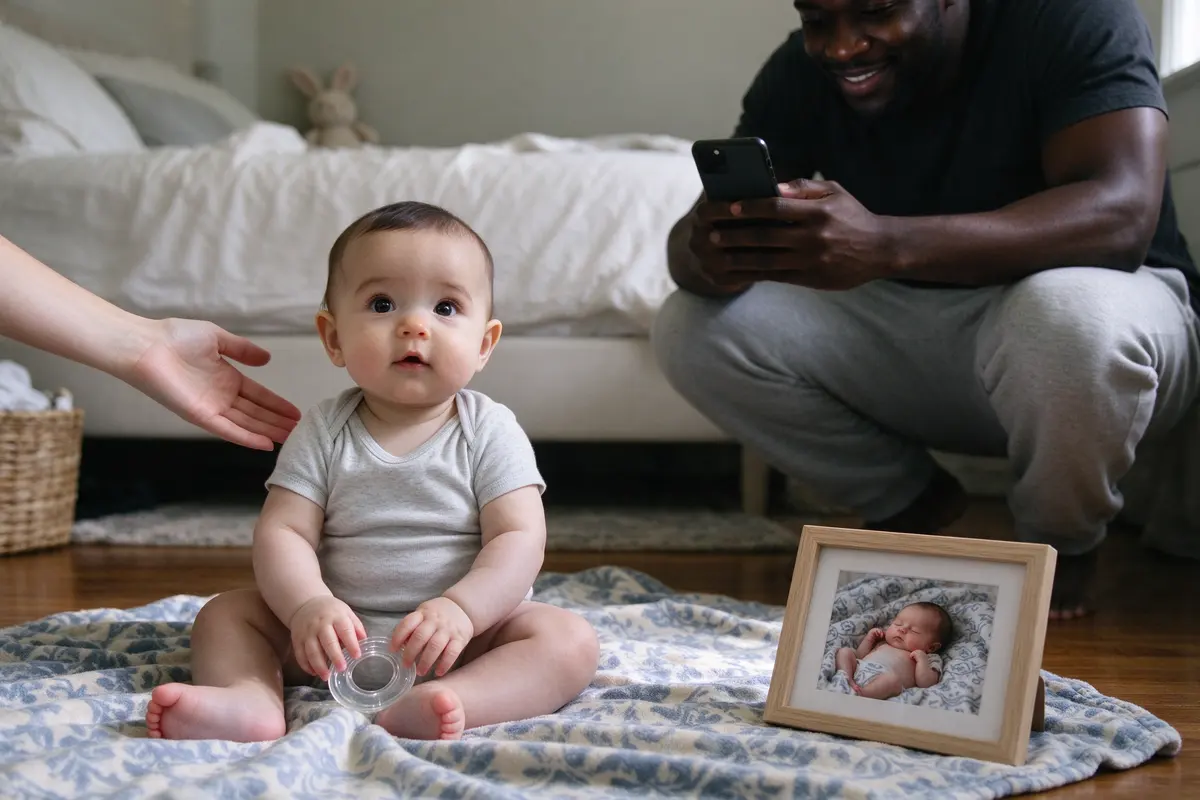
Nine-month photo and letter
Time: 10 minutes, the day-one spot, the baby rested
Lay the blanket from the first photo in the same spot, with the same window, and sit the baby on it, you kneeling an arm's length away in case of a topple.
Take the picture at their eye level, and say "nine months" and the date out loud for the video version, and nothing about what they can or can't do.
Tonight, write them a page: one thing they did this month that made you laugh, one that made you worry and then didn't, and one thing you want them to know about how you were at nine months.
Put the letter with the ones from six, seven, and eight months, and the photo next to the day-one and six-month ones.
Make it work:If there's no first photo on a blanket, any corner of your home works. The point is the same spot, year after year.
Watch for
Normal
a baby who pulls up to the sofa and then cries because they can't get down.
Set the crib mattress at its lowest position
before your baby learns to stand, if it isn't there already (AAP).
Normal
a tumble sideways from sitting onto a rug, with a cry that's over in a minute.
Go to the ER now
if, after a head injury, your baby vomits 2 or more times, cries and won't stop, or is awake but not alert (AAP).
Normal
panting with effort at the top of a crawl across the room, settled within a breath or two.
Call 911
if your baby is struggling for each breath or can barely cry (AAP).
For you
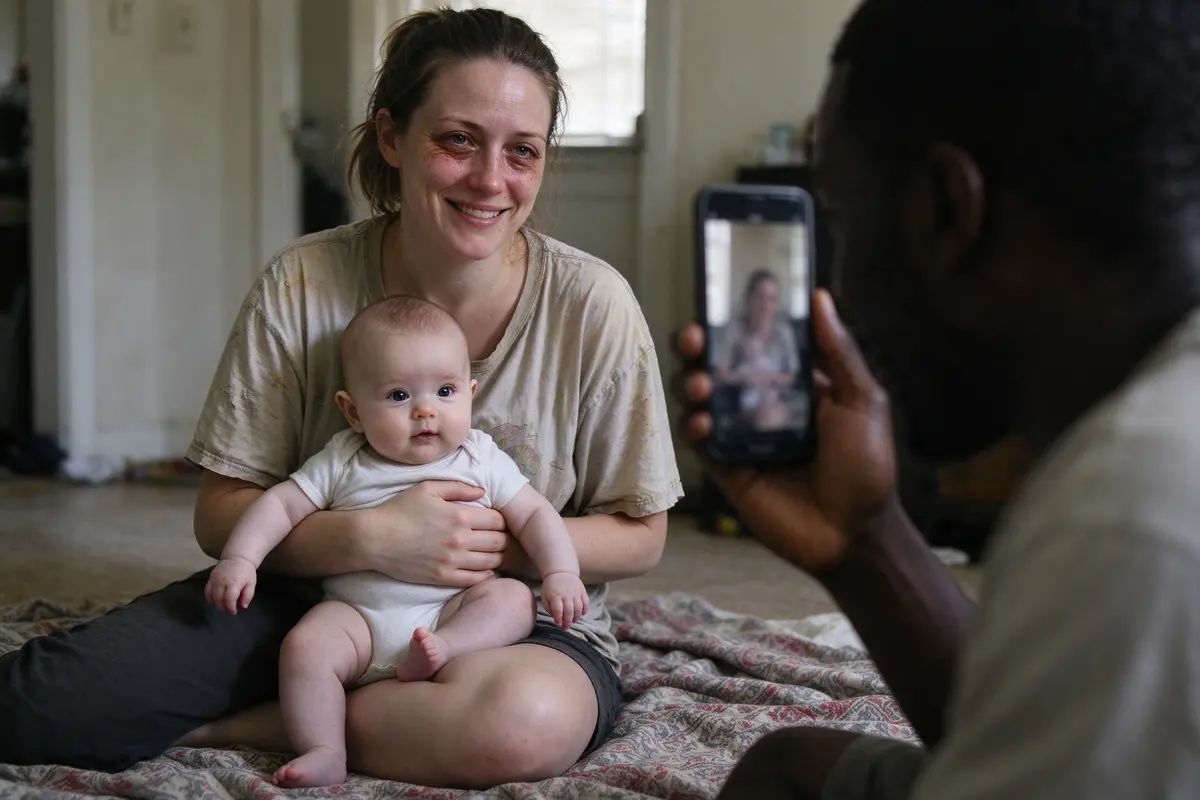
The photo of you. Take it today, on the blanket, in whatever you're wearing, with the baby on your lap, and don't delete it because of your hair. This is what nine months of doing this looks like, and it's worth seeing from the outside. Look at it honestly, too: if the woman in it has been flat or sad for more than two weeks, that's the sign to go to your own doctor, without waiting for a visit that isn't scheduled (Office on Women's Health).
If you're the partner: you take hers, then hand over the phone and sit on the blanket.
Sources
- Centers for Disease Control and Prevention. "Milestones by 9 Months." Learn the Signs. Act Early. program, updated 2026. https://www.cdc.gov/act-early/milestones/9-months.html
- WHO Multicentre Growth Reference Study Group. "WHO Motor Development Study: windows of achievement for six gross motor development milestones." Acta Paediatrica Supplement, 2006. https://pubmed.ncbi.nlm.nih.gov/16817682/
- American Academy of Pediatrics. "Hand and Finger Skills." HealthyChildren.org, updated 2009. https://www.healthychildren.org/English/ages-stages/baby/Pages/Hand-and-Finger-Skills.aspx
- American Academy of Pediatrics. "Language Development: 8 to 12 Months." HealthyChildren.org, updated 2009. https://www.healthychildren.org/English/ages-stages/baby/Pages/Language-Development-8-to-12-Months.aspx
- American Academy of Pediatrics. "Corrected Age For Preemies." HealthyChildren.org, updated 2018. https://www.healthychildren.org/English/ages-stages/baby/preemie/Pages/Corrected-Age-For-Preemies.aspx
- Zubler JM, Wiggins LD, Macias MM, et al. "Evidence-Informed Milestones for Developmental Surveillance Tools." Pediatrics, 2022. https://pubmed.ncbi.nlm.nih.gov/35132439/
- Centers for Disease Control and Prevention. "Milestones by 1 Year." Learn the Signs. Act Early. program, updated 2026. https://www.cdc.gov/act-early/milestones/1-year.html
- American Academy of Pediatrics. "Movement Milestones in Babies 8 to 12 Months Old." HealthyChildren.org, updated 2021. https://www.healthychildren.org/English/ages-stages/baby/Pages/Movement-8-to-12-Months.aspx
- American Academy of Pediatrics. "Make Baby's Room Safe: Parent Checklist." HealthyChildren.org, updated 2020. https://www.healthychildren.org/English/safety-prevention/at-home/Pages/Make-Babys-Room-Safe.aspx
- American Academy of Pediatrics. "Head Injury" (symptom checker). HealthyChildren.org, accessed 2026. https://www.healthychildren.org/English/tips-tools/symptom-checker/Pages/symptomviewer.aspx?symptom=Head+Injury
- American Academy of Pediatrics. "Fever" (symptom checker). HealthyChildren.org, accessed 2026. https://www.healthychildren.org/English/tips-tools/symptom-checker/Pages/symptomviewer.aspx?symptom=Fever
- Office on Women's Health. "Recovering from birth." US Department of Health and Human Services, 2021. https://womenshealth.gov/pregnancy/childbirth-and-beyond/recovering-birth
This guide is general education that summarizes published research and guidance from groups like the American Academy of Pediatrics, the CDC, and the WHO. It isn’t medical advice, and every child develops on their own timeline. Your pediatrician knows your child; if something feels wrong, call them. In an emergency, call 911.
Get each day’s note the morning it applies
Add your baby to a free Chorevia household with their date of birth, and every morning for 300 days the day’s note arrives in the app and by email: what’s developing, one thing to try, what to watch for, and a word for you.
Create your household