Day 263 of 300 · Week 36
Banging and dropping, on purpose
Last reviewed · 4 min read · 6 sources · Plain-text version
Banging two things together is a 9-month milestone, and once a baby can let go on purpose, dropping becomes a favorite game. The pot-and-spoon drum, and why the kitchen floor is a classroom.

Every spoon that lands on the floor today was let go of on purpose. That's new, and it's the whole subject of this note.
Heart
By 9 months, most babies bang two things together and look for objects dropped out of sight (CDC). The banging looks like noise and the dropping looks like provocation, but the AAP files both under thinking: dropping and banging are experiments in how things work (AAP). What makes them possible is a hand that can open on command. Early in this stage, your baby rakes things in with the whole hand; by the end, most pinch with thumb and finger, and once they can let go on purpose, dropping and throwing become favorite games (AAP). A thirty-six-week-old who drops the cup, watches it, and looks at you is running the experiment and checking the result.
Head
The lesson being learned is cause and effect: I hit this, it makes that sound; I open my hand, the thing falls, and a parent appears. The AAP suggests handing over a cup, a spoon, or a hairbrush and being an enthusiastic audience when your baby copies you, because "things have uses" is one of the big ideas of this stage (AAP). At this age, ordinary household objects are the most fascinating toys: wooden spoons, pots, plastic containers (AAP). The drum set is already in your cabinet.
Body
Two cautions, both about the floor. Everything still goes in the mouth, so check the floor often (AAP), and check between cushions too, for coins, toy parts, and pen caps (AAP). Anything you hand over to bang with should be too big to fit entirely in your baby's mouth (AAP). A wooden spoon passes; a teaspoon doesn't. And the pot goes upside down on the floor, not on the stove it came from.
Try today
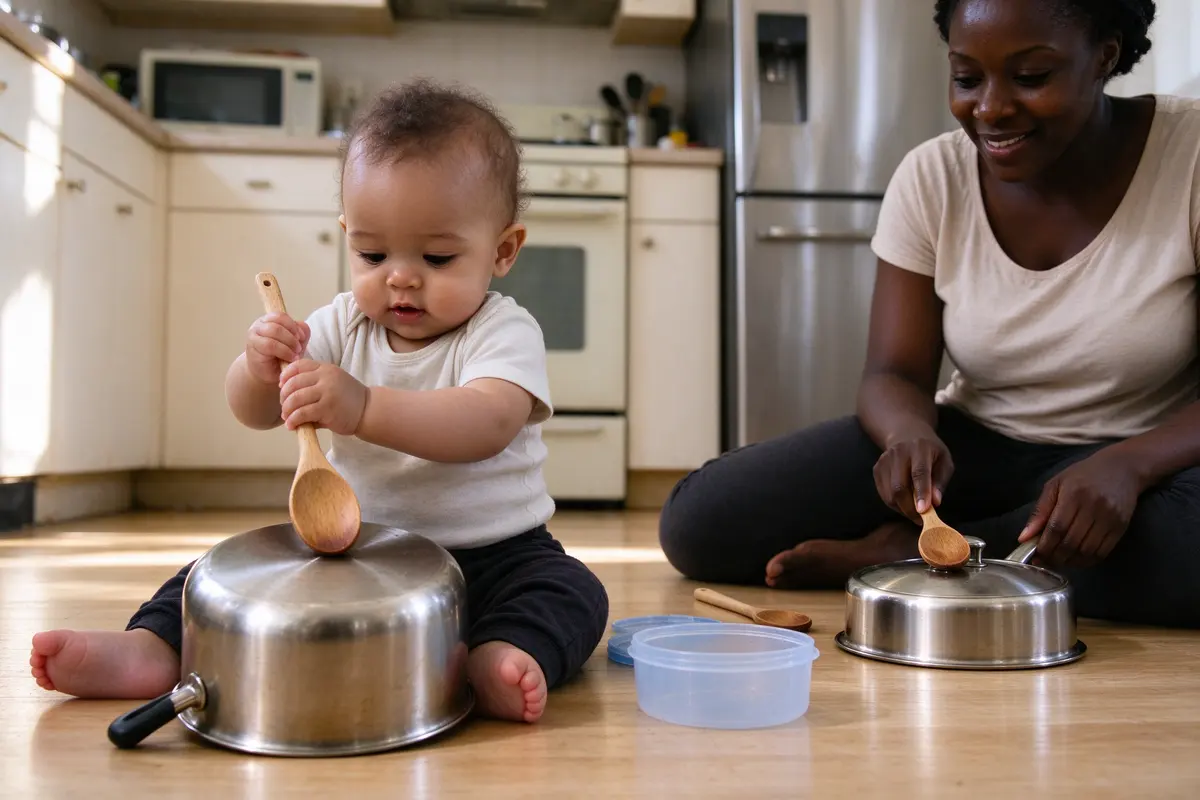
The pot-and-spoon drum
Time: 5 minutes, floor cleared first
Turn a steel pot or mixing bowl upside down on the kitchen floor and set a wooden spoon beside it. Add a plastic container and a saucepan lid for different sounds (AAP).
Sit opposite your baby with a spoon of your own. Bang once, slowly, and wait.
Whatever they do, copy it back: one bang for one bang, a drop for a drop. Say "bang!" and "drop!" as they happen.
When a spoon goes over the edge, pick it up, hand it back, and say "again?" Five rounds, then let them keep drumming without you.
Make it work:Every object in the set stays too big to fit entirely in the mouth (AAP). If a lid has a loose knob or a pot has a wobbly handle, it's out of the band.
Watch for
Normal
a spoon that goes in the mouth between every bang.
Call 911
if your baby is choking and can't breathe, cry, or make noise, turns bluish, or goes limp, and start back blows and chest thrusts while someone calls (AAP).
Normal
a baby who drums with the right hand one day and the left the next.
Talk with your pediatrician
if your baby uses one arm or leg much more than the other (AAP).
Normal
a long, loud session that ends in a sweaty, thirsty baby.
Call your pediatrician right away
for signs of dehydration: no urine in more than 8 hours, dark urine, a very dry mouth, and no tears (AAP).
For you
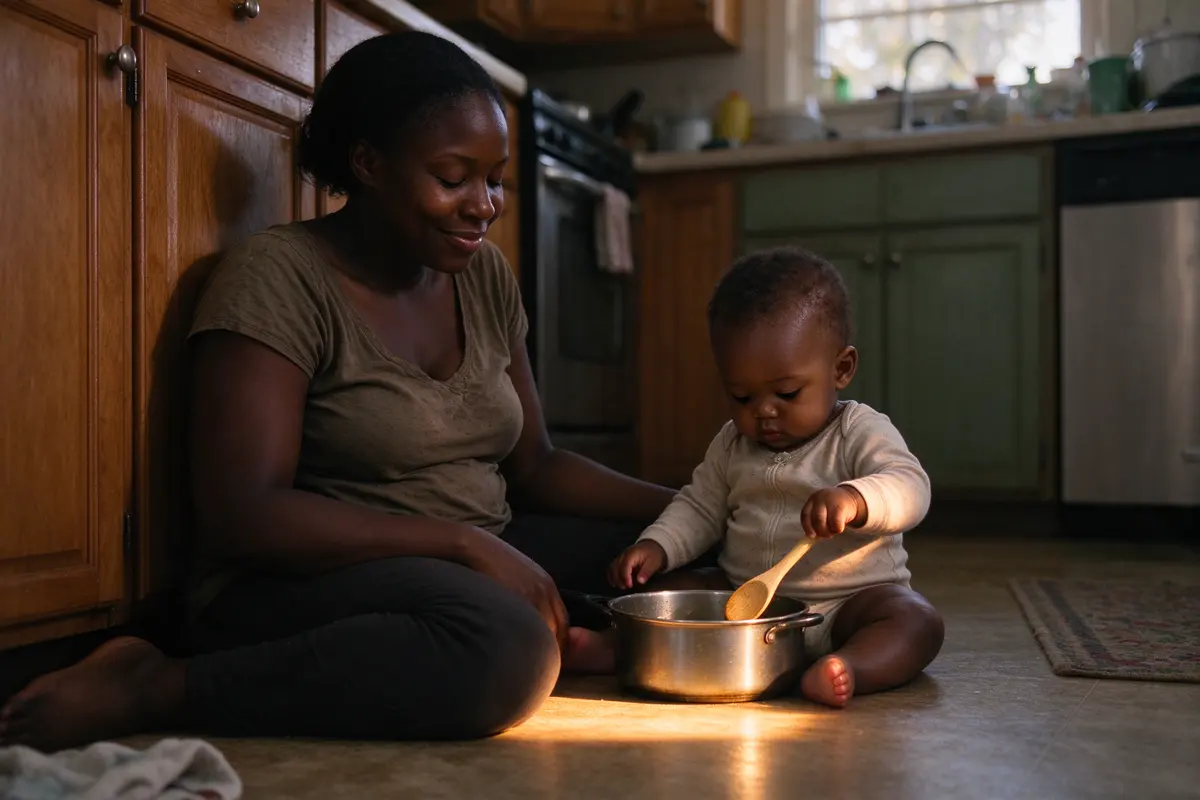
The kitchen floor is a classroom, which means you can stop feeling that the afternoon on it was wasted. The AAP's list of the most fascinating toys at this age is wooden spoons, pots, and plastic containers (AAP), and the curriculum is cause and effect, taught by a parent who picks the spoon up and hands it back. You don't need to be interesting. You need to be there, sitting against the cabinets, handing things back. Earplugs are allowed. So is closing your eyes for the last two minutes while the drumming goes on without you.
If you're the partner: the evening drum session is yours. Pots are louder than toys, and you're the one who hasn't heard them all day.
Sources
- Centers for Disease Control and Prevention. "Milestones by 9 Months." Learn the Signs. Act Early. program, updated 2026. https://www.cdc.gov/act-early/milestones/9-months.html
- American Academy of Pediatrics. "Cognitive Development in Infants: 8 to 12 Months." HealthyChildren.org, updated 2023. https://www.healthychildren.org/English/ages-stages/baby/Pages/Cognitive-Development-8-to-12-Months.aspx
- American Academy of Pediatrics. "Hand and Finger Skills." HealthyChildren.org, updated 2009. https://www.healthychildren.org/English/ages-stages/baby/Pages/Hand-and-Finger-Skills.aspx
- Bradin S. "Choking Prevention for Babies & Children: What Every Parent Needs to Know." HealthyChildren.org, updated 2026. https://www.healthychildren.org/English/health-issues/injuries-emergencies/Pages/Choking-Prevention.aspx
- American Academy of Pediatrics. "Movement Milestones in Babies 8 to 12 Months Old." HealthyChildren.org, updated 2021. https://www.healthychildren.org/English/ages-stages/baby/Pages/Movement-8-to-12-Months.aspx
- American Academy of Pediatrics. "Fever" (symptom checker). HealthyChildren.org, accessed 2026. https://www.healthychildren.org/English/tips-tools/symptom-checker/Pages/symptomviewer.aspx?symptom=Fever
This guide is general education that summarizes published research and guidance from groups like the American Academy of Pediatrics, the CDC, and the WHO. It isn’t medical advice, and every child develops on their own timeline. Your pediatrician knows your child; if something feels wrong, call them. In an emergency, call 911.
Get each day’s note the morning it applies
Add your baby to a free Chorevia household with their date of birth, and every morning for 300 days the day’s note arrives in the app and by email: what’s developing, one thing to try, what to watch for, and a word for you.
Create your household