Day 260 of 300 · Week 35
The nine-month safety walk
Last reviewed · 4 min read · 16 sources · Plain-text version
Gates, windows, outlets, cords, small things, tip-overs, batteries, magnets, hot drinks, water, and poisons: the whole list in one walk through the house, two adults, half each.

Your baby can reach things this week they couldn't last month. Today is the whole list in one walk, done ahead of the next skill instead of behind it.
Heart
Gates go at the top and bottom of stairs, mounted firmly to the wall studs, and never accordion-style, which can trap an arm or neck (AAP). Windows open from the top or get guards; a screen won't stop a fall (AAP). Unused outlets get plugged and cords go out of reach (AAP); cordless window coverings are the only way to remove the strangulation risk from blind cords (CPSC). Floors and the gaps between cushions get checked for coins, toy parts, and pen caps (AAP). No walker (AAP).
Head
Anchor bookcases, dressers, and TV stands to the wall (AAP); CPSC counted 234 deaths from dresser and other clothing-storage tip-overs from 2000 to April 2022, 199 of them children, and still advises anchoring even dressers built to the tougher 2023 standard (CPSC). From 2011 to 2021, button and coin batteries were linked to 27 deaths and an estimated 54,300 emergency room visits (CPSC), and a battery stuck in the esophagus can cause severe damage in just 2 hours (Poison Control), so tape compartments shut and lock up spares (AAP). Two or more swallowed magnets can pull together inside the body; many cases have needed surgery (CPSC).
Body
Hot liquids in cups, mugs, and tableware cause 27% to 60% of scald burns in children under 5; never carry a hot drink while holding your baby, and keep mugs away from table edges (AAP). Set the water heater to no more than 120°F (AAP). Babies can drown in 1 or 2 inches of water, silently, within seconds (AAP), so empty buckets and wading pools right after use, latch toilet lids, and fence pools on all 4 sides (AAP). Lock up cleaners and alcohol; keep medicines, including the ones in your bag, vaping liquid, and cannabis edibles out of reach; don't rely on child-resistant caps (AAP). Save Poison Help, 1-800-222-1222, in your phone (Poison Control).
Try today
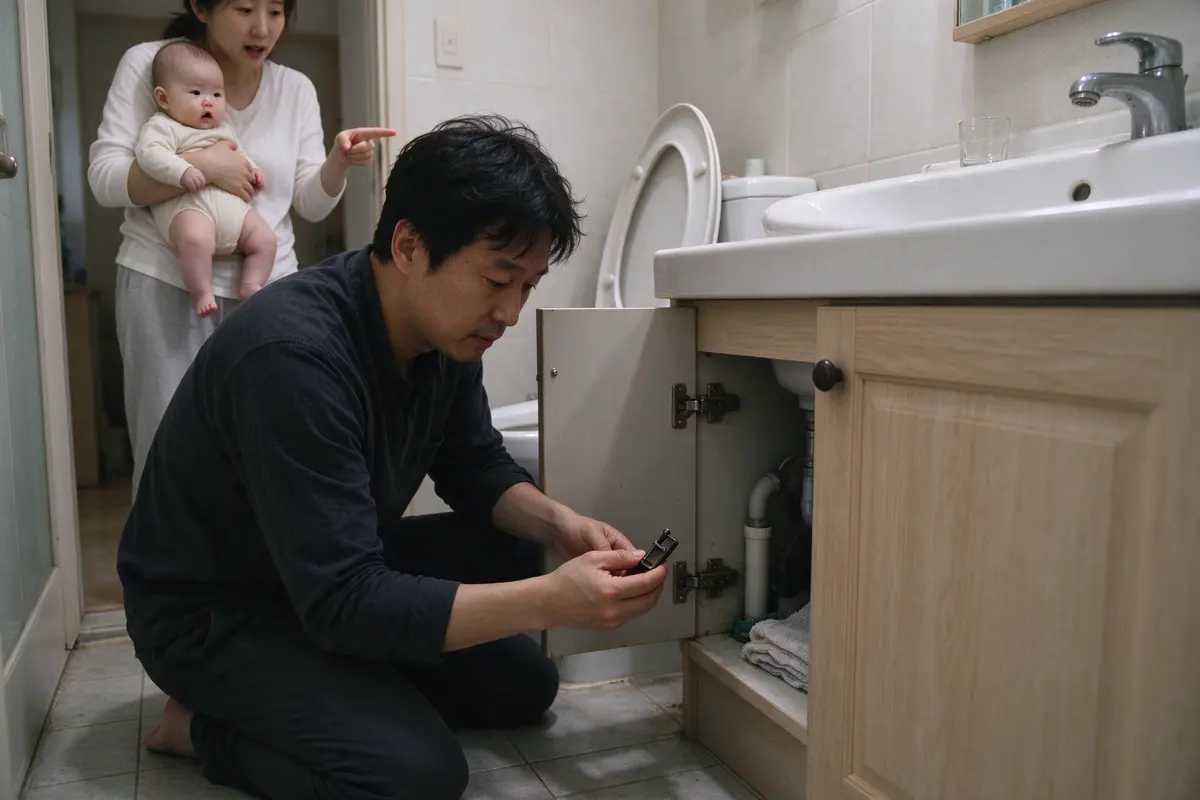
The whole-house walk
Time: 45 minutes, two adults, half the house each · Childproof at crawling height in the guide
Split the rooms. Each adult takes a list with eleven words on it: gates, windows, outlets, cords, small things, anchors, batteries, magnets, hot drinks, water, poisons (AAP).
In each room, kneel to your baby's height and go through the eleven words. Write one fix per room, the worst one.
Swap halves for a second look; the second pair of eyes finds the remote with the loose battery door.
Save Poison Help (1-800-222-1222) and the National Battery Ingestion Hotline (1-800-498-8666) in both phones before you stand up (Poison Control; CPSC).
Do the fixes this week, one a day.
Make it work:A baby who kneels at the bookcase today stands at it next month.
Watch for
Normal
a low drawer opened and emptied onto the floor the moment you look away (AAP).
Normal
a bump on the forehead from pulling up on the coffee table.
Call your pediatrician
for any head injury in a baby under 1 (AAP).
Normal
a baby who found the one thing you missed and is mouthing it.
Call 911
if your baby is choking and can't breathe, cry, or make noise, turns bluish, or goes limp (AAP).
Normal
knowing this baby better than any checklist.
Call anyway
if your baby just doesn't seem right to you. Trust your instincts; two hundred and sixty days have built them (Lurie Children's).
For you
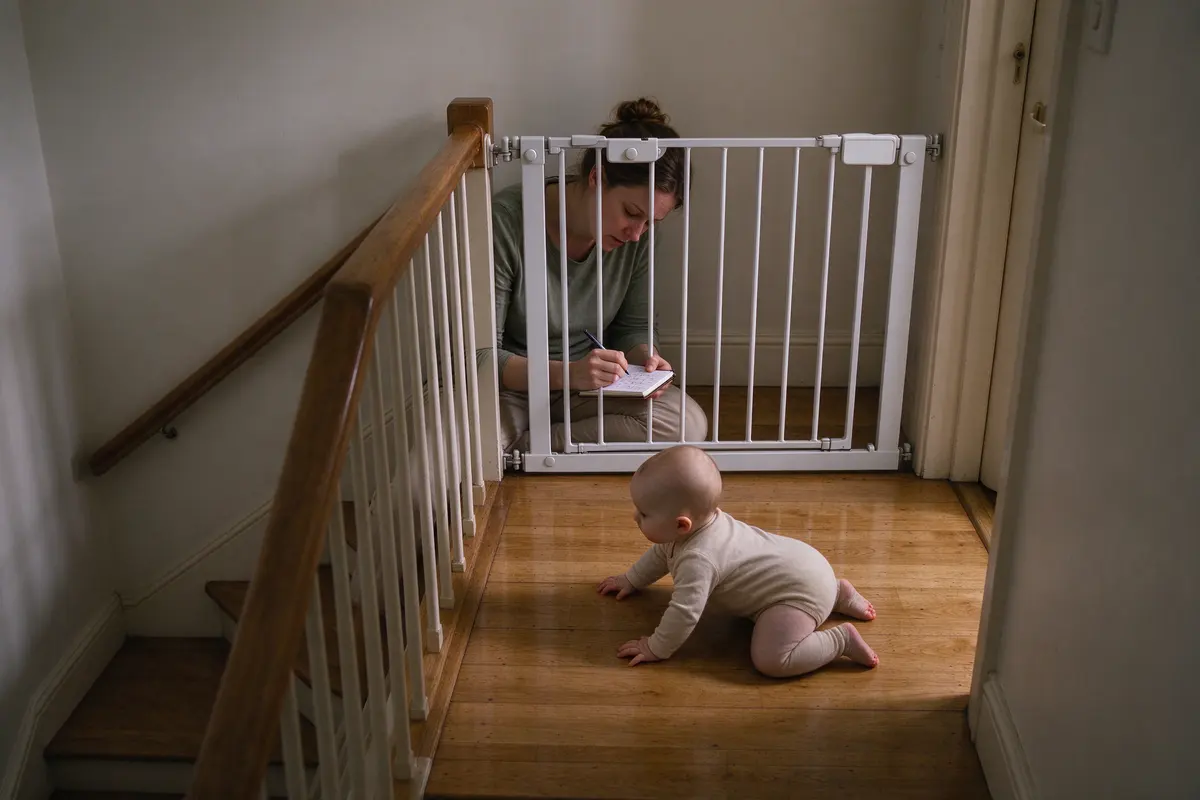
The partner takes half the house. Not "helps": takes half, with their own list and their own rooms. The AAP's home safety checklist is long (AAP), and it stays undone in so many homes because one person is carrying it in her head. Splitting it on paper moves it out of your head and onto the wall.
If you're the partner: your half is the bathroom, the kitchen, and the stairs, the rooms where the fixes need tools. Swap next month, when the baby is taller.
Sources
- American Academy of Pediatrics. "Home Safety: Tips for Families With Young Children." HealthyChildren.org, updated 2022. https://www.healthychildren.org/English/safety-prevention/at-home/Pages/Home-Safety-Heres-How.aspx
- US Consumer Product Safety Commission. "Window Covering Cords." Accessed 2026. https://www.cpsc.gov/gocordless
- Bradin S. "Choking Prevention for Babies & Children: What Every Parent Needs to Know." HealthyChildren.org, updated 2026. https://www.healthychildren.org/English/health-issues/injuries-emergencies/Pages/Choking-Prevention.aspx
- American Academy of Pediatrics. "Baby Walkers: A Dangerous Choice." HealthyChildren.org, updated 2022. https://www.healthychildren.org/English/safety-prevention/at-home/Pages/Baby-Walkers-A-Dangerous-Choice.aspx
- US Consumer Product Safety Commission. "CPSC Adopts Final Consumer Product Safety Standard to Prevent Tip-overs of Dressers and Other Clothing Storage Units." 2023. https://www.cpsc.gov/Newsroom/News-Releases/2023/CPSC-Adopts-Final-Consumer-Product-Safety-Standard-to-Prevent-Tip-overs-of-Dressers-and-Other-Clothing-Storage-Units
- US Consumer Product Safety Commission. "Making Families Safer from Button Cell or Coin Battery Dangers; Reese's Law Leads to New Federal Mandatory Safety Standard." 2023. https://www.cpsc.gov/Newsroom/News-Releases/2023/Making-Families-Safer-from-Button-Cell-or-Coin-Battery-Dangers-Reeses-Law-Leads-to-New-Federal-Mandatory-Safety-Standard
- National Capital Poison Center. "Button Battery Ingestion." Poison Control, accessed 2026. https://www.poison.org/battery
- American Academy of Pediatrics. "How Small Batteries Can Become Dangerous to Children." HealthyChildren.org, updated 2021. https://www.healthychildren.org/English/safety-prevention/at-home/Pages/Button-Battery-Injuries-in-Children-A-Growing-Risk.aspx
- US Consumer Product Safety Commission. "Magnets" (Safety Education Center). Accessed 2026. https://www.cpsc.gov/Safety-Education/Safety-Education-Centers/Magnets
- American Academy of Pediatrics. "Infant Drowning Prevention & Water Safety: How to Protect Your Baby." HealthyChildren.org, updated 2026. https://www.healthychildren.org/English/safety-prevention/at-play/Pages/Infant-Water-Safety.aspx
- American Academy of Pediatrics. "Burn Treatment & Prevention Tips for Families." HealthyChildren.org, updated 2023. https://www.healthychildren.org/English/health-issues/injuries-emergencies/Pages/Treating-and-Preventing-Burns.aspx
- American Academy of Pediatrics. "Drowning Prevention for Curious Toddlers: What Parents Need to Know." HealthyChildren.org, updated 2026. https://www.healthychildren.org/English/safety-prevention/at-play/Pages/Water-Safety-And-Young-Children.aspx
- National Capital Poison Center. "Poison Control." Accessed 2026. https://www.poison.org/
- American Academy of Pediatrics. "Cognitive Development in Infants: 8 to 12 Months." HealthyChildren.org, updated 2023. https://www.healthychildren.org/English/ages-stages/baby/Pages/Cognitive-Development-8-to-12-Months.aspx
- American Academy of Pediatrics. "Head Injury" (symptom checker). HealthyChildren.org, accessed 2026. https://www.healthychildren.org/English/tips-tools/symptom-checker/Pages/symptomviewer.aspx?symptom=Head+Injury
- Latimer T. "When to Call the Pediatrician for Your Newborn." Lurie Children's Hospital of Chicago, 2022. https://www.luriechildrens.org/en/blog/when-to-call-the-pediatrician-for-your-newborn/
This guide is general education that summarizes published research and guidance from groups like the American Academy of Pediatrics, the CDC, and the WHO. It isn’t medical advice, and every child develops on their own timeline. Your pediatrician knows your child; if something feels wrong, call them. In an emergency, call 911.
Get each day’s note the morning it applies
Add your baby to a free Chorevia household with their date of birth, and every morning for 300 days the day’s note arrives in the app and by email: what’s developing, one thing to try, what to watch for, and a word for you.
Create your household