Day 254 of 300 · Week 34
Thirty-four weeks: answering babble
Last reviewed · 3 min read · 9 sources · Plain-text version
Babies reshape their babble when it's answered right away, and coaching parents in parentese at 6, 10, and 14 months increased back-and-forth turns. Five minutes of parentese on purpose.

Thirty-four weeks. You've been answering the babble for months. Today is the evidence that the way you answer matters, and the five minutes that put it to use.
Heart
By 9 months, most babies make lots of different sounds like "mamamama" and "bababababa" (CDC). Coos turn into syllables like "ba," "da," and "ma," and babies understand more than they can say (AAP). Your baby is 8 months old, and somewhere in this month the strings get longer and start to rise and fall like sentences. They aren't sentences. They're the baby's half of a conversation, waiting for yours.
Head
In a lab experiment, 9.5-month-olds whose mothers answered their babble right away quickly reshaped it using sounds from their mothers' speech; babies answered at random times didn't (Goldstein & Schwade, 2008). In a randomized trial of 71 families, coaching parents at 6, 10, and 14 months increased parentese and back-and-forth turns (Ferjan Ramírez et al., 2020), and in a follow-up of 59 children, the coached group had larger vocabularies through 30 months (Huber et al., 2023). The trial and its follow-up are small and come from one lab group. What the coaching taught was two things: the parentese voice, and taking turns.
Body
Parentese is the voice you already slip into: higher pitch, slower, more melody (Ferjan Ramírez et al., 2020). The words are real words, stretched and sung. Repeat their sounds, add simple words, and describe what they see (CDC). Ask questions, and wait for an answer (AAP). The waiting is the half most of us skip.
Try today
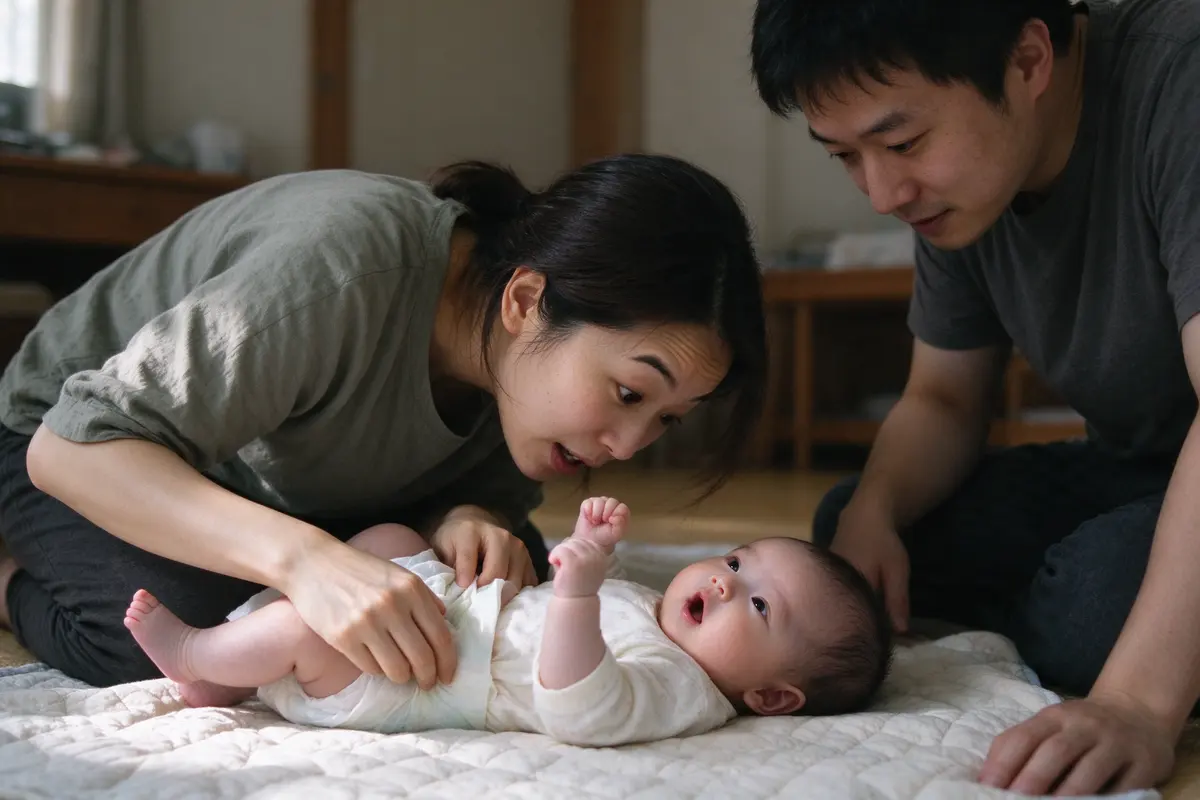
Parentese on purpose
Time: 5 minutes, at a diaper change or a meal · Talk back with words in the guide
Pick one routine today and do it in full parentese: high, slow, sing-song, eyebrows up, about whatever is in front of you (Ferjan Ramírez et al., 2020). "Where's your sock? Here's your sock! On it goes."
After each sentence, stop. Count to five in your head and wait for a sound.
When a sound comes, answer it right away: the same sound back, then one real word (Goldstein & Schwade, 2008).
Keep the turns going until the routine ends, then drop back to your normal voice. Five minutes is the dose.
Make it work:Right away matters more than how much you say. The babies answered off the beat didn't change their babble (Goldstein & Schwade, 2008).
Watch for
Normal
a week of nothing but "dadada," then a new sound out of nowhere.
Bring it up
if your baby isn't babbling lots of different sounds by 9 months (CDC).
Normal
going silent when a stranger is in the room, then chattering the moment they leave (CDC).
Talk with your pediatrician
if your baby seems not to hear well (AAP).
Normal
a hoarse babble the morning after a day of happy shrieking.
Call your pediatrician right away
for trouble breathing that isn't severe, and call 911 if your baby is struggling for each breath or can barely cry (AAP).
For you
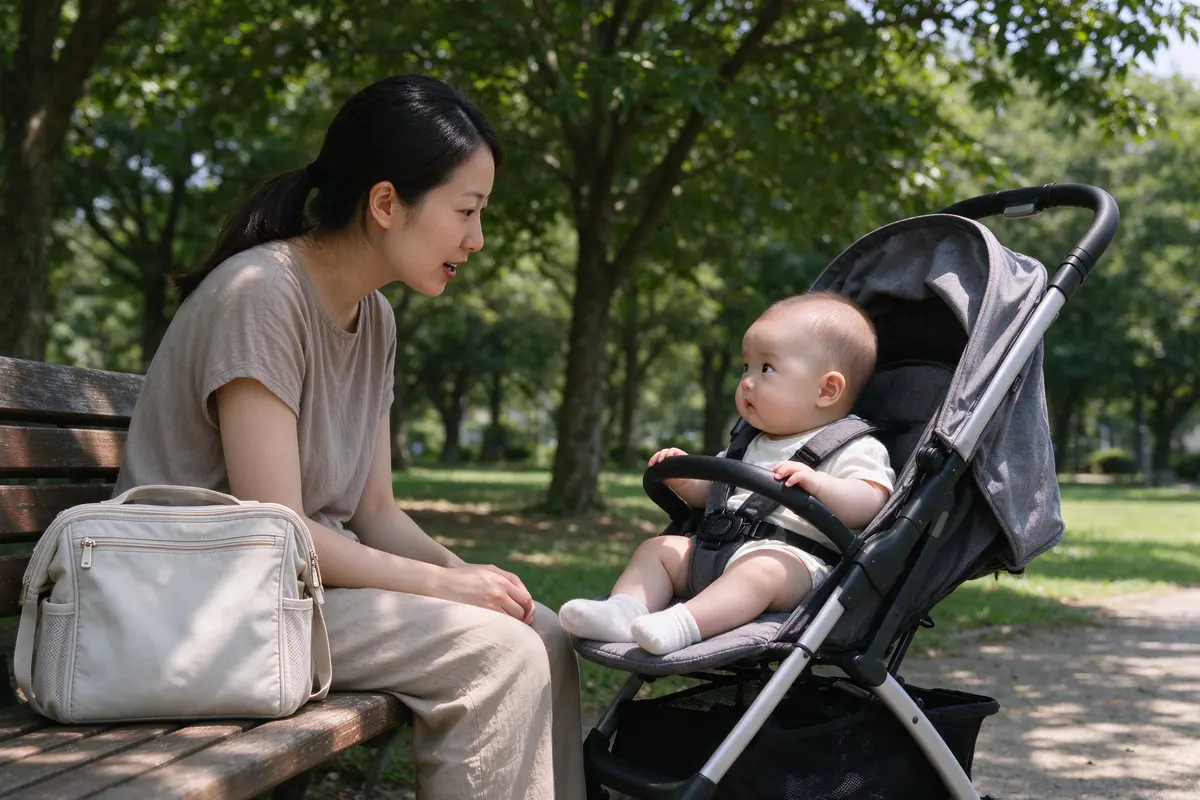
Your voice is enough. The trial that moved the needle coached parents, in person, to talk and wait; it didn't hand them an app (Ferjan Ramírez et al., 2020). The WHO doesn't recommend any screen time for babies under 1 (WHO), and the AAP's reason is the one you just read: babies this age learn best from real-world interactions (Munzer, AAP). Nothing on a screen can answer in time. You can, and you do, dozens of times a day without noticing.
If you're the partner: the sing-song voice feels silly for about a day. Do the bath in parentese tonight and count the turns. You'll stop feeling silly around turn four.
Sources
- Centers for Disease Control and Prevention. "Milestones by 9 Months." Learn the Signs. Act Early. program, updated 2026. https://www.cdc.gov/act-early/milestones/9-months.html
- American Academy of Pediatrics. "Language Development: 8 to 12 Months." HealthyChildren.org, updated 2009. https://www.healthychildren.org/English/ages-stages/baby/Pages/Language-Development-8-to-12-Months.aspx
- Goldstein MH, Schwade JA. "Social feedback to infants' babbling facilitates rapid phonological learning." Psychological Science, 2008. https://pubmed.ncbi.nlm.nih.gov/18466414/
- Ferjan Ramírez N, Lytle SR, Kuhl PK. "Parent coaching increases conversational turns and advances infant language development." Proceedings of the National Academy of Sciences, 2020. https://pubmed.ncbi.nlm.nih.gov/32015127/
- Huber E, Ferjan Ramírez N, Corrigan NM, Kuhl PK. "Parent coaching from 6 to 18 months improves child language outcomes through 30 months of age." Developmental Science, 2023. https://pubmed.ncbi.nlm.nih.gov/36999222/
- American Academy of Pediatrics. "Checkup Checklist: 9 Months Old." HealthyChildren.org, updated 2021. https://www.healthychildren.org/English/ages-stages/Your-Childs-Checkups/Pages/Your-Checkup-Checklist-9-Months-Old.aspx
- American Academy of Pediatrics. "Fever" (symptom checker). HealthyChildren.org, accessed 2026. https://www.healthychildren.org/English/tips-tools/symptom-checker/Pages/symptomviewer.aspx?symptom=Fever
- World Health Organization. "To grow up healthy, children need to sit less and play more." 2019. https://www.who.int/news/item/24-04-2019-to-grow-up-healthy-children-need-to-sit-less-and-play-more
- Munzer T. "Helping Kids Thrive in a Digital World: AAP Policy Explained." HealthyChildren.org, updated 2026. https://www.healthychildren.org/English/family-life/Media/Pages/helping-kids-thrive-in-a-digital-world-AAP-policy-explained.aspx
This guide is general education that summarizes published research and guidance from groups like the American Academy of Pediatrics, the CDC, and the WHO. It isn’t medical advice, and every child develops on their own timeline. Your pediatrician knows your child; if something feels wrong, call them. In an emergency, call 911.
Get each day’s note the morning it applies
Add your baby to a free Chorevia household with their date of birth, and every morning for 300 days the day’s note arrives in the app and by email: what’s developing, one thing to try, what to watch for, and a word for you.
Create your household