Day 249 of 300 · Week 34
Three meals and snacks
Last reviewed · 4 min read · 8 sources · Plain-text version
At 9 months the AAP suggests 3 meals and 2 to 3 snacks a day, with breast milk or formula still the main drink and 4 to 8 ounces of water. The snack shelf: two snacks planned, not grazed.
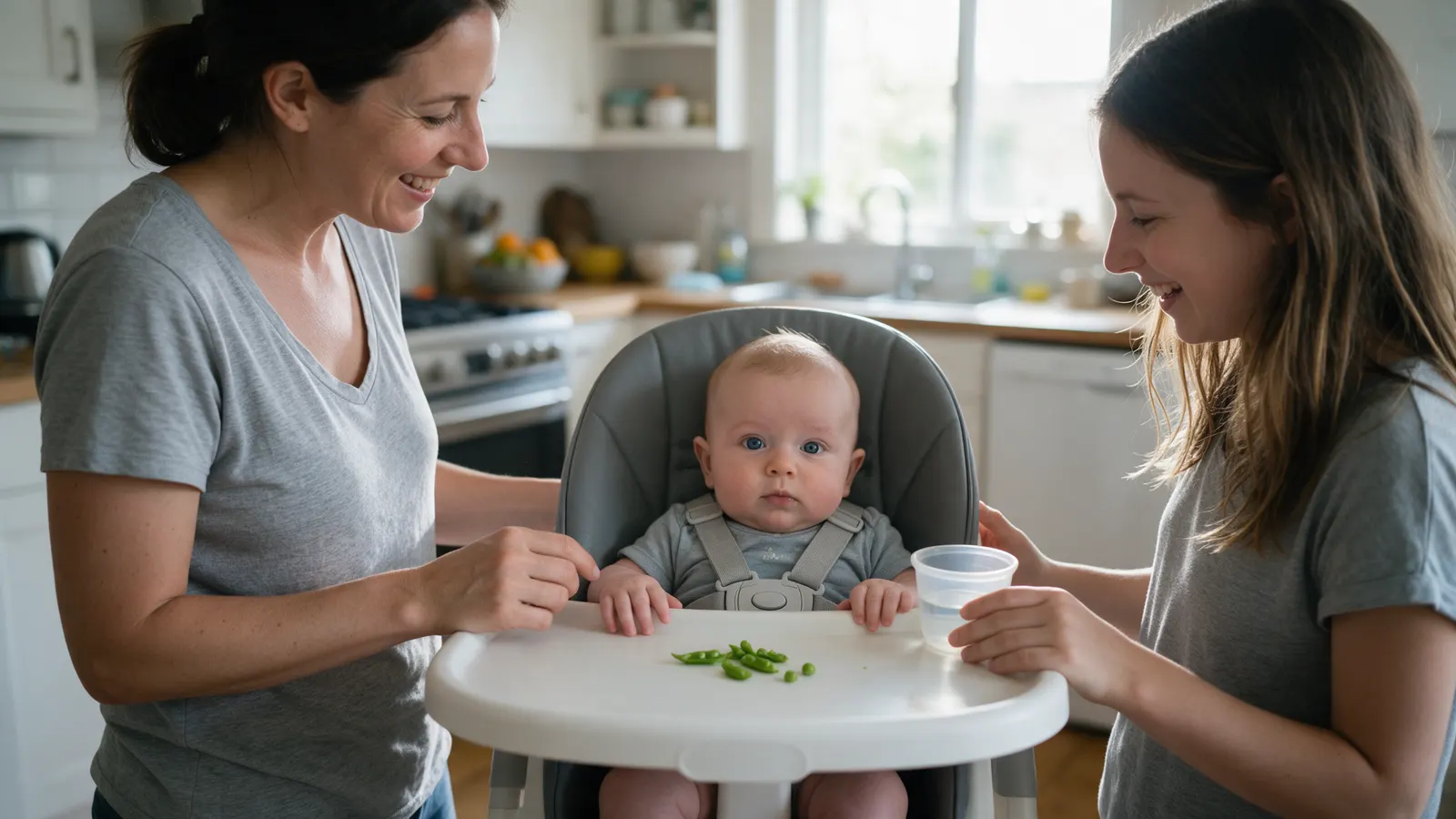
Solids started as a taste after the milk. By the end of this month, they take the shape of a day. Today is that shape, and the snack that isn't grazing.
Heart
At 9 months, the AAP suggests 3 meals and 2 to 3 snacks a day (AAP). That's the direction of travel for the next few weeks, not a rule for an 8-month-old who ate two bites of egg yesterday. Breast milk or formula is still the main drink, plus 4 to 8 ounces of water a day (Muth, AAP), so the milk feeds don't go anywhere; the meals and snacks grow up around them. Three meals is the family's three meals, with the baby at the table (AAP); the snacks are the new part.
Head
A snack at this age is a small meal at a set time, not a steady trickle of puffs. The reason is the research on refused foods: a systematic review of 21 studies, mostly controlled trials, found moderate evidence that tasting a vegetable or fruit daily for 8 to 10 or more days makes babies and toddlers more willing to eat it (Spill et al., 2019), and the CDC's plain version is to keep offering foods your baby refused before (CDC). A planned snack is a tenth chance at the peas. A baby who's been nibbling crackers since the last meal doesn't want the peas, and you've lost the try.
Body
What doesn't go in the cup yet: juice waits until after 12 months (AAP), and so does cow's milk as a drink; before the first birthday, the AAP says babies shouldn't drink cow's milk or other milk substitutes, because it lacks enough iron and other nutrients and in some babies irritates the gut (AAP). Water in a cup at the snack, milk at the feeds, and the snack itself is food from the plate, cut to half an inch, with you there (AAP).
Try today
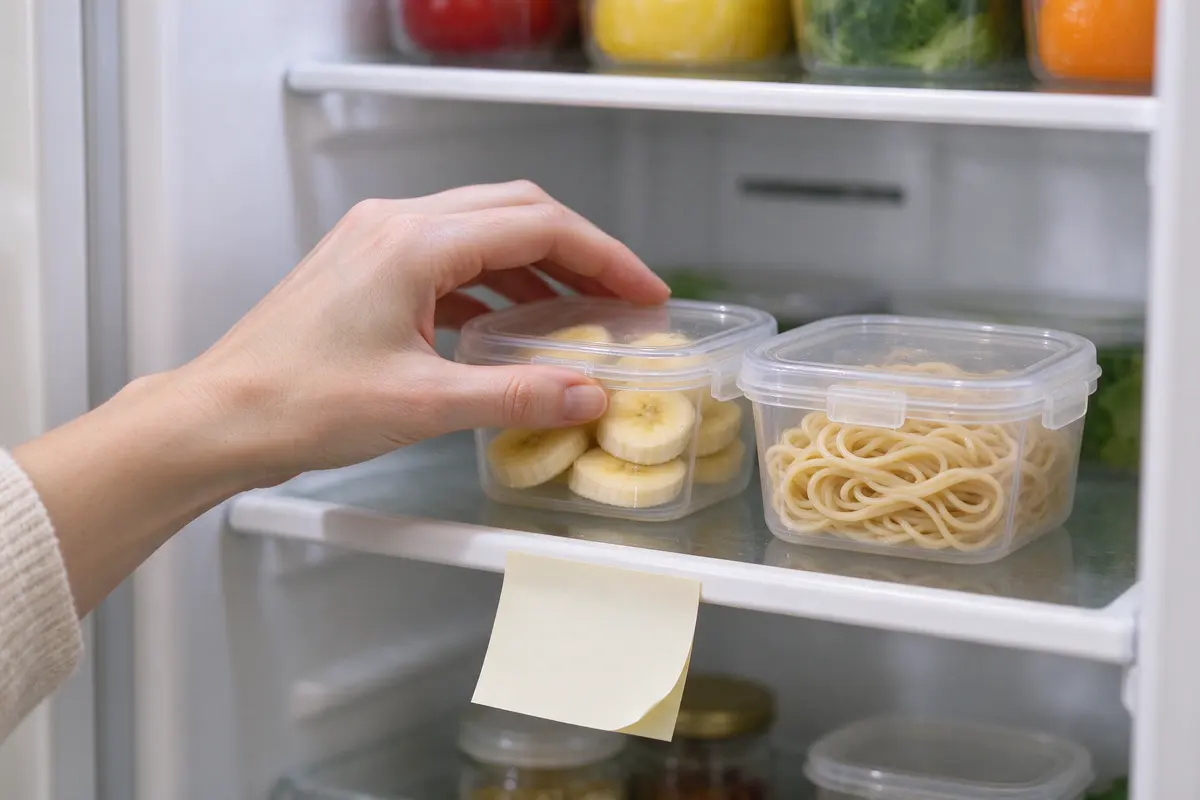
The snack shelf
Time: 10 minutes tonight, for tomorrow
Pick two snack times for tomorrow that sit between milk feeds and meals, and write them on a sticky note on the fridge; the AAP's 9-month shape is 3 meals and 2 to 3 snacks (AAP).
Fill two small containers from today's cooking: soft pieces no larger than half an inch, one of them a food that got refused this week (AAP).
Put them on one fridge shelf, with the baby's cup. That shelf is tomorrow's snacks; nothing else counts as one.
Tomorrow, serve each in the high chair at its time, with water in the cup, and let the tray decide how much. Nothing between.
Make it work:If tomorrow's naps move, move the snack, not the rule. A snack is a sit-down, however short.
Watch for
Normal
a snack ignored entirely on a day the milk feeds were big.
Call your pediatrician right away
for signs of dehydration: no urine in more than 8 hours, dark urine, a very dry mouth, and no tears (AAP).
Normal
smaller meals for a few days with a cold, then a hungry week (Muth, AAP).
Call within 24 hours
if a fever comes back after a day without one, or any fever lasts more than 3 days (AAP).
Normal
the refused pea refused again, on day six of ten (Spill et al., 2019).
Call your pediatrician right away
if your baby cries nonstop, or looks or acts very sick (AAP).
For you
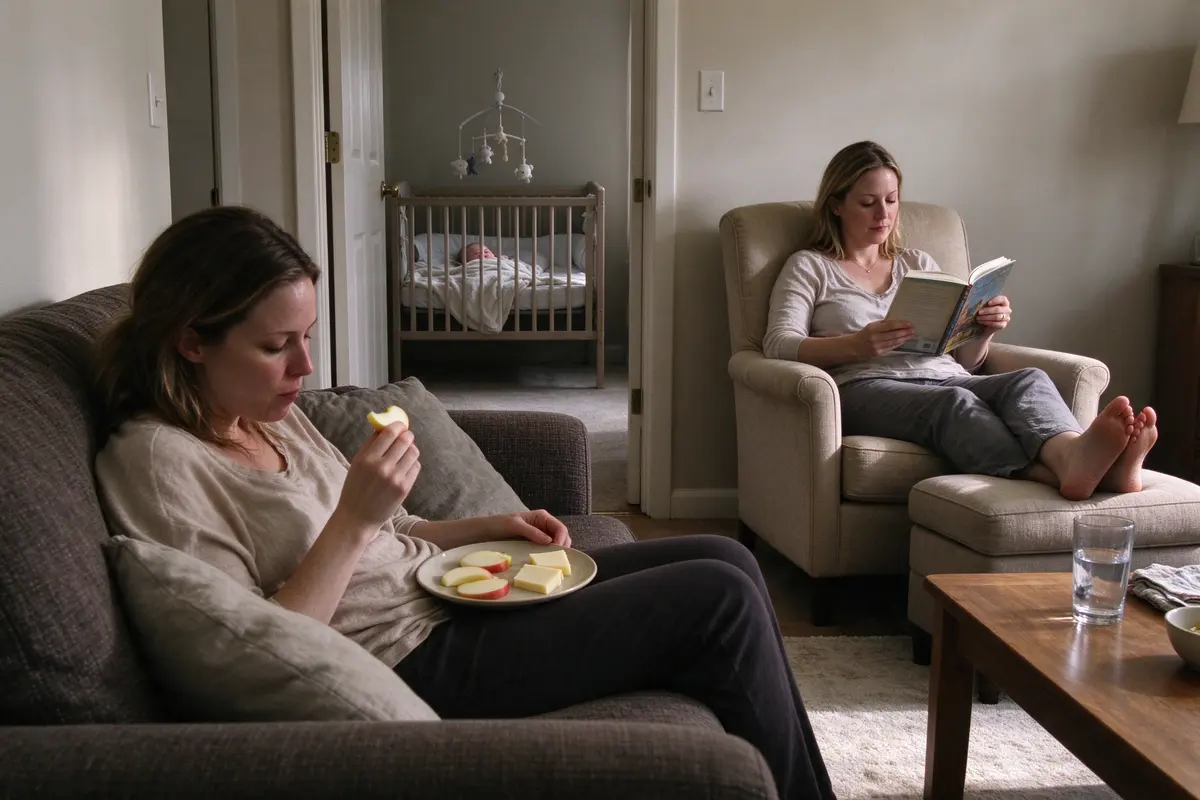
Your own snack on the shelf. The baby's day is getting the structure the AAP suggests, 3 meals and snacks at set times (AAP), and yours probably has less than it did before the baby. When you fill the two containers tonight, fill a third for you: cheese, fruit, whatever you'd eat if someone handed it to you at three in the afternoon. Put it on the same shelf. The baby's snack time is yours too, at the table, sitting down, from a plate. If you're breastfeeding, you're feeding two people's days from one body; the shelf is the least of what you're owed.
If you're the partner: the third container is yours to fill, every night, without being asked.
Sources
- American Academy of Pediatrics. "Checkup Checklist: 9 Months Old." HealthyChildren.org, updated 2021. https://www.healthychildren.org/English/ages-stages/Your-Childs-Checkups/Pages/Your-Checkup-Checklist-9-Months-Old.aspx
- Muth ND. "Recommended Drinks for Children Age 5 & Younger." HealthyChildren.org, updated 2023. https://www.healthychildren.org/English/healthy-living/nutrition/Pages/Recommended-Drinks-for-Young-Children-Ages-0-5.aspx
- American Academy of Pediatrics. "When Can Babies Start Solid Foods? Readiness & Feeding Tips." HealthyChildren.org, updated 2026. https://www.healthychildren.org/English/ages-stages/baby/feeding-nutrition/Pages/Starting-Solid-Foods.aspx
- Spill MK, Johns K, Callahan EH, et al. "Repeated exposure to food and food acceptability in infants and toddlers: a systematic review." American Journal of Clinical Nutrition, 2019. https://pubmed.ncbi.nlm.nih.gov/30982874/
- Centers for Disease Control and Prevention. "Milestones by 9 Months." Learn the Signs. Act Early. program, updated 2026. https://www.cdc.gov/act-early/milestones/9-months.html
- American Academy of Pediatrics. "Why Do Infants Need Baby Formula Instead of Cow's Milk?" HealthyChildren.org, updated 2024. https://www.healthychildren.org/English/ages-stages/baby/formula-feeding/Pages/Why-Formula-Instead-of-Cows-Milk.aspx
- Bradin S. "Choking Prevention for Babies & Children: What Every Parent Needs to Know." HealthyChildren.org, updated 2026. https://www.healthychildren.org/English/health-issues/injuries-emergencies/Pages/Choking-Prevention.aspx
- American Academy of Pediatrics. "Fever" (symptom checker). HealthyChildren.org, accessed 2026. https://www.healthychildren.org/English/tips-tools/symptom-checker/Pages/symptomviewer.aspx?symptom=Fever
This guide is general education that summarizes published research and guidance from groups like the American Academy of Pediatrics, the CDC, and the WHO. It isn’t medical advice, and every child develops on their own timeline. Your pediatrician knows your child; if something feels wrong, call them. In an emergency, call 911.
Get each day’s note the morning it applies
Add your baby to a free Chorevia household with their date of birth, and every morning for 300 days the day’s note arrives in the app and by email: what’s developing, one thing to try, what to watch for, and a word for you.
Create your household